

Dr. Amelia
Sleep Specialist & Medical Reviewer • 12+ Years Exp in Behavioral Sleep Medicine
It’s 3:14 a.m. Your eyes snap open, your bladder feels like it’s about to burst, and by the time you shuffle back to bed, you’re wide awake staring at the ceiling. If this happens once in a while, it’s just bad luck — maybe you had an extra glass of water with dinner. But if you’re waking up at the same time, night after night, with the same urgent pressure, that’s not bad luck. That’s a pattern, and patterns usually have a cause.
This kind of nighttime urination has a name: nocturia. It’s one of the most common — and most underdiscussed — reasons people wake up exhausted no matter how many hours they spent in bed. Here’s what’s actually happening in your body at 3 a.m., why it might be happening to you specifically, and what tends to help.

Table of Contents
Is Wake Up at 3 AM to Pee at Night Normal?
Occasionally, yes. Drink a big glass of water an hour before bed, or have a nightcap, and your body will do exactly what it’s supposed to do — wake you up to relieve a full bladder. A healthy adult bladder should comfortably hold urine for 6 to 8 hours overnight, which is why most people can sleep through the night without a bathroom trip at all.
The line between “normal” and “worth investigating” is usually drawn at two or more wakeups a night, happening consistently. If you’re finding yourself up 3 or 4 times a night, every night, regardless of how much you drink before bed, that’s no longer a hydration quirk — it’s your body sending a signal that something in the system is off.
What Is Nocturia?
Nocturia is the medical term for waking up more than once during your main sleep period specifically to urinate. It’s different from simply peeing a lot during the day (that’s frequent urination), and it’s also different from a single bathroom trip that doesn’t really disturb your sleep.
Roughly one in three adults over the age of 30 deals with nocturia, and the odds climb with age — though, as plenty of people in their 30s and 40s discover, it’s far from an “old person’s problem.” Broadly speaking, nocturia comes down to one of three mechanisms:
- Nocturnal polyuria — your kidneys are producing too much urine specifically during the night, even if your total 24-hour output is normal.
- Reduced bladder capacity — your bladder can’t comfortably store as much urine as it used to, so it signals “full” sooner.
- Global polyuria — your body is simply making too much urine around the clock, day and night.
Figuring out which of these is driving your symptoms is really the whole game, because the fix looks different depending on which bucket you fall into.
➟ 7 Shocking Reasons You Wake Up at 3am Sweating—and How to Stop It
The Usual Suspects Behind a 3 AM Wakeup
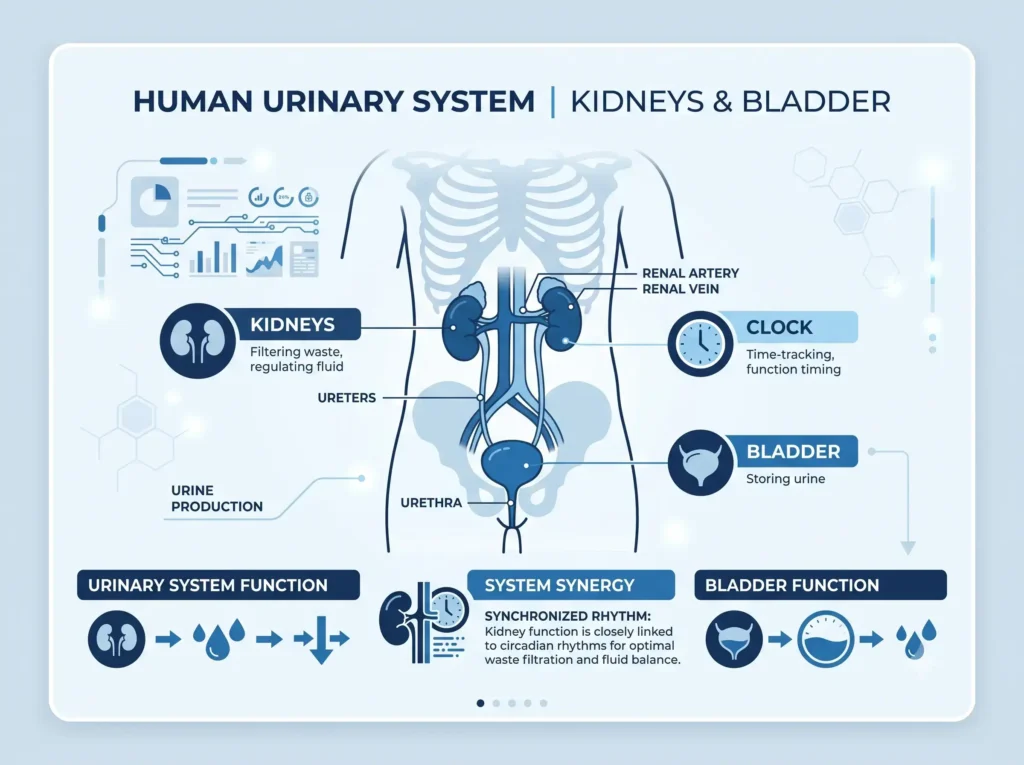
1. What (and When) You’re Drinking
This is the obvious one, and it’s still worth ruling out first. Alcohol and caffeine are both diuretics — they push your kidneys to produce more urine than the fluid volume alone would suggest. So does a surprising amount of “relaxing” herbal tea; chamomile and valerian root, ironically, have mild diuretic properties of their own. Watermelon, cucumber, soup, and other water-dense foods eaten late in the evening can add to the load as well.
The fix: Cut off fluids about 2 hours before bed and see what changes over a week or two. If a specific evening habit — tea, wine, a late snack — lines up with your wakeups, that’s your answer.
2. Sleep Apnea
This is one of the least obvious and most overlooked causes. When breathing repeatedly stops and starts during sleep — the hallmark of obstructive sleep apnea — it triggers a hormonal chain reaction.
The drop in oxygen and the effort to keep breathing raises pressure inside the chest, which in turn increases the release of a hormone that tells your kidneys to produce more urine. People often blame their bladder for these wakeups, when the real culprit is disrupted breathing. If nighttime urination is paired with snoring, gasping, morning headaches, or daytime exhaustion, sleep apnea deserves a real look — ideally with a sleep study.
3. Overactive Bladder (OAB)
Overactive bladder at night happens when the bladder muscle contracts involuntarily, even when it isn’t full, creating a sudden and often intense urge to go. Unlike polyuria, where your kidneys are genuinely producing extra urine, OAB is more about the bladder’s signaling going haywire. It’s manageable with pelvic floor therapy, bladder training, and in some cases medication — but it’s worth distinguishing from a purely fluid-related issue, since the treatment path is different.
4. Hormonal Shifts
As we age, the body naturally produces less antidiuretic hormone (ADH) — the hormone responsible for telling the kidneys to hold onto water overnight. Less ADH means more urine production while you sleep. This decline affects men and women differently: in women, dropping estrogen around menopause reduces bladder capacity and pelvic floor strength; in men, changes in testosterone can contribute to prostate enlargement (BPH), which physically presses on the bladder and urethra.
5. Blood Sugar and Blood Pressure
Elevated blood glucose forces the kidneys to flush out excess sugar through urine, pulling extra fluid along with it — a classic early sign of undiagnosed or poorly controlled diabetes. Fluctuating blood pressure overnight can have a similar effect on urine output. This is exactly why a basic blood panel is one of the first things worth ruling out if nighttime urination shows up out of nowhere.
6. Medications
Diuretics prescribed for blood pressure are the most obvious offender, but antidepressants, sedatives, and certain heart medications can also throw off fluid balance. Simply shifting a diuretic dose to earlier in the day — with a doctor’s approval — is often enough to cut nighttime trips significantly.
When the Cause Isn’t in the Textbook: A Real-World Case
Most articles on nocturia stop at the list above — hydration, hormones, apnea, medication. But sometimes a person checks every one of those boxes as normal and is still waking up like clockwork. That’s exactly the situation one reader, Joe, ran into.
Joe is 34, and his sleep fell apart after relocating from India to Australia in 2019. No matter what he adjusted — cutting off water 2, 4, even 6 hours before bed — he woke up 3 to 4 hours after falling asleep with intense bladder pressure. A full blood panel came back clean. Blood sugar, normal. He’d already tried the “obvious” fixes and hit a wall.
What made his case interesting is his job: he’s on his feet for 8 to 10 hours a day, finishing work around 8 p.m. and going straight to bed by 9. That one-hour gap turned out to matter more than anything he was eating or drinking. Standing all day causes gravity to pull fluid downward, where it pools in the lower legs. The moment he lies flat, that pooled fluid re-enters circulation, and the kidneys — sensing the shift in blood volume — start filtering it into urine almost immediately. Lying down for sleep essentially triggers a fluid dump that his body had no time to process beforehand, since he only had about an hour between finishing his shift and getting horizontal.
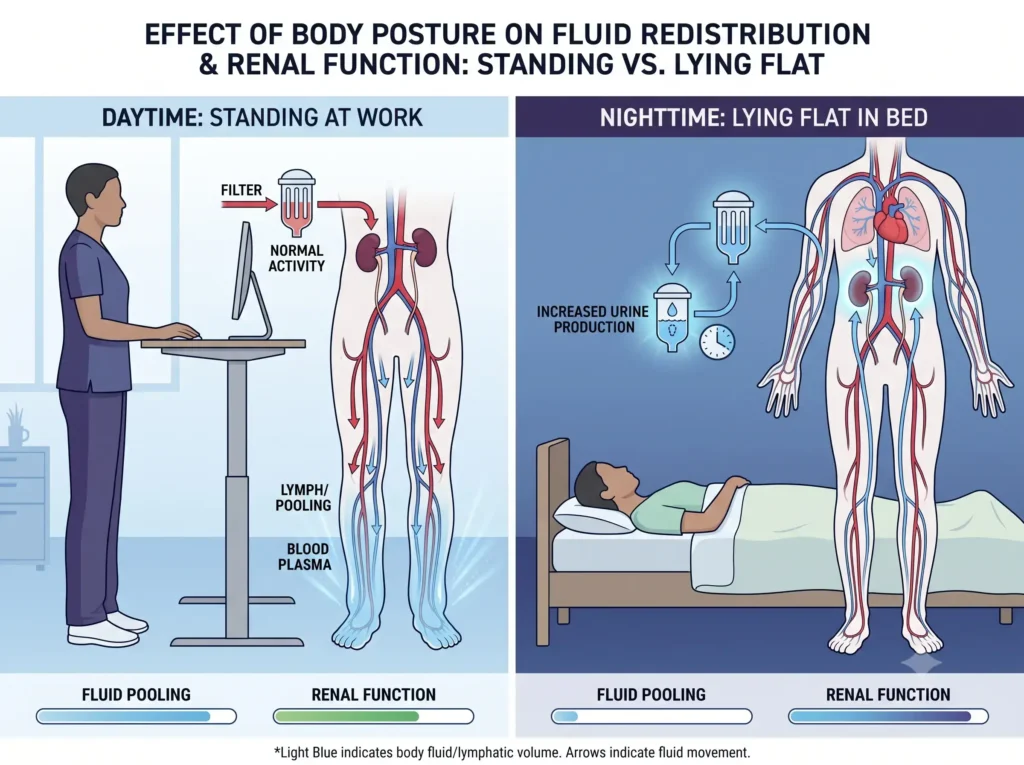
This is a recognized (if underdiscussed) mechanism. A peer-reviewed review in PubMed Central describes how fluid retained in the legs during the day shifts upward through the body once a person lies down, since gravity no longer holds it in the lower limbs — the same rostral fluid shift researchers study in relation to sleep-disordered breathing. It’s common in people who are on their feet for long shifts: retail workers, nurses, warehouse staff, factory workers. Joe tried the standard fix of elevating his legs against a wall for 10 minutes before bed, and it “barely made a dent” — likely because 10 minutes isn’t enough time to meaningfully redistribute hours’ worth of pooled fluid, and because a short elevation session close to bedtime can end up delivering that fluid to the bladder right as he’s falling asleep rather than hours earlier while he’s still upright and active.
A more effective approach for this specific pattern generally involves elevating the legs for longer stretches — 20 to 30 minutes — earlier in the evening rather than immediately before sleep, and wearing compression socks during the workday to reduce pooling in the first place. A 2022 clinical trial published via PubMed Central on workers who stood for more than 8 hours daily found that compression stockings measurably reduced leg swelling and pain compared to rest alone — which lines up with why the intervention needs to happen during the standing hours, not in the 10 minutes before bed. None of this is a guaranteed fix for everyone with a similar routine, and it’s worth saying plainly: if lifestyle adjustments like these don’t meaningfully change things after a few weeks, that’s a sign to loop in a doctor rather than keep troubleshooting alone, since prolonged leg swelling and fluid pooling can occasionally point to something beyond simple occupational standing.
How to Fix Frequent Nighttime Urination Naturally
Before reaching for medication, most people can meaningfully cut down their bathroom trips with a few structural changes:
- Front-load your fluids. Drink the bulk of your water earlier in the day and taper off in the 2 hours before bed.
- Watch the diuretics. Caffeine, alcohol, and certain herbal teas increase urine output more than their volume suggests — cut them out in the evening for a week and track the difference.
- Elevate your legs earlier, not right before bed. If you’re on your feet all day, spend 20–30 minutes with your legs up in the early evening, well before your bedtime routine starts.
- Consider compression socks during long shifts if fluid pooling in the legs is a likely factor.
- Keep a bladder diary. Track what you drink, when, and how many times you wake up. Patterns tend to jump out within a week or two.
- Time your medications with a doctor’s input. If you’re on a diuretic or blood pressure medication, ask whether an earlier dose is appropriate.
- Rule out sleep apnea if wakeups come with snoring, gasping, or unrefreshing sleep — treating the apnea often resolves the nocturia as a side effect.
When to See a Doctor
Lifestyle tweaks are worth trying first, but nighttime urination is worth a medical conversation if:
- You’re waking up two or more times a night consistently
- Blood and sugar-level tests come back normal but the pattern continues
- You notice weak urine flow, urgency during the day, or incomplete emptying
- Symptoms are paired with snoring, high blood pressure, or unexplained fatigue
- Nothing you adjust about your evening routine changes the pattern
A doctor can run a urinalysis, check kidney function, or refer you for a sleep study if apnea is suspected — steps that are much faster than months of trial and error on your own.
The Bottom Line
Waking up at 3 a.m. to pee isn’t just an annoyance — it fragments the deep sleep your body relies on for real recovery, and over time that catches up with your mood, focus, and energy. Sometimes the cause is as simple as an evening cup of tea. Sometimes it’s hormonal, sometimes it’s your medication schedule, and sometimes — as with Joe’s case — it’s a mechanical issue tied to your daily routine that most standard advice never touches. The fastest path to a full night’s sleep is usually a short stretch of honest tracking: what you drink, when you lie down, and what your body does in between.
This article is for informational and educational purposes only and is not a substitute for professional medical advice, diagnosis, or treatment. Always consult your doctor or a qualified health provider before starting any new diet, exercise, or wellness routine.
Frequently Asked Questions (FAQs):
Q1. Is it normal to wake up every 3am to pee?
Waking up once, occasionally, is normal — a healthy adult bladder can comfortably hold urine for 6 to 8 hours overnight. But if you’re waking up at the same time every single night regardless of how much you drink before bed, that’s a pattern called nocturia, not a hydration quirk, and it’s worth investigating.
Q2. What is your body telling you when you wake up at 3am?
It’s usually a signal that something in your system is producing too much urine overnight or that your bladder can’t hold as much as it used to. Common triggers include evening diuretics like caffeine or alcohol, sleep apnea disrupting your hormones, hormonal shifts (like declining ADH), blood sugar issues, or — in cases like fluid pooling from long hours on your feet — a mechanical cause your evening drinking habits have nothing to do with.
Q3. How can I stop peeing every 2 hours at night?
Start by front-loading your fluids earlier in the day and cutting off drinks about 2 hours before bed, especially caffeine, alcohol, and even “relaxing” herbal teas, which act as mild diuretics. Keep a bladder diary to spot what’s actually triggering the wakeups, and rule out sleep apnea if the pattern comes with snoring or daytime exhaustion — treating the apnea often resolves the nighttime urination as a side effect.
Q4. What is the natural remedy for frequent urination at night?
The core natural fixes are limiting fluids in the 2 hours before bed, avoiding evening caffeine and alcohol, and elevating your legs for 20–30 minutes earlier in the evening (not right before bed) if you’re on your feet all day. Compression socks during long standing shifts can also reduce the fluid pooling that leads to nighttime bathroom trips, and timing any diuretic medication earlier in the day — with a doctor’s input — helps too.
Q5. How to sleep all night without peeing?
Cut off fluids about 2 hours before bed and skip evening caffeine, alcohol, and herbal teas like chamomile, since all three push your kidneys to produce more urine. If you’re on your feet most of the day, elevate your legs for 20–30 minutes earlier in the evening and wear compression socks during your shift, so fluid doesn’t pool in your legs and flood your bladder the moment you lie down. If none of this changes the pattern, it’s worth ruling out sleep apnea or a hormonal cause with a doctor rather than continuing to troubleshoot alone.

Nova
Health & Neuroscience Writer
Nova simplifies complex sleep architecture, circadian biology, and hormonal mechanics into actionable daily guides.
More in Sleep Science

8 Powerful Ways to Increase REM Sleep (Stop Waking Up Tired)
Sleeping 8 hours but still exhausted? Discover 8 science-backed ways to increase…

How to Fix Sleeping Posture: 4 Proven Ways to Stop Morning Neck Pain
Learn how to fix sleeping posture with 4 research-backed rules. Discover the…
Stop Waking Up Exhausted: 7 Proven Ways to Increase Deep Sleep and REM Sleep Naturally
Sleeping 8 hours but still waking up tired? Discover science-backed habits, foods,…

5 Shocking Mouth Taping for Sleep Mistakes That Can Ruin Your Health
Discover the real benefits, hidden risks, and safety steps of mouth taping…

5 Hidden Tricks: How to Fall Asleep Fast Military Method Really Works!
It's 1 a.m. You have to be up in five hours. Your…

Why You Wake Up at 3AM After Drinking: 3 Shocking Reasons (And the Fix)
Wondering why you wake up at 3am after drinking? Discover the science…

5 Proven Tips for the Best Sleep Schedule for Night Shift Workers
Stop staring at the ceiling! Discover 5 vital strategies to build the…

5 Shocking Secrets to Reset Circadian Rhythm Naturally (No All-Nighters)
Struggling with late bedtimes? Learn 5 proven steps to reset circadian rhythm…