

Dr. Amelia
Sleep Specialist & Medical Reviewer • 12+ Years Exp in Behavioral Sleep Medicine
You fall asleep fine. Then, right around the same time every night, you’re awake — heart thudding a little, sheets damp, pajamas stuck to your back. If you keep asking yourself why do I wake up at 3am sweating, you’re dealing with something more specific than “the room was warm.” A truly warm room usually bothers you all night, not at one predictable hour.
That specificity matters. It’s the first clue in figuring out what’s actually going on.
Why 3 AM Specifically?
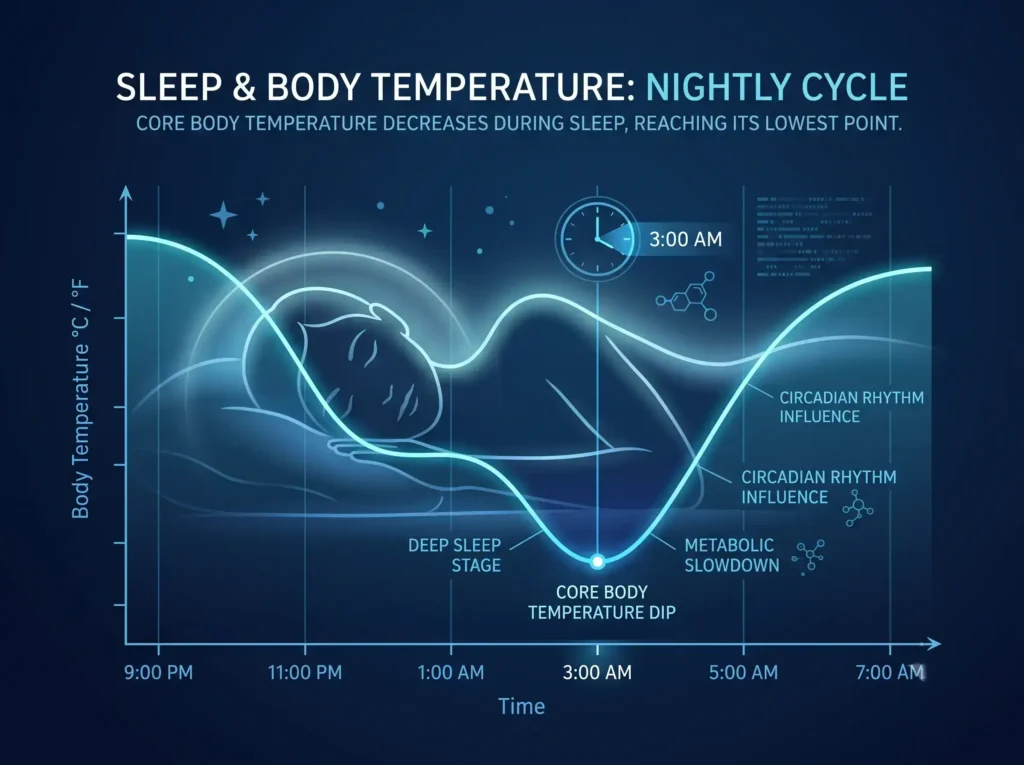
Your core body temperature isn’t flat throughout the night — it follows a curve. It starts dropping about two hours before you fall asleep, keeps falling through the early hours,

Table of Contents
and hits its lowest point somewhere in the pre-dawn window, often close to 3 or 4 AM, before climbing again toward morning. This dip is part of your circadian rhythm, the internal clock that also governs melatonin release and sleep depth, and it’s well documented in temperature-and-sleep research indexed through NIH.
Here’s the catch: that low point is also when your body is working hardest to hold its temperature steady. If anything is interfering with that regulation — a hormone swing, a blood sugar dip, an overactive nervous system, a medication — 3 AM is exactly when it shows up. So if you keep noticing your body hot at night, can’t sleep around that same hour, your body isn’t malfunctioning randomly. It’s revealing exactly when its temperature control is most vulnerable.
➟ 7 Proven Ways to Stop 3 AM Anxiety: Why Do I Wake Up at 3am With Anxiety?
Rule Out the Room First
Before chasing anything medical, eliminate the boring explanations. They’re the most common ones, and they’re the easiest to fix.
| Factor | Why It Raises Heat | Quick Fix |
|---|---|---|
| Room temperature | Above 68°F, your body struggles to release heat | Set thermostat to 60–67°F |
| Mattress material | Memory foam traps body heat against skin | Add a breathable topper or switch materials |
| Bedding | Fleece, flannel, and synthetics insulate rather than vent | Cotton, linen, or bamboo sheets |
| Sleepwear | Thick or synthetic fabric blocks evaporation | Loose, moisture-wicking cotton |
| Bed-sharing | A second body (or a dog) adds real heat output overnight | Separate blankets, more airflow |
If your body gets too hot when you sleep no matter how cold you make the room, the environment isn’t the problem. Something internal is overriding it.
Hormones: The Most Common Trigger, Especially in Women
Estrogen and progesterone both influence the hypothalamus, the part of the brain that acts as your internal thermostat. When those levels shift, your thermostat’s “set point” shifts with them, and your body sweats to correct a temperature change that hasn’t actually happened.
- Perimenopause and menopause — the leading cause of night sweats, driven by fluctuating estrogen. Roughly three-quarters of women in the perimenopausal transition report them.
- PMS and the menstrual cycle — the drop in estrogen right before a period can trigger occasional night sweats, though less commonly than other symptoms.
- Pregnancy and postpartum — hormone surges raise core temperature; sweating often continues for several weeks after delivery as hormones normalize.
- Low testosterone in men — sometimes called andropause, and often overlooked because night sweats aren’t typically associated with male hormonal decline.
The NHS’s clinical guidance on menopause symptoms covers hormone-related night sweats in detail, including when hormone replacement therapy is and isn’t appropriate.
When It’s Your Nervous System, Not Your Hormones
This is the piece most articles skip, and it’s worth sitting with. Not everyone with 3 AM overheating has a hormonal or environmental explanation — sometimes the issue is regulatory, not chemical.
One reader, Henry, described it well after working through his own pattern of nighttime overheating despite a cold bedroom and light bedding. He’d noticed that his body kept overheating regardless of how carefully he controlled the room, which pointed him toward something deeper: autonomic nervous system dysregulation. Body temperature is controlled by the hypothalamus, and if the nervous system gets stuck in a fight-or-flight state, metabolic activity increases — the body simply produces more heat than it needs to. He connected this to conditions like hyperthyroidism, adrenal dysfunction with cortisol spikes, and low testosterone, all of which can cause heat intolerance independent of room temperature. He also pointed to a mechanism worth taking seriously: when blood sugar drops overnight, the adrenal glands release adrenaline, which raises body temperature and is often enough to wake someone up on its own.
His approach wasn’t to chase one silver-bullet fix, but to calm the system first and investigate second:
- A lukewarm-to-cool shower before bed — not ice-cold, which can itself trigger a stress response and work against the goal.
- Progressive muscle relaxation (tensing and releasing muscle groups) to help downregulate an overactive nervous system.
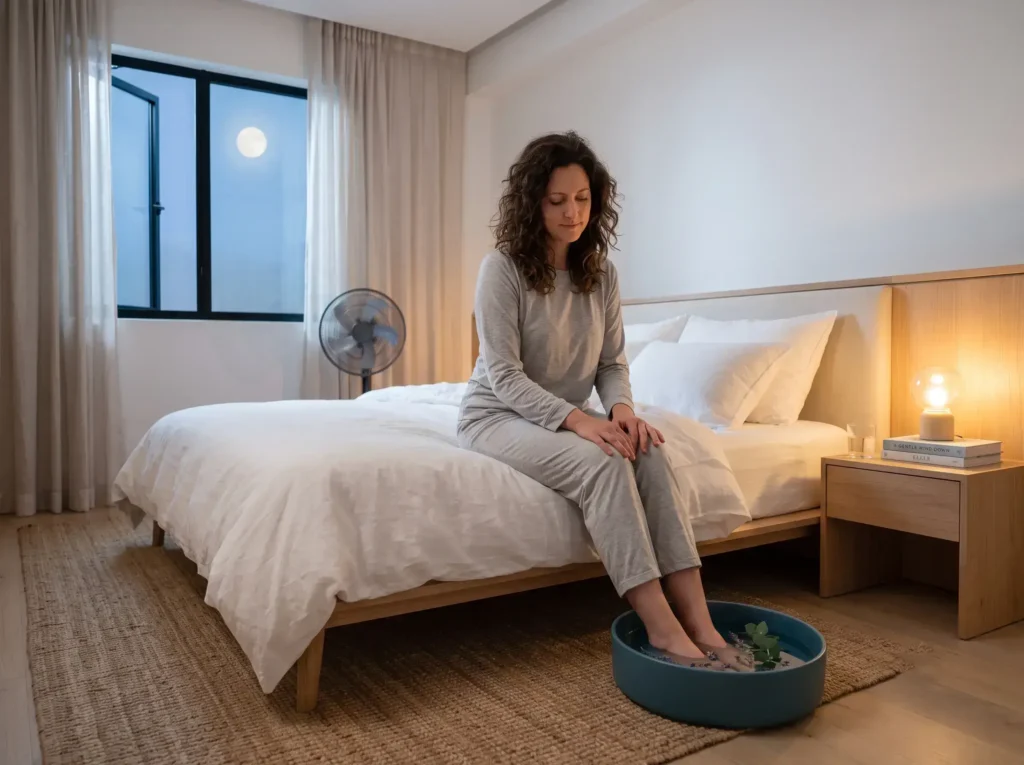
- Soaking feet in cool water for 10–15 minutes before bed, since the feet play an outsized role in dissipating body heat.
- A cooling mattress pad for anyone whose overheating is severe enough to disrupt sleep nightly.
- Keeping a cool, damp cloth within reach for the moment of waking up hot.
- A stable pre-bed snack — a small amount of protein or healthy fat, like almonds with honey or Greek yogurt with cinnamon — to prevent the blood sugar dip that can trigger an adrenaline spike overnight.
- Cutting refined carbohydrates in the 3–4 hours before bed, since a blood sugar spike followed by a crash is a common overnight pattern.
He was careful to frame this as a starting point, not a diagnosis — a two-week trial of cooling, nervous-system-calming, and blood-sugar-stabilizing habits, with blood work as the next step if the pattern didn’t resolve. That’s a reasonable way to think about it: address what’s modifiable first, then escalate to testing if the problem persists.
If your bedroom is objectively cold and you're still waking up overheated at a consistent hour, treat it as a signal — not a nuisance. It's worth two weeks of deliberate cooling and nervous-system habits before assuming it's "just how you sleep.
Blood Sugar and the 3 AM Wake-Up Specifically
Nocturnal hypoglycemia deserves its own mention because the timing lines up so precisely with the 3 AM pattern. For people on insulin or certain oral diabetes medications, blood sugar can drop several hours after the last meal — often landing right in that early-morning window. The adrenaline response that follows doesn’t just raise temperature; it can also cause shakiness, a racing heart, and vivid or unsettling dreams. Research on nocturnal glucose patterns available through PubMed has documented this adrenaline-driven sweating response in both diabetic and non-diabetic populations, particularly after high-refined-carbohydrate evening meals.
You don’t need diabetes for this to apply. Anyone who eats a carb-heavy dinner with little protein or fat can experience a blood sugar swing large enough to trigger an early-morning stress response.
Medications Worth a Second Look
If your night sweats started or worsened around the same time you began a new prescription, that’s not a coincidence worth ignoring. Common culprits include:
- Antidepressants (SSRIs and tricyclics) — the single most frequently cited medication cause
- Diabetes medications that can push blood sugar too low overnight
- Hormone-blocking cancer treatments, including those for breast and prostate cancer
- Steroids, such as prednisone
- Blood pressure medications, including some diuretics
- Fever reducers like paracetamol and aspirin, taken close to bedtime
Never stop a prescribed medication on your own. If you suspect a drug connection, bring it to your prescriber — there’s often an alternative or a dose adjustment available.
Underlying Conditions That Need Ruling Out
Most nighttime overheating is not dangerous. But a smaller set of causes are worth screening for, particularly if the sweating is drenching, recurring, and paired with other symptoms:
- Hyperthyroidism — an overactive thyroid speeds up metabolism and heat production
- Infections — from the flu to tuberculosis to endocarditis, fever-driven sweating is common
- Obstructive sleep apnea — repeated breathing interruptions trigger a stress response that can include sweating
- Certain cancers, particularly lymphoma, when paired with unexplained weight loss and fever
- Hyperhidrosis — a condition of excessive sweating without a clear underlying cause, affecting under 3% of people
A Practical Cooling Protocol You Can Start Tonight
None of this requires an overhaul. Layer these in gradually and give each change a few nights before judging whether it’s working.
- Set the room to 60–67°F and add airflow with a fan if central cooling isn’t enough.
- Switch to breathable bedding — cotton, linen, or bamboo — and drop any synthetic or down layers.
- Wear loose, moisture-wicking sleepwear, or none at all if that’s more comfortable.
- Keep cold water at the bedside and sip if you wake up overheated.
- Avoid alcohol, caffeine, and spicy food in the four to six hours before bed.
- Eat a protein- or fat-based bedtime snack instead of refined carbs if blood sugar swings seem to be a factor.
- Wind down deliberately — a cool shower and a few minutes of muscle relaxation before lights out.
When to See a Doctor
Self-care solves the environmental and mild hormonal cases. See a doctor if you notice:
- Sweating heavy enough to soak your sheets, not just your skin
- Unexplained weight loss alongside the sweating
- Persistent fever, cough, or diarrhea
- Sweating that continues after two weeks of consistent cooling and blood-sugar-stabilizing changes
- New sweating that started right after beginning a medication
A physician can order thyroid panels, glucose testing, and — if warranted — imaging or infection screening to rule out the less common causes. The CDC’s guidance on healthy sleep habits is also a solid baseline reference for optimal bedroom conditions while you sort out the rest.
The Bottom Line
If you’re still stuck on why do I wake up at 3am sweating, work through it in order: fix the room first, look at hormones and medications next, and consider the nervous-system and blood-sugar angle if the obvious causes don’t explain it. Give any change about two weeks before deciding it isn’t working. If the sweating keeps showing up despite a genuinely cool, comfortable setup, that’s your body telling you it’s time for bloodwork, not just a new set of sheets.
This article is for informational and educational purposes only and is not a substitute for professional medical advice, diagnosis, or treatment. Always consult your doctor or a qualified health provider before starting any new diet, exercise, or wellness routine.
Frequently Asked Questions (FAQs):
Q1. What causes 3am night sweats?
3am night sweats happen because your core body temperature hits its lowest point in the pre-dawn window, which is exactly when your body works hardest to hold its temperature steady. If a hormone swing, blood sugar dip, overactive nervous system, or medication is interfering with that regulation, it shows up right at this vulnerable point. This is why people keep asking why do I wake up at 3am sweating instead of sweating evenly through the whole night.
Q2. Why are night sweats a red flag?
Night sweats become a red flag when they’re heavy enough to soak your sheets rather than just dampen your skin, or when they show up alongside unexplained weight loss, persistent fever, cough, or diarrhea. They’re also worth flagging if the sweating continues after two weeks of consistent cooling and blood-sugar-stabilizing changes, or if it started right after beginning a new medication. In these cases, a doctor can run thyroid panels, glucose testing, or infection screening to find the cause.
Q3. What hormone causes waking up at 3am?
Estrogen and progesterone are the main hormones behind waking up hot at 3am, since both influence the hypothalamus and shift your body’s internal “set point,” triggering sweat to correct a temperature change that hasn’t really happened — this is why perimenopause and menopause are the leading cause. Adrenaline is the other key player: when blood sugar drops overnight, the adrenal glands release it, which raises body temperature and wakes you up on its own.
Q4. What organ is associated with waking up at 3am?
The hypothalamus is the organ directly associated with waking up at 3am, since it’s the part of the brain that acts as your body’s internal thermostat and controls temperature regulation. When the nervous system stays stuck in a fight-or-flight state, this regulation gets disrupted, increasing metabolic activity and heat production independent of room temperature.
Q5. What is the forbidden hour of sleep?
Based on the body’s temperature curve, 3 AM functions as sleep’s “forbidden hour” because it’s the point where core temperature hits its lowest dip and your body’s regulation system is under the most strain. It’s the hour where any underlying disruption — hormonal, nervous system, or blood sugar related — is most likely to break through and wake you, making it the hardest hour to sleep through undisturbed.

Nova
Health & Neuroscience Writer
Nova simplifies complex sleep architecture, circadian biology, and hormonal mechanics into actionable daily guides.
More in Sleep Science

8 Powerful Ways to Increase REM Sleep (Stop Waking Up Tired)
Sleeping 8 hours but still exhausted? Discover 8 science-backed ways to increase…
How to Fix Sleeping Posture: 4 Proven Ways to Stop Morning Neck Pain
Learn how to fix sleeping posture with 4 research-backed rules. Discover the…
Stop Waking Up Exhausted: 7 Proven Ways to Increase Deep Sleep and REM Sleep Naturally
Sleeping 8 hours but still waking up tired? Discover science-backed habits, foods,…

5 Shocking Mouth Taping for Sleep Mistakes That Can Ruin Your Health
Discover the real benefits, hidden risks, and safety steps of mouth taping…

5 Hidden Tricks: How to Fall Asleep Fast Military Method Really Works!
It's 1 a.m. You have to be up in five hours. Your…

Why You Wake Up at 3AM After Drinking: 3 Shocking Reasons (And the Fix)
Wondering why you wake up at 3am after drinking? Discover the science…

5 Proven Tips for the Best Sleep Schedule for Night Shift Workers
Stop staring at the ceiling! Discover 5 vital strategies to build the…

5 Shocking Secrets to Reset Circadian Rhythm Naturally (No All-Nighters)
Struggling with late bedtimes? Learn 5 proven steps to reset circadian rhythm…