

Dr. Amelia
Sleep Specialist & Medical Reviewer • 12+ Years Exp in Behavioral Sleep Medicine
Your body was built for daylight. Your job doesn’t care.
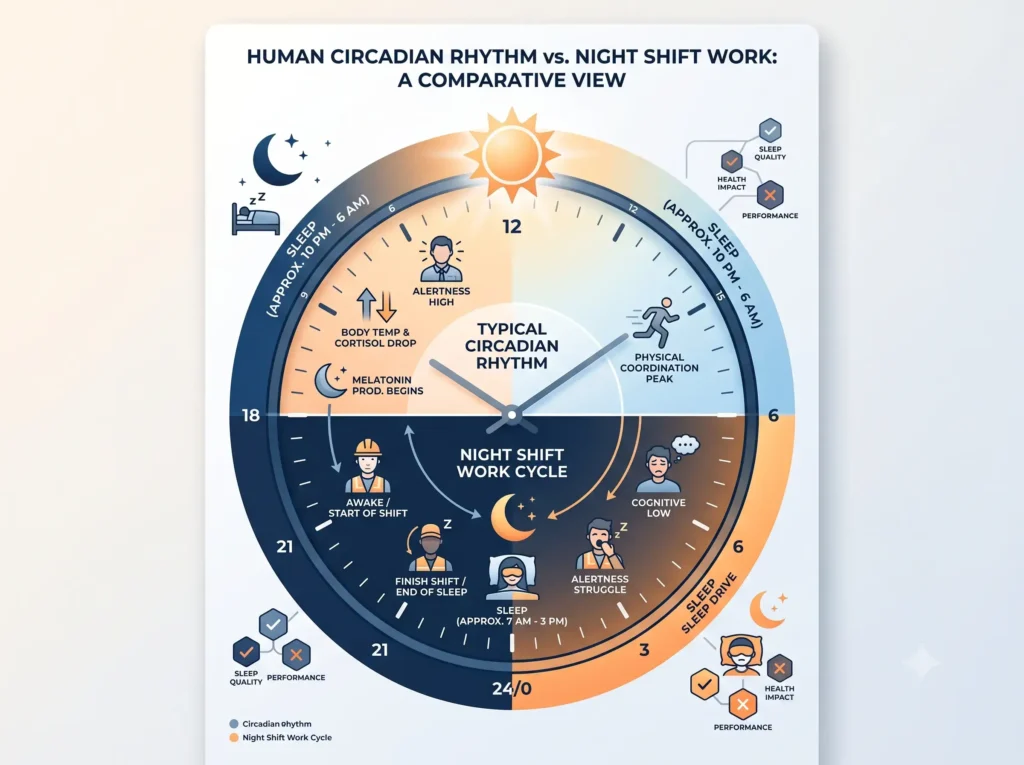
That mismatch is the entire problem. If you’ve ever clocked out at 7 AM and stared at your ceiling for two hours while the world outside gets loud and bright, you already know there’s no single best sleep schedule for night shift workers that works for everyone. What works depends on your roster, your body, and how honest you’re willing to be about your own habits. This guide breaks down what actually helps — not the generic “just sleep more” advice you’ve already tried.
What Is the Best Sleep Schedule for Night Shift Workers?
There isn’t one universal answer. There are two.

Table of Contents
If you work permanent nights, the goal is consistency — even on your days off. Bouncing between a night schedule during the week and a normal daytime schedule on weekends keeps your circadian rhythm perpetually confused. Most sleep researchers recommend anchoring your main sleep block to roughly the same hours every single day, whether you’re working or not. Ideally, that’s one solid stretch of 7 to 9 hours. If daytime obligations make that impossible, splitting sleep into two blocks — a fixed core sleep plus a flexible secondary nap — tends to work better than fragmenting it randomly.
If your shifts rotate or vary, rigid consistency isn’t realistic, so the strategy shifts. Go to bed as soon as you reasonably can after a shift ends, and let your body sleep as long as it needs. A short nap before your next shift can offset the sleep debt that builds up between irregular rest periods.
A Delphi consensus study published on PubMed — which surveyed 68 international sleep, shift work, and occupational health experts — found that traditional sleep hygiene advice largely fails shift workers because it assumes a normal day-night schedule. The experts instead recommended building a sleep routine around your actual roster, not around what a 9-to-5 worker’s doctor would tell them.
There's no perfect universal bedtime. There's only the schedule you can actually stick to, built around your specific shift pattern.
Permanent Night Shift vs. Rotating Shift: Quick Comparison
| Factor | Permanent Night Shift | Rotating Shift |
|---|---|---|
| Sleep Timing | Same fixed sleep window every day, including days off | Sleep as soon as possible after each shift ends; timing shifts with the roster |
| Napping Approach | Optional short nap only if the main sleep block falls short | Nap before the next shift to offset accumulated sleep debt |
| Days-Off Strategy | Stay on the night schedule as much as possible to avoid re-adjustment | Gradually shift sleep timing back toward normal hours, then re-adjust before the next rotation |
| Biggest Risk | Social isolation from staying “inverted” full-time | Chronic circadian disruption from constantly resetting |
How to Get Deep Sleep During the Daytime
Daytime sleep fights against your own biology, so your environment has to compensate hard.
Kill the light completely. Your circadian rhythm reads light as a wake-up signal regardless of what the clock says. Blackout curtains aren’t optional — they’re the single highest-leverage change most night shift workers can make. An eye mask helps close the remaining gaps.
Control the temperature. A room that’s too warm disrupts REM sleep specifically, which is the stage most tied to memory consolidation and mental recovery. Aim for somewhere between 60–68°F (16–20°C).
Cut the noise, don’t just reduce it. Daytime hours mean deliveries, lawnmowers, kids, traffic. Earplugs or a white noise machine mask the unpredictable spikes that jolt you out of deep sleep even when you don’t consciously wake up.
Protect your bed as a sleep-only zone. Scrolling your phone or working from bed trains your brain to associate that space with alertness instead of rest — the opposite of what you want going into a daytime sleep block.
Time your last dose of light exposure. Wearing sunglasses on the commute home after a night shift, especially once the sun is up, reduces the light signal telling your brain it’s time to be awake right before you’re trying to fall asleep.
Night Shift Fatigue Management Tips
Staying functional during the shift itself is a separate problem from sleeping well afterward, and it needs its own toolkit.
- Front-load bright light exposure. Use it in the first half of your shift when alertness naturally dips less, and dim it in the second half so your body starts winding down before you’re driving home.
- Nap strategically, not randomly. A 15–20 minute nap boosts alertness without leaving you groggy. A longer 90-minute nap can reduce accumulated sleep debt but should be avoided close to your main sleep window.
- Move your body. Even 10–15 minutes of walking or stretching during a break measurably improves alertness more than sitting still ever will.
- Watch what you eat at 3 AM. Heavy, greasy, or sugar-loaded food during overnight hours tanks your energy an hour later because digestion itself is slower and less efficient at night.
How to Stay Awake on Graveyard Shift Without Caffeine
Caffeine isn’t the only lever, and relying on it entirely just pushes the crash to a worse time.
- Use short bursts of activity — a quick walk, stairs, even standing stretches — to spike alertness without chemical stimulants.
- Keep the lights bright in your immediate workspace during the first half of your shift; dim lighting environments accelerate melatonin release even while you’re awake.
- Stay hydrated. Mild dehydration mimics fatigue almost exactly, and most people mistake one for the other.
- Break tasks into shorter blocks. Monotony is often what makes you feel tired, not actual sleep pressure — switching tasks periodically keeps your brain more engaged.
- If you do use caffeine, front-load it. Cutting it off in the first half of your shift, rather than sipping it steadily through the night, protects your ability to fall asleep once you’re home.
Building Your Personal Schedule: A Real Night Shifter’s Approach
The general guidelines only go so far. What actually happens when someone tries to live by them, night after night, for months or years?
One night shift worker, Riri, shared how her routine actually plays out in practice — and it’s a useful reality check against the “just be consistent” advice most articles hand out without acknowledging how hard consistency actually is. Her bedtime is set for 1 PM, aligned with hours similar to a typical overnight worker’s schedule. But she’s candid that she rarely hits that time exactly — it often slips an hour or two later, and Mondays are especially rough if she reverted to a normal daytime schedule over the weekend. Occasionally she crashes the moment she gets home, but by her own account, that’s usually a sign her sleep quality had already been slipping earlier in the week, not a typical night.
Her practical advice: cluster your errands, hobbies, and to-dos either right before your shift or immediately after it, rather than scattering them throughout your “day.” If a single consolidated sleep block genuinely doesn’t fit your life, a biphasic pattern — two separate sleep periods instead of one — can work as a deliberate strategy rather than something that only happens by accident.
That distinction matters. Biphasic sleep isn’t a failure state. For workers whose schedules genuinely can’t accommodate one long block, splitting sleep intentionally beats fighting for an unbroken stretch that never quite happens.
Talking to Family and Kids About Your Schedule
A sleep schedule only survives if the people around you actually respect it, and that’s harder when you’re a parent or living with family who keep normal daytime hours.
Kids don’t automatically understand why the house needs to go quiet at 1 PM. A few things that make this easier in practice:
- Put your sleep window somewhere visible — a sign on the bedroom door, a shared family calendar, or a simple “quiet hours” chart kids can actually read
- Assign the loudest household tasks to your awake hours — vacuuming, laundry, video calls — so your sleep block stays genuinely protected
- Loop in whoever handles school pickups or errands during your sleep window, so you’re not woken for something that could’ve waited
- Protect one overlapping window with your family each day, even if it’s short, so the relationship doesn’t quietly erode around the schedule
This isn’t about making your household walk on eggshells. It’s about treating your sleep block with the same seriousness a daytime worker’s 9-to-5 gets — because interrupted daytime sleep doesn’t just cost you rest, it compounds into the fatigue and irritability that make family time harder in the first place.
How to Stop Feeling Tired After Night Shift
The exhaustion that follows a night shift usually comes from one of two places: sleep debt, or a rough transition back toward a normal schedule.
On the day of your last night shift before days off, try capping your sleep to around 4–5 hours instead of sleeping a full block. Skip additional naps later that day. It sounds counterintuitive, but the resulting mild sleep pressure makes it much easier to fall asleep at a normal evening hour, which resets you toward a daytime schedule faster.
Get morning sunlight once you’re transitioning. Natural light exposure shortly after waking helps recalibrate your internal clock toward the day-night cycle your body actually evolved for.

Watch for sleep inertia. After waking — whether from a nap or a main sleep block — most people experience 15 to 30 minutes of grogginess, though it can stretch to two hours. According to NIOSH training guidance from the CDC, this window carries real safety risk, so avoid driving or operating machinery immediately after waking, even if you feel like you’re functioning fine.
Don’t chase sleep with alcohol. It might help you doze off faster, but it fragments the second half of your sleep cycle, which is exactly the deep, restorative portion night shift workers are already short on.
Melatonin: What the Research Actually Says
Melatonin comes up constantly in shift work forums, but the timing matters more than most people realize. Melatonin is the hormone your body naturally releases as darkness signals bedtime — for night shift workers, that natural release is happening at the wrong time entirely, which is part of why low-dose supplementation is sometimes used to nudge the body clock back into alignment.
A few practical notes worth knowing before considering it:
- Timing beats dose. Taking melatonin shortly before your intended sleep window matters more than how many milligrams you take. Most studies on shift workers use low doses, generally in the range of 0.5–5 mg, taken shortly before the planned sleep period — not as a nightly sedative.
- It’s not a knockout drug. Melatonin nudges your circadian signal; it doesn’t force sleep the way a sedative does. If your room is still bright and noisy, it won’t do much.
- Regulation differs by country. In the US, melatonin is sold over the counter as a supplement, while other countries regulate it more tightly as a prescription medication — so availability and recommended dosing can vary depending on where you live.
- It’s a short-term tool, not a long-term fix. Like most sleep aids, melatonin is best used to bridge a transition — starting a new rotation, adjusting after time off — rather than as a permanent nightly habit.
Anyone considering melatonin regularly, especially alongside other medications, should run it by a pharmacist or doctor first. Interactions and appropriate dosing vary enough person to person that generic advice only goes so far.

Is Working Night Shift Bad for Health Long Term?
Here’s the part most listicles gloss over: yes, there are real, well-documented long-term risks — but they’re not inevitable, and they scale with how well the disruption is managed.
Circadian misalignment from ongoing night work has been linked in research covered by the NIH to disrupted metabolic pathways, with associations to higher rates of type 2 diabetes, cardiovascular disease, obesity, and certain cancers. Night shift nurses specifically have been found to make measurably more medication and procedural errors compared to day shift colleagues, largely tied to impaired reaction time and cognitive flexibility from chronic sleep deprivation.
That said, night shift work also comes with real advantages some people genuinely value — less competition for promotions, quieter work environments, fewer meetings, and often better pay differentials.
The health risks aren’t a reason to assume night shift work is unsustainable; they’re a reason to take the sleep strategies in this guide seriously rather than treating exhaustion as an unavoidable cost of the job.
Tolerance for shift work also tends to decline with age, particularly past 40, according to occupational health research. That’s not a reason to panic — it’s a signal to be more deliberate about sleep hygiene as the years go on, rather than relying on whatever got you through your twenties.
Building a Schedule That Actually Survives Contact With Real Life
No guide, including this one, can hand you a schedule that works without adjustment. The frameworks here — consistent anchoring for permanent nights, adaptive recovery sleep for rotating shifts, environmental control for daytime rest, and deliberate fatigue management during the shift itself — are starting points, not rigid rules.
If sleep problems persist despite consistently applying these strategies, that’s worth raising with a doctor rather than pushing through. Persistent difficulty sleeping or staying alert on the job, especially if it’s happening more than a few times a week for weeks in a row, can indicate shift work disorder, which is a recognized condition with its own treatment options — not just something to tough out.
Signs worth taking seriously enough to talk to a doctor about:
- Trouble falling or staying asleep 3 or more times a week for several weeks straight, even with a controlled environment
- Falling asleep unintentionally during your shift, or fighting to stay awake during routine tasks
- Persistent headaches, irritability, or difficulty concentrating that don’t ease up on days off
- Relying on caffeine or other stimulants just to function through a normal shift, not just an occasional hard night
- Noticeable drop in mood, memory, or reaction time compared to before you started night shifts
None of these on their own are cause for alarm — everyone has a rough week. It’s the pattern, repeated over weeks, that separates ordinary shift work fatigue from something that needs professional attention.
Finding the best sleep schedule for night shift workers isn’t about finding the one “correct” answer. It’s about testing these strategies against your own roster, noticing what actually moves the needle for your body, and adjusting without guilt when Monday throws the whole plan off anyway. That’s not failure — that’s just what shift work looks like in practice.
This article is for informational and educational purposes only and is not a substitute for professional medical advice, diagnosis, or treatment. Always consult your doctor or a qualified health provider before starting any new diet, exercise, or wellness routine.
Frequently Asked Questions (FAQs) :
Q1. What time should you sleep if you work night shift?
It depends on whether your shifts are permanent or rotating. If you work permanent nights, anchor your main sleep block to the same hours every day — including days off — for 7 to 9 hours total. If your shifts rotate, sleep as soon as possible after each shift ends and let your body rest as long as it needs, adding a short nap before your next shift if sleep debt builds up. This flexible approach is really the core of the best sleep schedule for night shift workers — there’s no single fixed bedtime that works for everyone.
Q2. How to get good sleep as a night shift worker?
Good daytime sleep starts with killing light completely using blackout curtains and an eye mask, since your circadian rhythm reads any light as a wake-up cue. Keep your room cool (60–68°F), block out noise with earplugs or white noise, and use your bed only for sleep. These environmental controls are the fastest way to get deep sleep during daytime hours despite fighting your own biology.
Q3. How unhealthy is night shift?
Ongoing night work is linked to real long-term health risks, including higher rates of type 2 diabetes, cardiovascular disease, obesity, and certain cancers due to circadian misalignment. Night shift nurses specifically show measurably more medication and procedural errors from impaired reaction time and reduced cognitive flexibility. That said, is working night shift bad for health long term comes down to how well the disruption is managed — the risks aren’t inevitable, they scale with how seriously sleep strategies are applied.
Q4. What is the healthiest shift work schedule?
The healthiest approach is consistency matched to your specific roster type — not a universal schedule. Permanent night shift workers do best staying on the same sleep window every day, even on days off, to avoid social isolation from constant “inversion.” Rotating shift workers do better gradually adjusting sleep timing around each shift rather than forcing rigid consistency, which reduces chronic circadian disruption.
Q5. How do I prepare my body for night shift?
Front-load bright light exposure in the first half of your shift to boost alertness, then dim it in the second half so your body starts winding down before the drive home. Nap strategically — a 15–20 minute nap before or during your shift sharpens alertness without grogginess — and move your body for 10–15 minutes during breaks instead of sitting still. These night shift fatigue management tips, combined with short activity bursts and staying hydrated, cover how to stay awake on graveyard shift without caffeine if you’re trying to cut back on stimulants.

Nova
Health & Neuroscience Writer
Nova simplifies complex sleep architecture, circadian biology, and hormonal mechanics into actionable daily guides.
More in Sleep Science

8 Powerful Ways to Increase REM Sleep (Stop Waking Up Tired)
Sleeping 8 hours but still exhausted? Discover 8 science-backed ways to increase…
How to Fix Sleeping Posture: 4 Proven Ways to Stop Morning Neck Pain
Learn how to fix sleeping posture with 4 research-backed rules. Discover the…
Stop Waking Up Exhausted: 7 Proven Ways to Increase Deep Sleep and REM Sleep Naturally
Sleeping 8 hours but still waking up tired? Discover science-backed habits, foods,…

5 Shocking Mouth Taping for Sleep Mistakes That Can Ruin Your Health
Discover the real benefits, hidden risks, and safety steps of mouth taping…

5 Hidden Tricks: How to Fall Asleep Fast Military Method Really Works!
It's 1 a.m. You have to be up in five hours. Your…

Why You Wake Up at 3AM After Drinking: 3 Shocking Reasons (And the Fix)
Wondering why you wake up at 3am after drinking? Discover the science…

5 Shocking Secrets to Reset Circadian Rhythm Naturally (No All-Nighters)
Struggling with late bedtimes? Learn 5 proven steps to reset circadian rhythm…

Constantly Wake Up at 3 AM to Pee? Here Are 3 Fixes That Actually Work
Stop the frustrating cycle of wake up at 3 AM to pee.…