

Dr. Wilder
Neuroscientist & Clinical Consultant • 15+ Years Exp in Cognitive Health
Your heart races before you’ve even decided you’re scared. Your stomach drops before you’ve consciously registered the bad news. That’s not a character flaw or a lack of willpower — it’s your autonomic nervous system making decisions faster than your thinking brain can weigh in.
Polyvagal exercises for nervous system regulation work because they talk directly to that system, in a language it actually understands: sensation, sound, breath, and safety cues. Developed by neuroscientist Dr. Stephen Porges, polyvagal theory gives a name to something a lot of anxious, exhausted, or “wired but tired” people have felt for years without being able to explain it — the sense that your body reacts before your mind catches up, and that logic alone can’t talk it down.
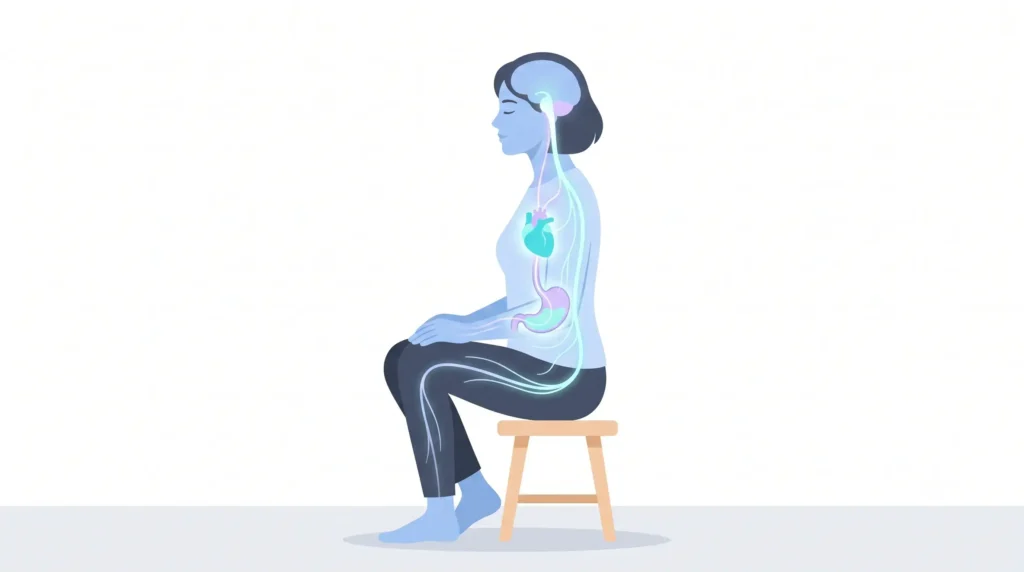
This guide walks through the science in plain terms, then gets practical — a full set of polyvagal theory exercises for anxiety, a vagus nerve reset for anxiety relief, and step-by-step techniques you can use today to shift out of shutdown or that foggy, disconnected in-between state.
Table of Contents
What Polyvagal Theory Actually Explains
Dr. Stephen Porges introduced polyvagal theory in 1994, building on decades of research into the vagus nerve — the longest cranial nerve in the body, running from the brainstem down through the heart, lungs, and gut. Before Porges, the autonomic nervous system was described as a simple two-way switch: sympathetic (activating) or parasympathetic (calming).
Porges found something more layered. The vagus nerve isn’t one uniform cable. It splits into two functionally distinct branches with different jobs and different evolutionary ages.
- The ventral branch is newer, myelinated, and fast-acting. It connects to the muscles of the face, throat, and middle ear, and it governs what Porges calls the social engagement system.
- The dorsal motor nucleus is older and slower. It’s shared with reptiles and governs immobilization — the freeze and shutdown response that kicks in when nothing else has worked.
Between these two poles sits the sympathetic nervous system, responsible for the fight-or-flight response most people already associate with stress.
This three-part structure is often described as the polyvagal ladder or the autonomic hierarchy — a stack of response options your nervous system climbs down through as a threat feels more severe, and climbs back up through as safety returns.
You don't consciously choose which state you're in. Your body picks for you, based on a process Porges calls neuroception.
Neuroception: The Scanner You Can’t Switch Off
Neuroception is the nervous system’s constant, subconscious scan for danger or safety cues — a tense voice, a closed-off posture, a sudden loud noise. It happens below the threshold of conscious thought, which is exactly why “just calm down” rarely works. Your thinking brain can know you’re safe while your body is still running last week’s threat assessment.
Research summarized through the National Institutes of Health has explored how vagal activity and heart rate variability relate to emotional regulation, giving the neuroception concept a measurable physiological basis rather than leaving it purely theoretical.
➟ Stop the Pain: 5 Proven Somatic Tracking for Fibromyalgia Steps
The Window of Tolerance: A Related but Separate Idea
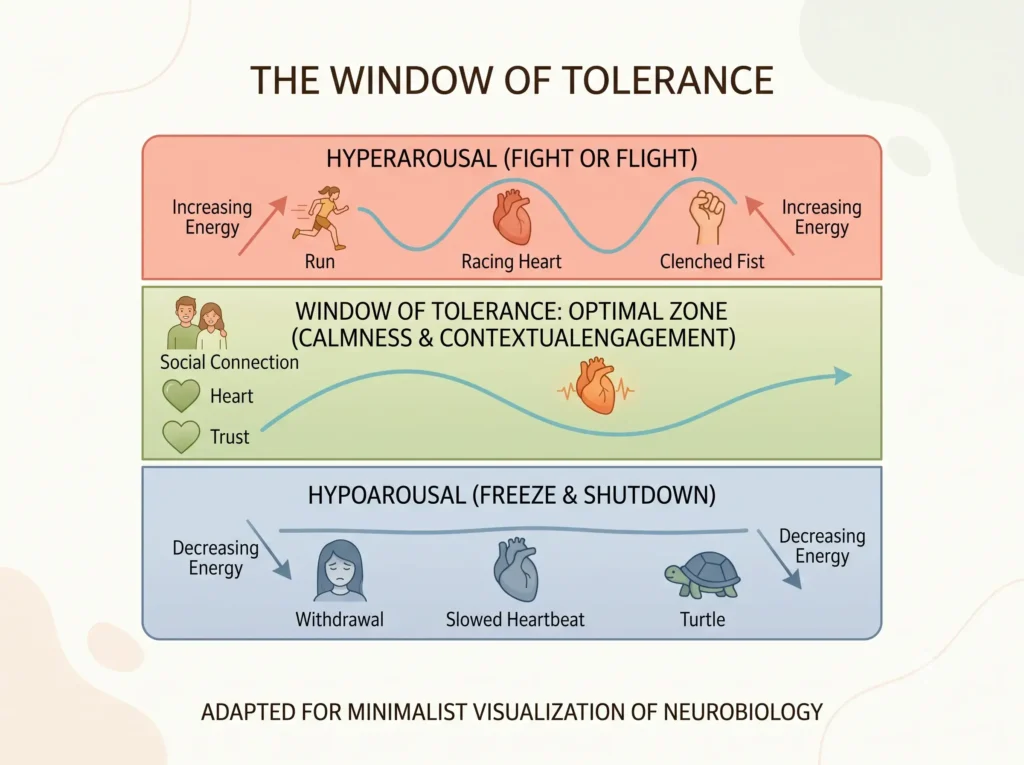
You’ll often see polyvagal theory discussed alongside the window of tolerance, a term coined by psychiatrist Dan Siegel. It’s worth being precise here: Siegel didn’t develop this concept as part of polyvagal theory, and Porges didn’t coin it either — but the two ideas pair naturally in trauma-informed work.
The window of tolerance describes the zone of arousal where you can think clearly, feel your emotions without being overwhelmed by them, and stay engaged with what’s happening around you. Step outside it in one direction and you land in hyperarousal — which maps closely onto the sympathetic, fight-or-flight rung of the polyvagal ladder. Step outside it the other way and you land in hypoarousal — the numbness and disconnection of dorsal vagal shutdown.
Where polyvagal theory explains the neural circuitry behind these shifts, the window of tolerance gives a simpler, everyday language for noticing when you’ve left your workable zone. Many therapists use both together: polyvagal theory to understand the mechanism, and the window of tolerance to track it in the moment.
The Three Rungs of the Autonomic Hierarchy
Understanding where you are on the ladder is the first step toward moving off it.
Ventral Vagal: Rest and Digest, Safe and Social Engagement
This is home base. Heart rate is steady, breathing is easy, digestion works properly, and you can make eye contact without effort. Porges calls this safe and social engagement — the state where connection, creativity, and problem-solving are actually available to you. This is also where “rest and digest” physiology lives, as opposed to the emergency mode of the sympathetic branch.
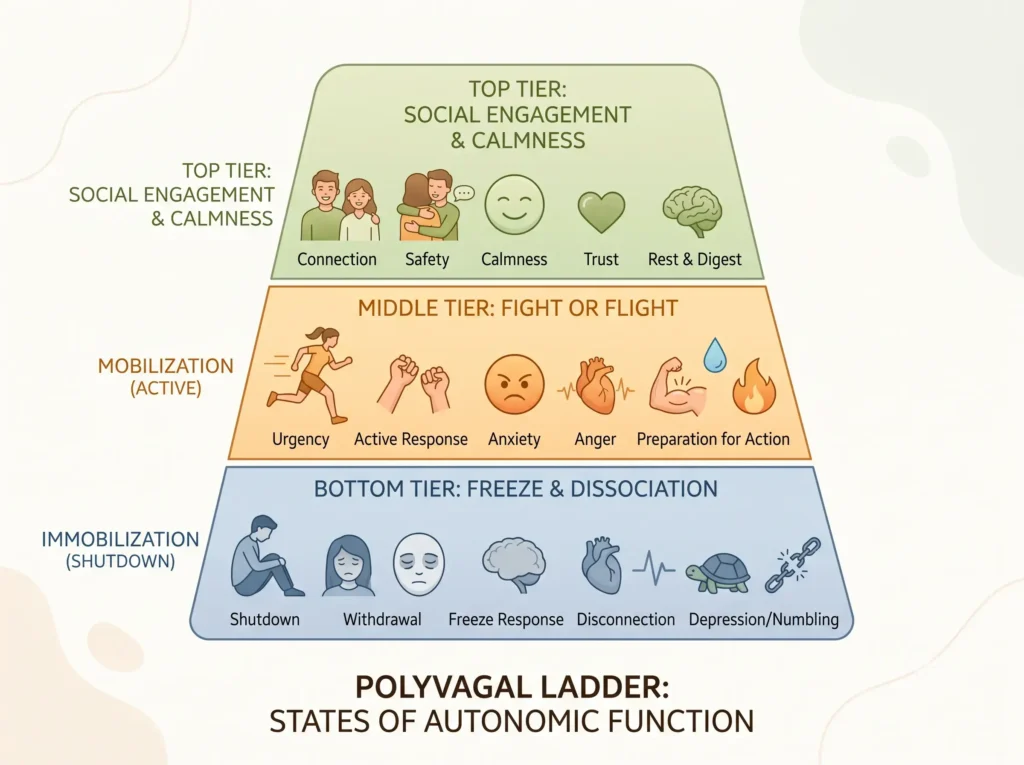
Sympathetic Arousal: Fight or Flight
When neuroception flags a threat, the vagal brake — the ventral vagus nerve’s restraint on heart rate — releases. Heart rate climbs, breathing gets shallow and high in the chest, and blood moves toward large muscle groups and away from digestion and, notably, the skin. This is the classic fight or flight response: useful for genuine danger, exhausting when it fires for a tense email.
Dorsal Vagal: Freeze and Shutdown
If the threat feels inescapable or the sympathetic response can’t resolve it, the older dorsal circuit takes over. Heart rate and metabolism drop. This is where freeze and shutdown response patterns live — the numbness, disconnection, and collapse that can follow overwhelming or prolonged stress. It’s a survival strategy, not a malfunction, but it’s an unpleasant place to live long-term.
Signs of Autonomic Nervous System Dysregulation
Dysregulation doesn’t always look dramatic. Often it shows up as a cluster of low-grade, hard-to-pin-down symptoms:
- Brain fog — difficulty concentrating, feeling mentally “underwater”
- Dissociation — a sense of watching yourself from outside, or feeling unreal
- Chronic fatigue that sleep doesn’t fully resolve
- Digestive complaints tied to the gut-brain axis, since the vagus nerve directly influences gut motility and sensation
- Low heart rate variability (HRV) — a measurable sign that the ventral vagal brake isn’t flexing the way it should
- Skin and sensory changes during stress spikes
That last one is easy to dismiss, but it’s real, and it’s a good example of how directly the autonomic nervous system shows up in the body.
A woman named Turi described this pattern clearly in her own words: a crawling, tingling, warming sensation across her torso and scalp — triggered by fear, by roughly ten minutes into a hard run, and even by spicy food. She’d noticed the same pattern for years and had come to a working theory: that anxiety narrows blood flow to the skin, and when that flow suddenly returns — during exercise, after a scare passes, or after eating something that dilates blood vessels — the capillaries expanding produces that itchy, crawling discomfort. She’s not a physiologist, and she said as much, but the mechanism she’s describing lines up with how the sympathetic nervous system redirects circulation away from the skin during a threat response and back again once it eases.
What changed the experience for her wasn’t fighting through it. It was meeting it with self-compassion — talking to herself gently, physically soothing herself, choosing to stay present with the sensation instead of trying to force it away. She still isn’t entirely sure why the pattern faded, but the shift from resistance to gentle acknowledgment tracks closely with what polyvagal-informed approaches actually recommend: cues of safety, including self-directed ones, help the nervous system stand down.
Polyvagal Exercises for Nervous System Regulation
These techniques are sometimes called Stephen Porges polyvagal exercises, since every one of them builds directly on his mapping of the vagus nerve’s two branches. More broadly, they fall under somatic exercises for vagus nerve stimulation — they share a common mechanism, bypassing reasoning and speaking straight to the body’s threat-detection system through breath, sound, temperature, or movement.
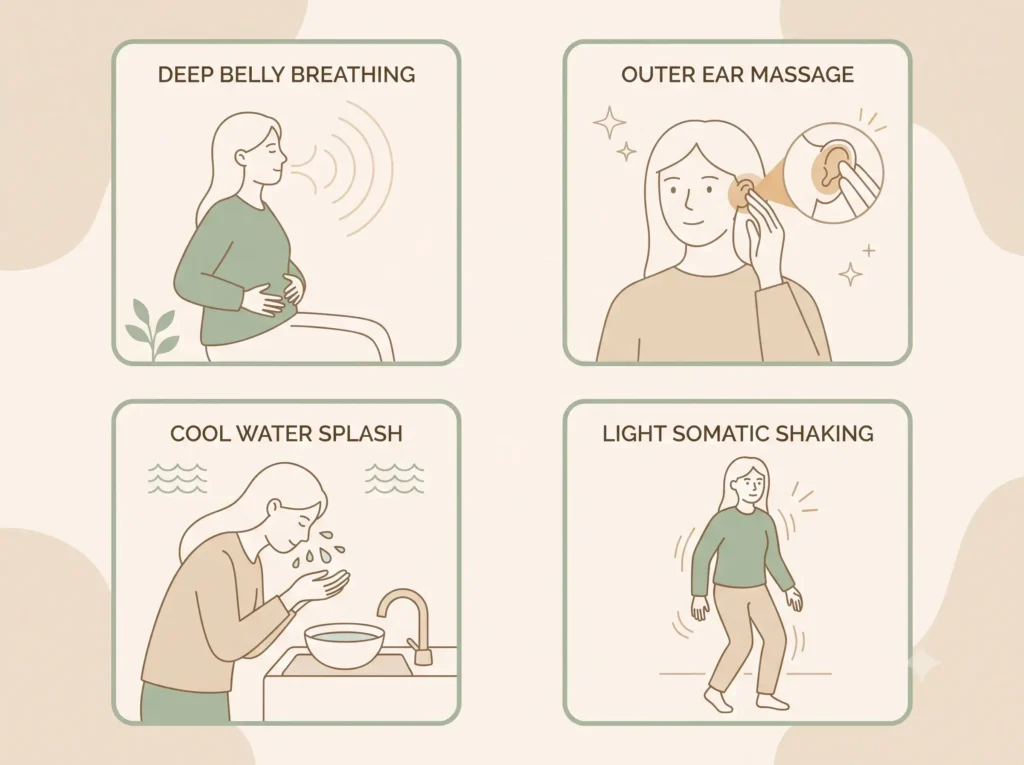
Diaphragmatic Breathing With Extended Exhale
The exhale phase is where the ventral vagal brake gets engaged. Making your exhale longer than your inhale directly slows heart rate through vagal activity.
How to do it: Inhale through the nose for a count of four. Exhale through the mouth for six to eight counts, slow and controlled. Repeat for three to five minutes. If you want a faster version, try a double inhale (one long breath in, then a short second sniff to top off the lungs) followed by one long, slow exhale — sometimes called a physiological sigh.
Humming and Chanting
The ventral vagus nerve runs close to the vocal cords and inner ear muscles. Low, sustained sound creates a vibration these structures can register as a safety signal.
How to do it: Hum a low, comfortable note on the exhale for two to three minutes, or try a slow “voo” sound from the belly. Chanting or singing works the same way.
Cold Water Face Immersion
Cold triggers the mammalian dive reflex, a rapid parasympathetic response that lowers heart rate.
How to do it: Splash cold water on your face, hold a cold pack against your cheeks and eyes, or briefly immerse your face in a bowl of cold water. Thirty seconds is usually enough to notice a shift. This is a stimulating, not a punishing, sensation — the goal is a brief jolt of cold, not prolonged discomfort.
Somatic Shaking
Animals in the wild physically shake off a stress response after a threat passes; humans mostly override that instinct. Deliberate shaking can help discharge leftover sympathetic activation.
How to do it: Stand and gently bounce or shake your hands, arms, and legs for sixty to ninety seconds, letting the movement feel loose rather than forced. Follow with a few slow breaths.
Auricular Branch Massage
A small cutaneous branch of the vagus nerve reaches the outer ear, which is why gentle stimulation there can have a calming effect.
How to do it: Massage the outer ear — the tragus, the ridges, and just behind the earlobe — using light, circular pressure for a minute or two. Combine with the earlobe if it feels grounding.
Grounding Techniques
Grounding pulls attention out of anticipated threat and into the present moment, which supports the orienting response the nervous system uses to confirm danger has passed.
How to do it: Name five things you can see, four you can touch, three you can hear, two you can smell, one you can taste. Or simply notice the contact between your feet and the floor, letting your gaze move slowly around the room to settle on something neutral or pleasant.
Stanley Rosenberg’s Basic Exercise
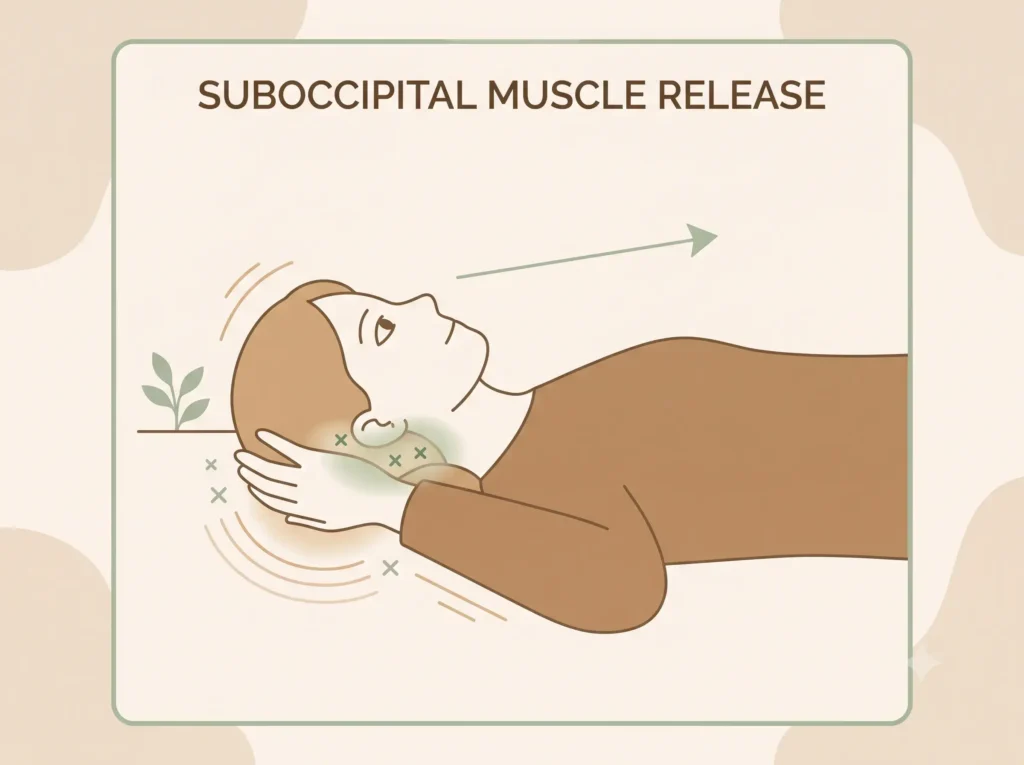
Physical therapist Stanley Rosenberg developed a well-known technique targeting the suboccipital muscles at the base of the skull, an area closely linked to vagal and cranial nerve function.
How to do it: Lie on your back, interlace your fingers behind your head, and rest your head in your hands without lifting it. Keep your head still and slowly move only your eyes to one side. Hold until you notice a spontaneous swallow, sigh, or yawn — often twenty to sixty seconds — then repeat looking the other direction.
How to Get Out of Dorsal Vagal Shutdown
Shutdown responds differently than sympathetic arousal, and pushing too hard, too fast, can backfire. The nervous system needs small, graduated signals of safety rather than a sudden jolt of stimulation
- Start with orienting, not action. A slow visual scan of the room re-establishes a sense of place before anything else.
- Use gentle movement before vigorous movement — small stretches, wiggling fingers and toes, rolling the shoulders.
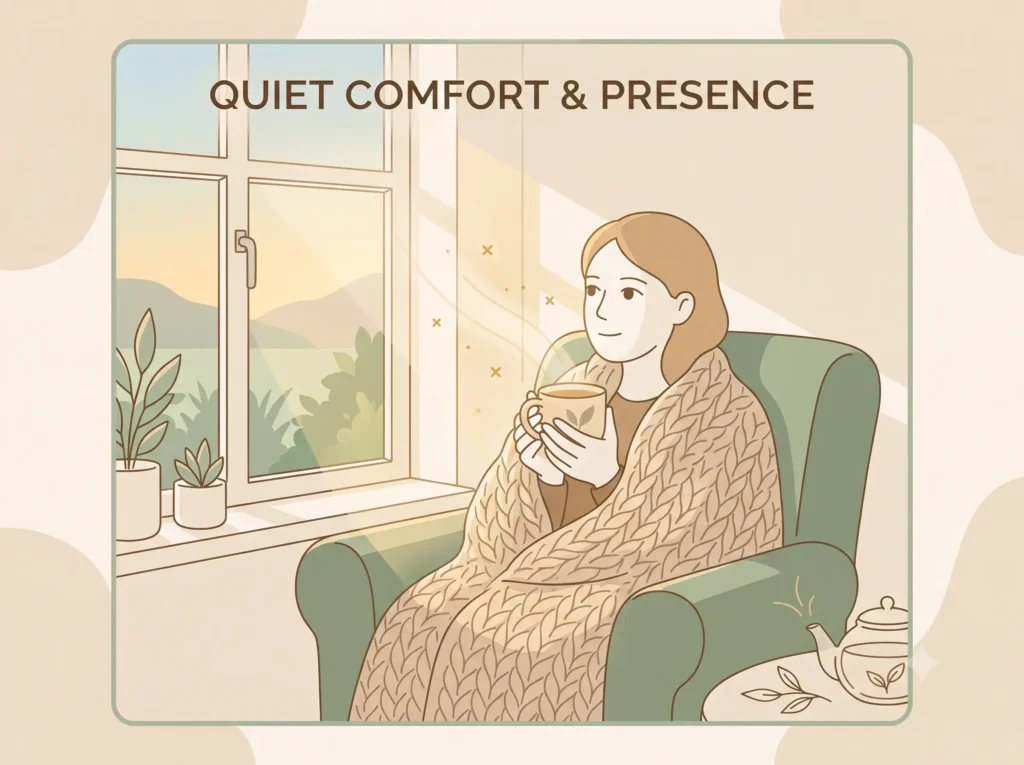
- Add warmth, not cold, at this stage. A warm drink, a blanket, or sunlight can be more effective than the activating techniques used for sympathetic states.
- Reach for co-regulation. A calm voice, a trusted person’s presence, or even a video call can help shift a dorsal state faster than any solo technique, because safety is fundamentally a social signal as much as a physiological one.
- Titrate. Approach any distressing thought or memory in small doses, pairing it with something neutral or pleasant, rather than confronting it head-on.
Building Ventral Vagal State Activation Into a Daily Routine
Ventral vagal state activation works best as a habit, not a rescue tool reached for only in crisis. A simple daily vagal tone routine might look like this:
- Morning: A few minutes of extended-exhale breathing before checking your phone
- Midday: A short orienting break after the first stressful task or meeting
- Afternoon: Humming, a walk outside, or a warm conversation with someone you trust
- Evening: Somatic tracking — sitting quietly and noticing where tension or ease shows up in the body, without trying to fix it — followed by slow breathing before bed
Somatic tracking deserves its own mention here. It isn’t about analyzing why a sensation is there. It’s about noticing it, staying curious, and letting the body process at its own pace — which is close to what Turi described: meeting the sensation with warmth instead of resistance, and letting that itself be the intervention.
Consistency matters more than intensity. A ninety-second practice done daily builds emotional resilience more reliably than an occasional hour-long session.
➟ 7 Secrets of Breathing Exercise for Vagus Nerve Stimulation to Stop Anxiety Fast
Common Challenges When Building a Polyvagal Practice
Most people don’t struggle with understanding these exercises — they struggle with sticking to them. A few obstacles show up again and again, and knowing them in advance makes them easier to work around.
- Inconsistency. A technique done once, during a crisis, rarely feels as effective as the same technique practiced daily when you’re already calm. Anchor a practice to something you already do — brushing your teeth, waiting for coffee to brew — instead of relying on willpower to remember it.
- Forgetting in the moment. When sympathetic arousal or shutdown actually hits, the part of your brain that remembers “I should try breathing” is often offline. A phone reminder, a sticky note, or a physical object (a ring, a bracelet) that cues the practice can help.
- Impatience. Nervous system regulation is a retraining process, not a switch. Expecting a single humming session to erase months of chronic stress sets up disappointment. Small, repeated signals of safety compound over time — they don’t work like a painkiller.
- Self-criticism when it “doesn’t work.” It’s common to judge yourself for still feeling anxious after trying a technique, which just adds another layer of threat signal for the nervous system to detect. Approaching the practice with the same gentleness Turi described — curiosity instead of frustration — tends to work better than forcing a result.
- The wrong exercise for the state you’re in. Activating techniques like cold water immersion can feel counterproductive during dorsal shutdown, when the body needs warmth and gradual re-engagement instead. Matching the tool to the state matters more than finding one “best” exercise.
Clinical and Therapeutic Applications: VNS and Occupational Therapy
Beyond self-directed exercises, polyvagal theory has shaped several formal clinical approaches.
Vagus nerve stimulation (VNS) delivers mild electrical impulses to the vagus nerve, most established as an implantable device for treatment-resistant epilepsy and depression. Non-invasive, transcutaneous versions that stimulate the vagus nerve through the skin — often at the ear — have also been studied for mood and anxiety symptoms, with a growing body of research indexed on PubMed examining its effects on heart rate variability and autonomic regulation. This is a medical intervention requiring a clinician, distinct from the self-massage techniques covered earlier.
Occupational therapy (OT) has also adopted polyvagal principles, particularly for clients whose sensory processing or social engagement capacity is affected by trauma, autism, or developmental differences. OT practitioners may use breathing techniques, environmental modifications, and graded social engagement activities to help a client shift out of a defensive state before working on the daily-living skills that are their primary focus.
Where the Science Is Still Being Debated
A responsible look at polyvagal theory has to include its critics, because presenting it as settled science would overstate the evidence.
- Limited direct empirical testing. Some researchers argue that specific claims — particularly around vagal tone as a precise, standalone marker of emotional state — haven’t been validated as rigorously as the theory’s popularity suggests.
- Oversimplification concerns. Critics point out that the autonomic nervous system is more interconnected and less cleanly hierarchical than a three-state model implies, and that reducing complex physiology to “ventral, sympathetic, dorsal” risks losing nuance.
- Overreliance on heart rate variability. Because HRV is relatively easy to measure, some worry it gets treated as a stand-in for the whole theory, when it’s only one imperfect proxy for vagal activity among several physiological signals.
None of this means the framework is without value. The core, testable claim — that the nervous system organizes defensive and social responses hierarchically, and that body-based safety cues can shift someone out of a defensive state — has substantial clinical support and is widely used in trauma-informed care. The more specific, mechanistic claims are where the scientific conversation is still open. Treating polyvagal theory as a useful clinical model rather than a fully proven neuroscientific fact is the more accurate — and more honest — way to use it.
When to Seek Professional Support
Self-directed polyvagal exercises are genuinely useful for everyday stress, but they’re a complement to professional care, not a substitute for it — particularly for complex trauma, PTSD, dissociation, or a diagnosed anxiety disorder. If grounding or breathing techniques leave you feeling more overwhelmed or destabilized rather than calmer, that’s a signal to bring in a trauma-informed clinician rather than push through alone. General guidance on recognizing and managing anxiety symptoms is also available through the NHS’s overview of anxiety, fear, and panic, which covers when symptoms warrant medical attention.
It’s also worth remembering that unusual physical sensations — skin crawling, warming, tingling — deserve a conversation with a doctor if they’re new, worsening, or paired with other symptoms, since polyvagal-informed self-regulation isn’t a diagnostic tool and shouldn’t replace a proper medical evaluation.
The Bottom Line
Learning how to regulate your nervous system using polyvagal theory starts with recognizing that you’re not fighting a character flaw when anxiety or shutdown hits — you’re working with a hierarchy of automatic, protective circuits that evolved to keep you alive. The exercises here — extended-exhale breathing, humming, cold water immersion, somatic shaking, ear massage, grounding, and Rosenberg’s technique — all send the same underlying message to your body: it’s safe now. Practiced consistently, they don’t just interrupt a bad moment. They retrain the baseline your nervous system defaults to, one small, repeatable signal of safety at a time.
This article is for informational and educational purposes only and is not a substitute for professional medical advice, diagnosis, or treatment. Always consult your doctor or a qualified health provider before starting any new diet, exercise, or wellness routine.
Frequently Asked Questions (FAQs) :
Q1. What is the fastest way to activate the vagus nerve?
The fastest response usually comes from cold water on the face or a slow, extended exhale (longer than the inhale) — both trigger a measurable drop in heart rate within 30–90 seconds via the ventral vagal brake.
Q2. How do I know if I'm in dorsal vagal shutdown?
Common signs include numbness, brain fog, low motivation, flat emotion, and a sense of disconnection from your body or surroundings — distinct from the racing heart of fight-or-flight.
Q3. How long does it take to regulate your nervous system with polyvagal exercises?
Individual exercises can shift your state within seconds to minutes, but building lasting vagal tone through a daily practice typically takes several weeks of consistent repetition.
Q4. Is polyvagal theory scientifically proven?
The core framework — that the nervous system organizes defensive and social responses hierarchically — has solid clinical support, though some specific claims, like vagal tone as a standalone measure, are still debated among researchers.
Q5. Can polyvagal exercises help during a panic or anxiety attack?
Yes — extended-exhale breathing, cold water immersion, and grounding techniques can interrupt acute sympathetic arousal within minutes, though they work best as a complement to, not a replacement for, professional treatment for recurring panic attacks.

Remi
Mental Health & Psychology Writer
Remi focuses on stress physiology, nervous system regulation, cognitive resilience, and mindfulness.
More in Mind & Nervous

Stop the Pain: 5 Proven Somatic Tracking for Fibromyalgia Steps
Break the chronic flare-up cycle. Learn how Somatic Tracking for Fibromyalgia calms…

7 Secrets of Breathing Exercise for Vagus Nerve Stimulation to Stop Anxiety Fast
Struggling with stress? Discover 5 science-backed breathing exercise for vagus nerve stimulation…

1 Proven Way to Heal Chronic Pain: Somatic Tracking Alan Gordon Guide
Learn somatic tracking Alan Gordon techniques to retrain your brain's alarm system…
12 Powerful Somatic Exercises for Stress to Reset Your Nervous System
Feeling overwhelmed or physically tense? Discover 12 simple somatic exercises for stress…

7 Powerful Polyvagal Exercises to Heal Your Dysregulated Nervous System
Stuck in anxiety or shutdown? Learn how 7 powerful polyvagal exercises help…
7 Proven Ways How to Activate the Vagus Nerve for Rapid Stress Relief
Discover how to activate the vagus nerve naturally with science-backed habits. Improve…

Infrared Sauna vs Traditional Sauna: Don’t Waste 1 Minute on the Wrong Choice
Discover Infrared Sauna vs Traditional Sauna for muscle recovery and longevity. Compare…

8 Powerful Ways to Increase REM Sleep (Stop Waking Up Tired)
Sleeping 8 hours but still exhausted? Discover 8 science-backed ways to increase…