

Dr. Wilder
Neuroscientist & Clinical Consultant • 15+ Years Exp in Cognitive Health
Your heart is racing. Your chest feels tight. Someone tells you to “just breathe,” and you want to scream.
Here’s the frustrating part: breathing does work. But not the way most people try it. A well-chosen breathing exercise for vagus nerve stimulation can shift your body out of fight-or-flight in under two minutes — if you know which pattern actually reaches the nerve, and which one just makes you dizzy.
This guide breaks down the real mechanics behind vagal breathing, the techniques with actual research behind them, and where the limits of “just breathe” really are.
What Is the Vagus Nerve, and Why Does Breathing Reach It?
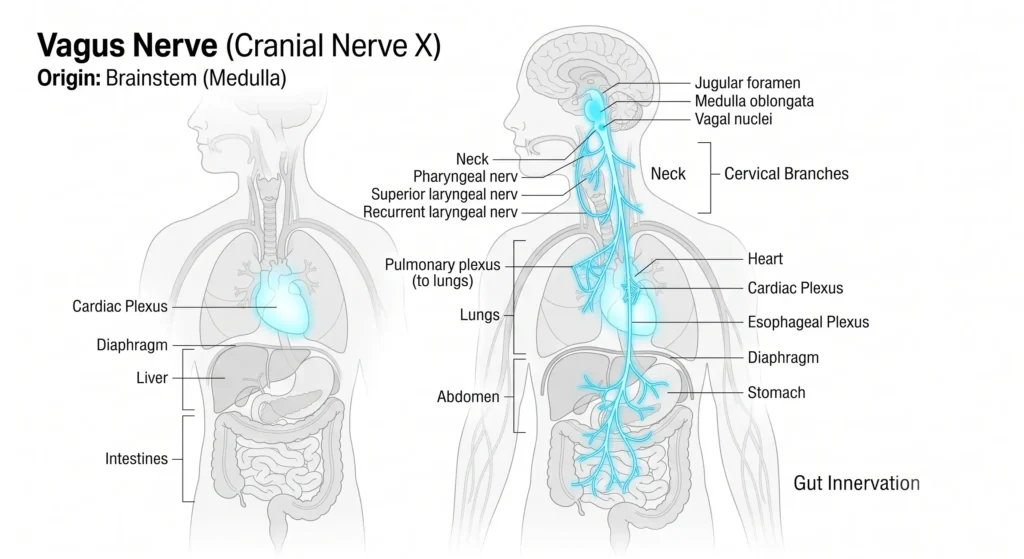
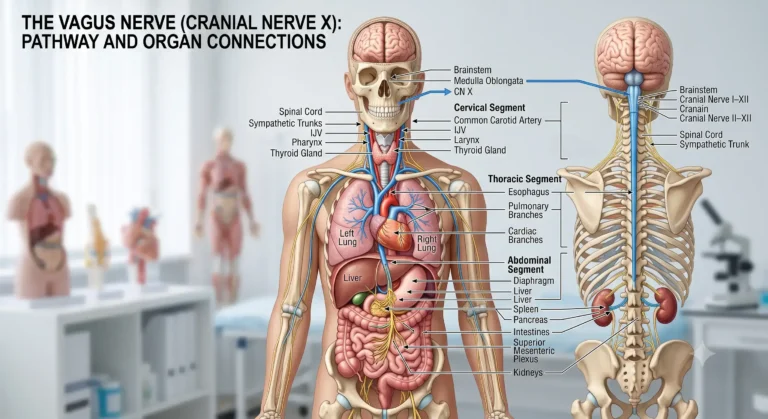
The vagus nerve is the longest cranial nerve in the body — it runs from your brainstem down through your neck, chest, and abdomen, touching your heart, lungs, and gut along the way. Roughly 80% of its fibers carry signals up to the brain, not down. That’s the part most explainers skip: your breath isn’t just being controlled by your nervous system — it’s actively reporting back to it.

The vagus nerve is the main channel of the parasympathetic nervous system (PNS), the “rest and digest” counterbalance to the sympathetic nervous system’s (SNS) fight-or-flight alarm. When the SNS dominates, heart rate climbs and breathing gets short and shallow. When the vagus nerve is doing its job, heart rate drops, digestion resumes, and the body settles.
Vagal tone describes how efficiently this system operates. It’s measured through heart rate variability (HRV) — the natural fluctuation in time between heartbeats. Higher HRV generally tracks with better stress recovery, lower resting heart rate, and a nervous system that returns to baseline quickly after a spike. Lower HRV shows up alongside chronic stress and, in some research, poorer cardiovascular and mental health outcomes.
Why does this matter for breathing specifically? Because the vagus nerve isn’t equally active through the whole breath cycle. It’s suppressed slightly during inhalation and re-engaged during exhalation. That single fact is the foundation of almost every vagal breathing technique that exists.
Table of Contents
The Science: How a Breathing Exercise for Vagus Nerve Stimulation Actually Works
There are two separate pathways at play, and understanding both explains why some breathing advice contradicts other breathing advice.
The direct route: Slowing your respiration rate and lengthening your exhale directly increases vagal outflow to the heart, dropping heart rate and blood pressure almost immediately. This is a fast, mechanical effect — you can feel it within a few breaths.
The indirect route (biofeedback): Vagal afferents — the “upward” fibers mentioned earlier — constantly report your breathing pattern back to the brain. Slow, steady breathing signals “no threat” to the central nervous system, which responds by dialing up parasympathetic activity even further. This is a slower loop, but it’s the one responsible for lasting improvements in vagal tone rather than a momentary dip in heart rate.
A frequently cited mechanism behind both routes is the baroreflex — a blood pressure-regulating system triggered by stretch receptors in major blood vessels. Slow breathing at roughly five to six breaths per minute appears to line up almost perfectly with the frequency at which this reflex is most sensitive, which is likely why so much of the research converges on that particular pace rather than a faster or slower one.
Carbon dioxide plays a supporting role too. Slowing your breathing allows CO2 to build up slightly in the blood, and mild CO2 elevation is associated with improved vagal signaling — one reason “breathe deeper” (which blows off CO2) can backfire, while “breathe slower” tends to help.
Why the Exhale Matters More Than the Inhale
Since vagal activity concentrates during exhalation, a longer, unforced out-breath does more for vagal tone than a big dramatic inhale. This is the physiological reason yoga, Zen breathing, and clinical breathing protocols all converge on the same instruction: don’t gulp air in — let it out slowly.
Research comparing equal-ratio breathing (inhale and exhale the same length) against skewed-ratio breathing (a longer exhale than inhale) has found both raise HRV, though results on which ratio wins have been mixed depending on the study and pace used. The practical takeaway is simpler than the debate: any structured slowing of the breath, exhale-weighted or not, appears to move the needle.
Vagus Nerve Breathing Exercises Worth Practicing
Not every breathing pattern targets the vagus nerve equally. These are the techniques with the clearest link back to vagal mechanics.
4-7-8 Breathing and the Vagus Nerve
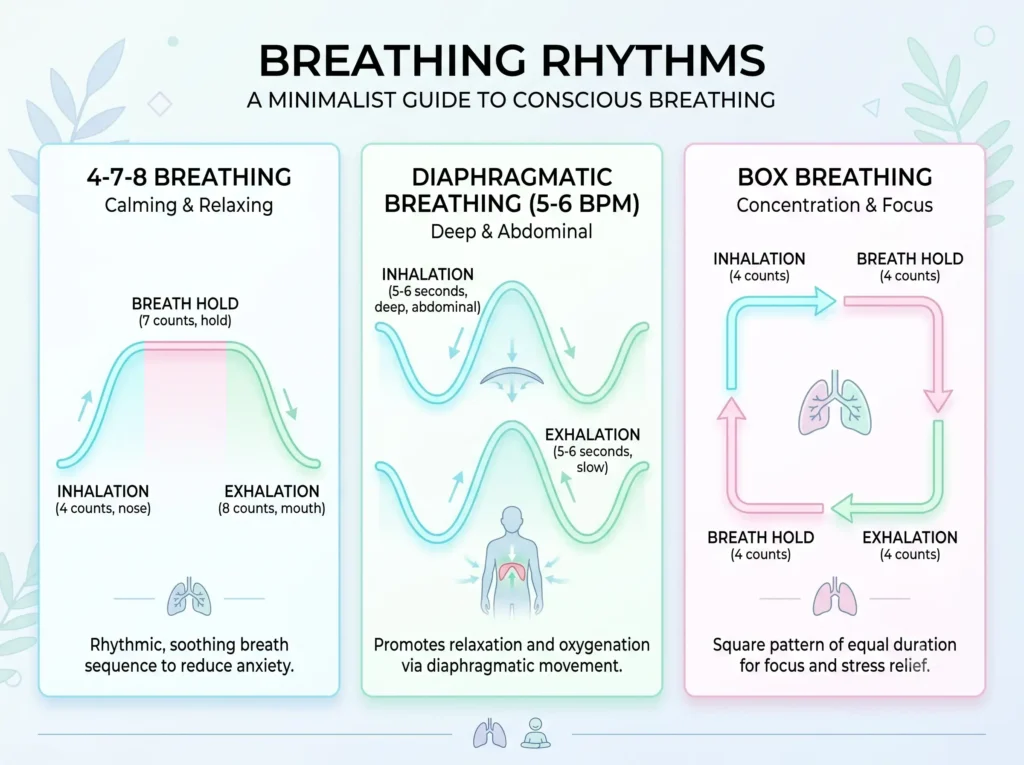
Popularized by Dr. Andrew Weil, this pattern asks you to inhale through the nose for 4 counts, hold for 7, and exhale through pursed lips for 8. The extended exhale is doing the real work here — it’s a deliberately exaggerated version of the exhale-dominant pattern the vagus nerve responds to. It’s a solid option before bed or during an acute stress spike, though the breath-hold can feel uncomfortable for beginners.
Diaphragmatic (Belly) Breathing at 5–6 Breaths Per Minute
This is the pattern most directly supported by the baroreflex research mentioned above. Instead of counting a strict ratio, you simply slow the breath until you’re taking around five or six full cycles per minute, letting the belly — not the chest — do the moving. Consistency here matters more than perfect timing.
Box Breathing (4-4-4-4)
Inhale for 4, hold for 4, exhale for 4, hold empty for 4. The equal timing creates a steady, predictable rhythm rather than emphasizing the exhale specifically, which makes it a gentler entry point for people who find breath-holding or exhale-focused patterns anxiety-provoking rather than calming.
| Technique | Pattern | Best Used For |
|---|---|---|
| 4-7-8 Breathing | Inhale 4 / Hold 7 / Exhale 8 | Acute stress, pre-sleep |
| Diaphragmatic (5–6 bpm) | Slow belly breathing, no strict count | Daily vagal tone building |
| Box Breathing | 4-4-4-4 equal count | Beginners, high-anxiety starting points |
| Extended Exhale (4:8 ratio) | Inhale 4 / Exhale 8, no hold | Quick reset before demanding tasks |
There's no single "correct" ratio. What separates a vagus-nerve-relevant breathing exercise from ordinary deep breathing is slowness and control — not how much air you pull in.
Best Breathing Technique for Vagus Nerve: What the Research Actually Prefers
If you’re looking for the single best breathing technique for vagus nerve activation, the honest answer is: it depends on what you’re measuring. Some research has found equal-ratio breathing at roughly 5.5 breaths per minute produced the largest HRV increase and the strongest baroreflex response compared to a longer-exhale ratio at the same pace. Other work on brief “vagal breathing” sessions — around two minutes of longer-than-inhale exhales — has linked the practice to measurable drops in self-reported stress and improved performance on decision-making tasks immediately afterward.
Read together, the pattern that emerges isn’t “one ratio beats all.” It’s that respiration rate matters more than ratio. Somewhere in the 5–6.5 breaths-per-minute range appears to be where most of the benefit concentrates, regardless of whether the exhale is extended or matched to the inhale. This is worth knowing because a lot of marketing around specific breath ratios implies precision that the underlying research doesn’t fully support.
Breathing Technique for Vagus Nerve and Anxiety: What This Looks Like in Practice
The physiology only tells half the story. The other half is what happens when someone actually tries to use a breathing technique for vagus nerve calming in the middle of a panic spiral — and it doesn’t always go the way the textbooks describe.
Writer Ana Nardelli spent years looking for what she calls a “silver bullet” for anxiety before landing on a harder truth: there isn’t one fix, but there is a way through. Her instinct, like a lot of people’s, was to take huge gulping breaths the moment panic hit, operating on the logic that more oxygen would calm her down. It did the opposite. Anxiety convinces the body it’s suffocating, and flooding the lungs in response only intensifies that alarm. What actually helped was the counterintuitive part: slower breaths, with real pauses between them, rather than more air.
She also picked up something important from a friend who’d come to dread breathing exercises entirely — because he only reached for them mid-panic-attack, his brain had quietly linked the act of deep breathing itself with danger. Trying to breathe deeply became a trigger in its own right.
The fix wasn’t a different breathing pattern. It was timing. Practicing slow breathing on ordinary, low-stress days — during tea, during a scroll break, during nothing in particular — builds the pattern into the body without fear attached to it. When a real spike hits later, the nervous system already knows the rhythm and doesn’t associate it with emergency.
That distinction matters more than most breathing guides admit: a vagal breathing exercise practiced only in crisis can become another crisis cue. Practiced on calm days, it becomes a genuine reset switch.
➟ 12 Powerful Somatic Exercises for Stress to Reset Your Nervous System
Vagus Nerve Exercises for Digestion
The vagus nerve’s reach doesn’t stop at the heart. It also governs gut motility, stomach acid secretion, and the release of digestive enzymes — which is why chronic stress so often shows up as bloating, sluggish digestion, or irritable bowel symptoms rather than just an anxious mind.
Slow, diaphragmatic breathing before or after meals is one of the more practical vagus nerve exercises for digestion, since it mechanically shifts pressure in the abdominal cavity while simultaneously nudging the nervous system toward the “rest and digest” state digestion actually requires. A body still running on sympathetic alert tends to divert blood flow away from the gut — slow breathing is one of the few voluntary tools that can interrupt that diversion in real time.
Building This Into a Routine (Without Overdoing It)
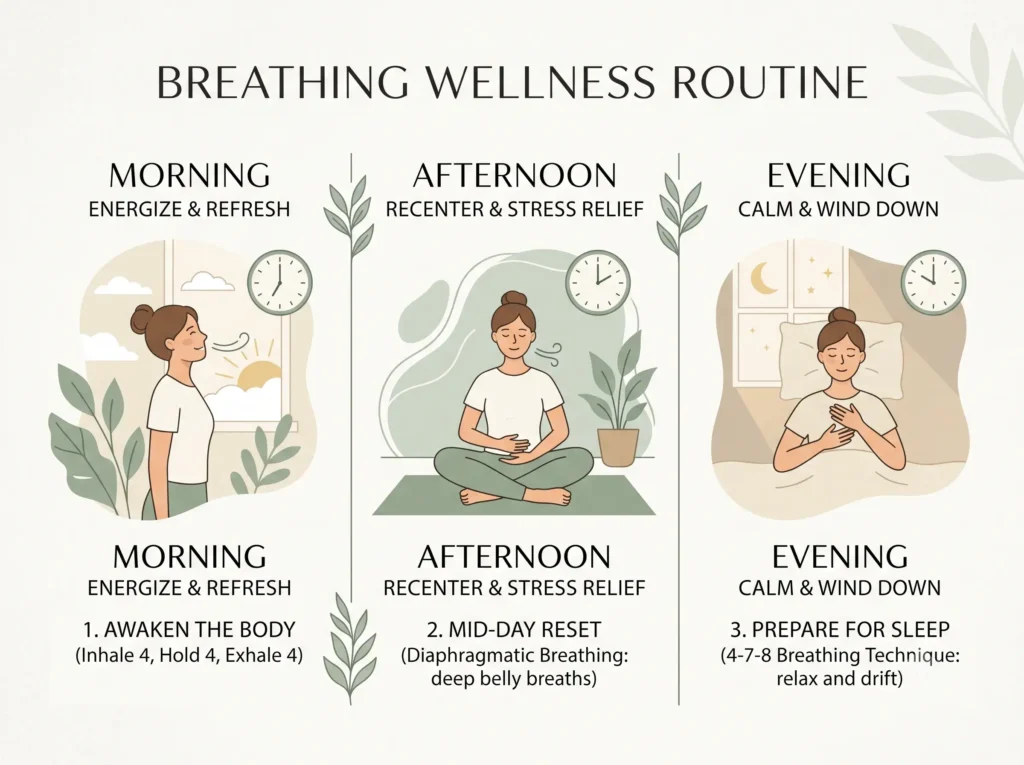
Consistency outperforms intensity here. A short daily practice tends to build vagal tone more reliably than occasional long sessions.
- Morning: 3–5 minutes of diaphragmatic breathing before checking your phone
- Midday: A 2-minute extended-exhale reset before a demanding meeting or task
- Evening: 4-7-8 breathing or box breathing to downshift before sleep
- On calm days generally: Short, unforced practice — not saved exclusively for emergencies
Who Should Be Cautious
Slow breathing is low-risk for most people, but it isn’t universal. Anyone with a history of fainting, low blood pressure, or vasovagal syncope should introduce breath-holding patterns gradually,
since strong vagal stimulation can drop blood pressure further than intended. People with asthma or other respiratory conditions should check with a clinician before adopting breath-hold-heavy techniques, since some vagal stimulation research has noted airway effects in sensitive individuals. As with most self-directed nervous system tools, these exercises support — but don’t replace — professional care for diagnosed anxiety, depression, or cardiovascular conditions. Broader guidance on relaxation and breathing for stress is available through the NHS’s breathing exercises for stress resource, and the physiological research behind slow-breathing and heart rate variability can be explored directly through NIH-indexed studies on PubMed. The NIH’s National Center for Complementary and Integrative Health also outlines the broader evidence base for relaxation-focused practices.
The Bottom Line
A breathing exercise for vagus nerve stimulation isn’t a trick — it’s a direct line into one of the few autonomic systems you can consciously influence. Slow the breath to somewhere around five to six cycles a minute, let the exhale lengthen without forcing it, and practice on the days when nothing is wrong, not just the days when everything feels wrong. That’s the part the research and the lived experience actually agree on: the nervous system learns rhythm through repetition, not through rescue missions. Build the habit first, and the calm shows up exactly when you need it.
This article is for informational and educational purposes only and is not a substitute for professional medical advice, diagnosis, or treatment. Always consult your doctor or a qualified health provider before starting any new diet, exercise, or wellness routine.
Frequently Asked Questions (FAQs) :
Q1: How do I stimulate my vagus nerve with breathing?
You stimulate the vagus nerve by slowing your respiration to roughly five to six breaths per minute and letting the exhale run longer than the inhale. This works through two routes — a fast direct route that immediately lowers heart rate, and a slower biofeedback route that signals “no threat” to the brain. The effect is amplified by mild CO2 buildup and by engaging the baroreflex, which is most sensitive at that same slow pace.
Q2: Does 4-7-8 breathing stimulate the vagus nerve?
Yes — 4-7-8 breathing works specifically because of its extended 8-count exhale, which is where vagal activity concentrates. It’s an exaggerated version of the exhale-dominant pattern the vagus nerve responds to, making it effective before bed or during an acute stress spike. Beginners may find the 7-count hold uncomfortable at first.
Q3: What is the 7-minute vagus nerve reset?
The article doesn’t outline a specific “7-minute” protocol — its recommended resets run shorter, built around a 2-minute extended-exhale practice for quick situational resets and a 3–5 minute diaphragmatic breathing session for daily vagal tone building. The core principle stays the same regardless of duration: slow, controlled breathing with a longer exhale, not the length of the session, drives the vagal response.
Q4: Which pranayama is best for the vagus nerve?
The article doesn’t name a specific pranayama style, but its research points to a broader principle: respiration *rate* matters more than any particular ratio or tradition. Any slow-breathing practice in the 5–6.5 breaths-per-minute range — whether equal-ratio or exhale-extended — activates the same vagal mechanics that underlie yoga and Zen breathing techniques.
Q5: What is the quickest way to reset your vagus nerve?
A short, roughly 2-minute session of extended-exhale breathing is the fastest reset described — brief vagal breathing sessions using longer-than-inhale exhales have been linked to a quick drop in stress and improved focus almost immediately after. For it to work reliably in the moment, it should already be a familiar rhythm from calm-day practice, not something attempted for the first time mid-panic.
Remi
Mental Health & Psychology Writer
Remi focuses on stress physiology, nervous system regulation, cognitive resilience, and mindfulness.
More in Mind & Nervous
7 Proven Polyvagal Exercises for Nervous System Regulation: End Chronic Panic & Feel Safe
Logic can't talk your body down from panic. Master 7 polyvagal exercises…
Stop the Pain: 5 Proven Somatic Tracking for Fibromyalgia Steps
Break the chronic flare-up cycle. Learn how Somatic Tracking for Fibromyalgia calms…
1 Proven Way to Heal Chronic Pain: Somatic Tracking Alan Gordon Guide
Learn somatic tracking Alan Gordon techniques to retrain your brain's alarm system…
12 Powerful Somatic Exercises for Stress to Reset Your Nervous System
Feeling overwhelmed or physically tense? Discover 12 simple somatic exercises for stress…

7 Powerful Polyvagal Exercises to Heal Your Dysregulated Nervous System
Stuck in anxiety or shutdown? Learn how 7 powerful polyvagal exercises help…
7 Proven Ways How to Activate the Vagus Nerve for Rapid Stress Relief
Discover how to activate the vagus nerve naturally with science-backed habits. Improve…

Infrared Sauna vs Traditional Sauna: Don’t Waste 1 Minute on the Wrong Choice
Discover Infrared Sauna vs Traditional Sauna for muscle recovery and longevity. Compare…

8 Powerful Ways to Increase REM Sleep (Stop Waking Up Tired)
Sleeping 8 hours but still exhausted? Discover 8 science-backed ways to increase…