

Dr. Atlas
Preventive Medicine & Wellness Advisor • 8+ Years Exp in Preventive Healthcare
Stop for a second and check your head position right now. Chin jutting forward? Ears sitting ahead of your shoulders instead of stacked above them? You’re not imagining it — you’re one of roughly 66% to 90% of people walking around with forward head posture, and your screen habits are probably the reason why.
The fix isn’t complicated, but it does require consistency. This guide breaks down exactly why forward head posture happens, what it does to your body over time, and which fix forward head posture exercises actually move the needle — backed by a real person’s month-by-month experience correcting the same problem.
What Forward Head Posture Actually Is
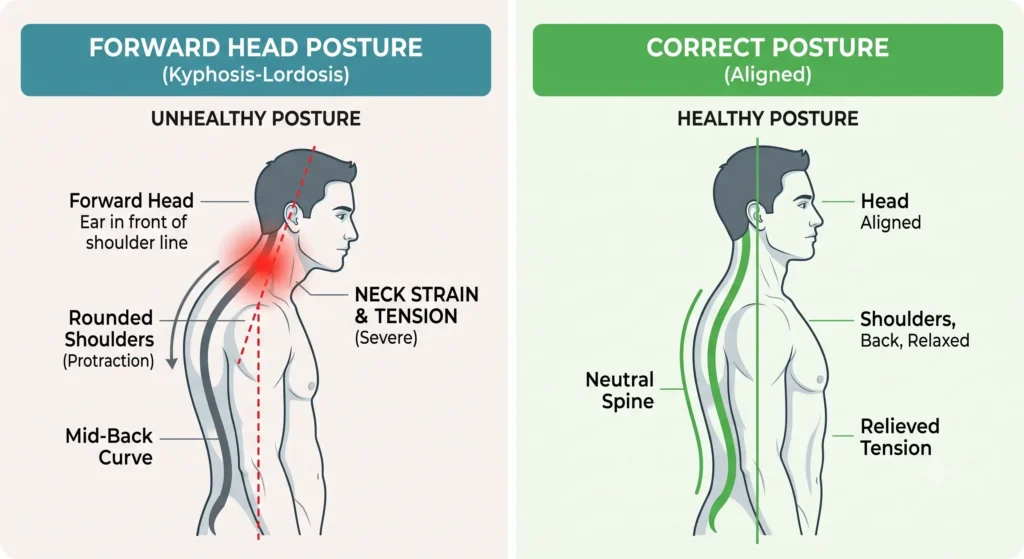
Table of Contents
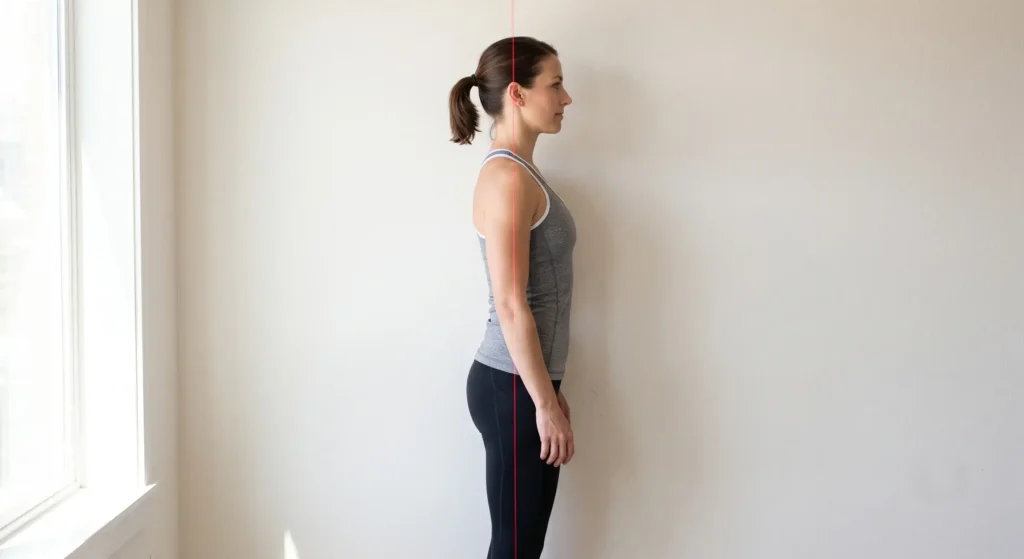
Forward head posture (FHP) — also called tech neck, nerd neck, or scholar’s neck — happens when your skull shifts more than an inch forward of your first cervical vertebra (the atlas). In a neutral position, your ears should line up directly over your shoulders. In FHP, they don’t.
➟ 1 Proven Way to Heal Chronic Pain: Somatic Tracking Alan Gordon Guide
Quick self-test:
- Stand with your back against a wall, heels shoulder-width apart.
- Press your buttocks and shoulder blades flat against the wall.
- Check the back of your head — is it touching the wall without straining?
If it’s not, you’re dealing with forward head posture.
The mechanics behind it are straightforward physics. Your head weighs 10 to 14 pounds in a neutral position. Tilt it forward, and the effective load on your cervical spine climbs fast — some researchers estimate an extra 10 pounds of strain for every inch of forward lean, while a study referenced by the NIH has linked forward-leaning head posture to significantly increased load on the neck at greater tilt angles. Your neck simply wasn’t built to carry that weight off-center for eight hours a day.
Why This Posture Sneaks Up on Everyone
FHP rarely comes from one single habit — it accumulates from dozens of small daily positions:
- Extended screen time on laptops, phones, and monitors positioned too low
- Driving hunched toward the wheel
- Sleeping with your head propped too high on pillows, or on a couch armrest
- Carrying heavy backpacks or bags on one shoulder
- One-sided sports like golf, tennis, or hockey
- Occupations demanding repetitive forward lean — hairstylists, programmers, massage therapists, seamstresses
- Weak neck and upper back muscles, often worsened by anxiety-driven muscle tension
That last point matters more than most articles mention. Muscular tension isn’t purely mechanical — chronic stress and anxiety can keep the shoulders and neck locked in a protective, hunched position, compounding whatever your desk setup is already doing to your spine.
What Happens Inside Your Body
Forward head posture doesn’t stay isolated to your neck. Here’s the chain reaction, according to research published in the Journal of Physical Therapy Science:
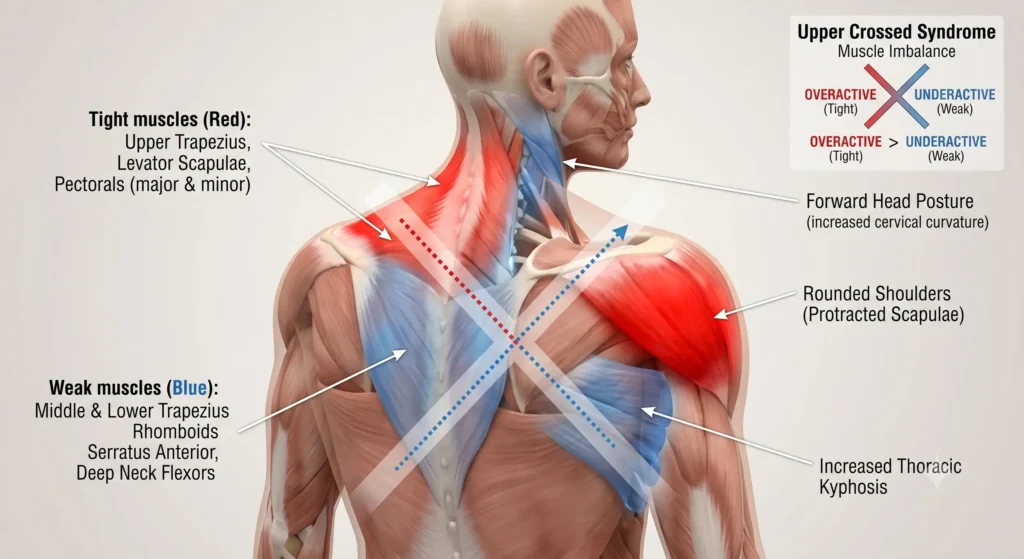
Muscle imbalance develops first. The deep muscles at the front of your neck (longus colli, longus capitis) weaken and lengthen, while the muscles at the base of your skull, your upper trapezius, and your chest (pectoralis major/minor) tighten and shorten.
Your center of gravity shifts. With your head sitting forward of your spine’s natural axis, your body compensates — often by rounding the shoulders and increasing thoracic kyphosis (upper back curvature) to keep you from tipping over.
Everything downstream gets recruited. Your balance control mechanisms adjust to the new alignment, which paradoxically makes you less stable, not more. This is part of why FHP has been associated with a higher fall risk in older adults.
Left unaddressed, this cascade contributes to:
- Chronic neck and upper back pain
- Tension-type headaches and migraines
- Reduced range of motion
- TMJ (jaw) pain
- Numbness or tingling down the arms
- Restricted breathing capacity, since a collapsed chest position limits how much your ribcage can expand
FHP isn't just a cosmetic issue. It's a mechanical chain reaction that starts at your neck and eventually recruits your shoulders, upper back, breathing muscles, and balance system.
The 5 Best Exercises for Fixing Nerd Neck
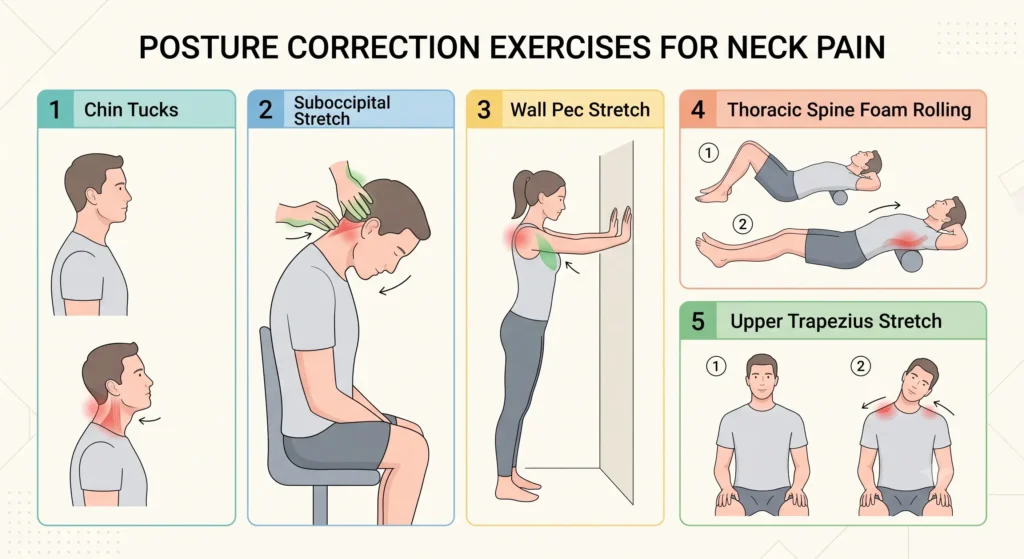
These five moves target the specific muscle imbalances described above — weak deep neck flexors, tight suboccipitals, shortened pecs, and a stiff thoracic spine. Do them daily; consistency matters more than intensity here.
1. Chin Tucks
The foundational move for reactivating your deep cervical flexors.
- Place two fingers on your chin.
- Gently tuck your chin straight back (not down), as if making a double chin, while your fingers guide the motion.
- Hold 3–5 seconds, then release.
- 2–3 sets of 10 reps.
You should feel a lengthening sensation at the back of your neck and mild “packing” at the front — that’s the deep flexors switching on.
2. Suboccipital Stretch (Neck Flexion)
Loosens the tight muscles at the base of your skull that develop from constant forward lean.
- Tuck your chin in with one hand.
- Place your other hand on the back of your head and gently pull your head toward your chest.
- Hold 20–30 seconds, repeat 3 times, keeping the chin tucked throughout.
3. One-Arm Pec Stretch at a Wall
Rounded shoulders and a forward head go hand in hand — this move directly counters chest tightness.
- Stand close to a wall, extend one arm behind you with your palm flat against it.
- Brace your core, lean slightly forward and away from the extended arm.
- Hold 30 seconds, then switch sides.
Adjust the arm angle slightly until you feel the stretch across your chest, not just your shoulder.
4. Thoracic Spine Foam Rolling
A stiff mid-back forces your neck to compensate — this move restores upper-back mobility.
- Lie on your back, hands behind your head, foam roller placed under your upper back.
- Slowly roll from mid-back toward the top of your shoulders, keeping your core engaged.
- Move slowly — no rushing.
5. Upper Trapezius Stretch
Targets the tight muscles running from your neck down to your shoulder.
- Sit or stand tall. Place one hand on the opposite side of your head, tuck the other hand behind your back.
- Gently bring your head toward your shoulder, using your top hand for a light extra pull.
- Hold 20–30 seconds per side.
Fixing Rounded Shoulders Alongside Forward Head Posture
You can’t fully correct FHP without also addressing rounded shoulders — the two conditions reinforce each other in what’s sometimes called upper crossed syndrome: tight chest and neck muscles paired with weak mid-back and deep neck muscles.
Add these to your routine:
- Doorway chest stretch — forearms on the doorframe, step forward until you feel a chest stretch, hold 15–30 seconds, repeat several times daily.
- Band pull-aparts — hold a resistance band at arm’s length, pull it apart by squeezing your shoulder blades together. 2 sets of 10–12 reps.
- Scapular wall slides — back flat against a wall, arms bent to 90 degrees pressed into the wall, slide upward without losing contact. 2 sets of 10 reps.
- Prone I-T-Y raises — lying face down, raise your arms into I, T, and Y shapes to strengthen the smaller stabilizing muscles of your upper back.
Real Progress Takes Real Time: One Person’s Recovery Approach
Fixing years of accumulated postural strain isn’t a one-week project, and hearing how someone else actually approached it can be more useful than another list of stretches. Leo, who dealt with a combination of anxiety-related tension and rounded shoulders, shared how he tackled it across four fronts rather than relying on stretching alone.
He built a full-body resistance training routine, deliberately emphasizing back work — face pulls with a resistance band, supermans, and dumbbell rows — while balancing it with push-ups so his chest and back strength developed together rather than one side dominating. On the mobility side, he used a yoga block turned on its side, lying with his mid-upper back resting on it so his head could hang back, opening his chest and stretching the front of his neck. He admitted the first sessions were rough enough that breathing felt difficult, a sign of just how tight his front-body muscles had become. He stuck with it daily anyway.
He also changed how he slept, going pillow-free while sleeping on his back to encourage his head to settle backward into alignment overnight — a habit he found easier to adopt than expected. And throughout the day, he built a simple awareness check: whenever he caught his shoulders rounding forward or his head drifting ahead of his spine, he’d consciously reset — head back, shoulders down and back, sitting taller.
His takeaway is worth repeating to anyone starting this process: the problem built up over years, so expect the fix to take months, not days. Muscles need time to strengthen on one side and loosen on the other — patience is part of the protocol, not a footnote to it.
Correct Sitting Posture at Your Desk: The Ergonomics That Prevent a Relapse
Exercises undo the damage that’s already there; your desk setup decides whether new damage keeps piling on. This matters even more if you work remotely — home setups tend to be improvised (kitchen chairs, coffee tables, laptops balanced on knees), and that improvisation is exactly what feeds forward head posture back into your body every day.
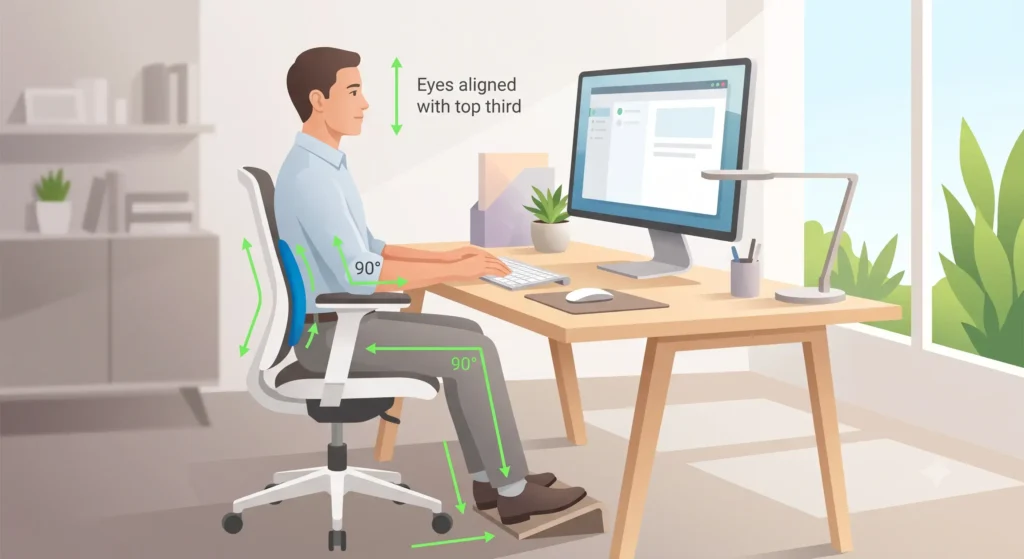
Start with the fundamentals:
| Body Part | Correct Position |
|---|---|
| Feet | Flat on the floor, or on a footrest if they don’t reach |
| Knees | 90-degree angle, level with or slightly below hips |
| Pelvis | Neutral, buttocks against the back of the chair |
| Lower back | Supported by a lumbar cushion or the chair’s built-in support |
| Shoulders | Relaxed, not hunched toward the ears |
| Elbows | 90 degrees, forearms resting flat on the desk |
| Head | In line with your spine, ears stacked above shoulders |
| Monitor | Top third at eye level, 18–24 inches from your face |
If you don’t have a proper office chair or a dedicated setup, a few improvised fixes still get you most of the way there — guidance highlighted by Boston University’s Environmental Health & Safety team backs all of these:
- No lumbar support? A firm cushion or tightly folded towel under your glutes raises your hips slightly and restores some lower-back curve.
- Feet dangling? Stack a few books or a box under your desk so your thighs stay close to parallel with the floor.
- Working off a bare laptop? Prop it on a stand and add an external keyboard and mouse — your eye line should land on your browser’s address bar, not the bottom edge of the screen.
- Retire the couch as a workstation. Sitting with your legs elevated or your spine unsupported for hours leads to numbness and reinforces the exact slouch you’re trying to undo.
Common mistakes to eliminate:
- Craning your neck toward the screen instead of adjusting monitor height
- Crossing your legs for extended periods
- Perching on the edge of your seat without back support
- Skipping breaks because “just one more email” turns into three hours of stillness
Two habits that reinforce everything above:
- The 20-20-20 rule — every 20 minutes, look at something 20 feet away for 20 seconds. It rests your eyes and naturally cues you to reset your neck position too.
- Move for a few minutes every hour. Standing, stretching, or a short walk keeps the muscles supporting your neck from locking into one position for an entire shift.

Text Neck Stretches You Can Do Anywhere
Beyond your desk routine, these moves work at a stoplight, during a meeting, or between phone calls:
- Exaggerated nod: Look up toward the ceiling with your mouth closed, let your jaw relax open, then draw your head slightly further back before closing your mouth. You’ll feel a stretch along the front of your neck.
- Cat-Cow: On all fours, alternate between arching and rounding your spine, letting your neck follow the movement instead of staying rigid.
- Downward-Facing Dog: Opens the chest and shoulders while actively lengthening the neck — draw your shoulder blades down your back rather than shrugging them toward your ears.
When to See a Professional
Home exercises resolve most cases of forward head posture, but certain signs mean it’s time to loop in a doctor, physical therapist, or chiropractor rather than pushing through alone:
- Pain that persists or worsens despite consistent stretching and strengthening
- Numbness, tingling, or weakness radiating down your arms
- A suspected underlying condition — arthritis, a prior whiplash injury, or a congenital spinal issue
- Symptoms that interfere with sleep, concentration, or daily function
According to the NHS guidance on posture and back pain, professional manual therapy combined with a targeted exercise plan tends to produce better outcomes than stretching alone when pain has already become chronic.
Fixing Forward Head Posture Is a Long Game, Not a Quick Fix
The muscle imbalances behind forward head posture didn’t develop in a week, and they won’t resolve in one either. What actually works is unglamorous: chin tucks and suboccipital stretches daily, chest-opening work to counter rounded shoulders, an ergonomic setup that keeps your screen at eye level, and constant small corrections throughout the day until upright alignment starts to feel normal instead of effortful.
Give it weeks, not days, before judging progress. Combine the fix forward head posture exercises above with better desk ergonomics and consistent posture awareness, and the forward lean that’s been quietly loading your spine for years starts to reverse — one chin tuck at a time.
This article is for informational and educational purposes only and is not a substitute for professional medical advice, diagnosis, or treatment. Always consult your doctor or a qualified health provider before starting any new diet, exercise, or wellness routine.
Frequently Asked Questions (FAQs) :
Q1. Can you actually fix forward head posture?
Yes — forward head posture is very fixable with consistent daily effort, not a quick one-time fix. Combining targeted fix forward head posture exercises with better desk ergonomics and posture awareness reverses the forward lean over weeks to months. The key is patience: muscles that tightened or weakened over years need real time to rebalance.
Q2. How to undo forward head posture?
Undo it by working both sides of the imbalance — strengthen the weak deep neck flexors with chin tucks, and stretch the tight suboccipitals, chest, and upper traps. Pair this with correct sitting posture at your desk (screen at eye level, ears stacked over shoulders) so the gains don’t get undone during work hours. Addressing rounded shoulders alongside the neck work speeds up results, since the two conditions reinforce each other.
Q3. Is it too late to fix forward head posture?
No — but expect the timeline to match how long the problem took to build. If the posture accumulated over years, correcting it takes weeks to months of daily chin tucks, stretching, and ergonomic changes, not days. Consistency, not speed, determines whether it resolves.
Q4. What exercises improve forward head posture?
Five core moves work directly on the muscle imbalances behind FHP: chin tucks, the suboccipital stretch, the one-arm pec stretch at a wall, thoracic spine foam rolling, and the upper trapezius stretch. For fixing nerd neck fully, add exercises for rounded shoulders and forward head posture like doorway chest stretches, band pull-aparts, and scapular wall slides. Text neck stretches — like the exaggerated nod and cat-cow — work anywhere as quick daily add-ons.
Q5. What is the root cause of forward head posture?
It’s a muscle imbalance: the deep neck flexors weaken and lengthen while the suboccipitals, upper trapezius, and chest muscles tighten and shorten. This imbalance develops from accumulated daily habits — extended screen time, driving hunched over, poor sleep positions, heavy bags, and even anxiety-driven muscle tension — rather than from any single cause.

Amara
Holistic Wellness & Lifestyle Editor
Amara translates daily wellness science into simple, sustainable, and actionable habits for modern living.
More in Daily Wellness

Don’t Ignore These 9 Warning Early Perimenopause Symptoms in 30s
Struggling with irregular cycles or fatigue? Don't ignore these early perimenopause symptoms…

Stop Sitting Wrong! 5 Fatal Causes of Lower Back Pain From Sitting at Desk
Is your 9-to-5 job damaging your spine? Avoid these 5 fatal mistakes…
7 Proven Polyvagal Exercises for Nervous System Regulation: End Chronic Panic & Feel Safe
Logic can't talk your body down from panic. Master 7 polyvagal exercises…

Infrared Sauna vs Traditional Sauna: Don’t Waste 1 Minute on the Wrong Choice
Discover Infrared Sauna vs Traditional Sauna for muscle recovery and longevity. Compare…

8 Powerful Ways to Increase REM Sleep (Stop Waking Up Tired)
Sleeping 8 hours but still exhausted? Discover 8 science-backed ways to increase…
How to Fix Sleeping Posture: 4 Proven Ways to Stop Morning Neck Pain
Learn how to fix sleeping posture with 4 research-backed rules. Discover the…
Stop Waking Up Exhausted: 7 Proven Ways to Increase Deep Sleep and REM Sleep Naturally
Sleeping 8 hours but still waking up tired? Discover science-backed habits, foods,…

Stop the Pain: 5 Proven Somatic Tracking for Fibromyalgia Steps
Break the chronic flare-up cycle. Learn how Somatic Tracking for Fibromyalgia calms…