

Dr. Amelia
Sleep Specialist & Medical Reviewer • 12+ Years Exp in Behavioral Sleep Medicine
You’ve tried a new mattress. You’ve tried melatonin. You’ve tried counting sheep, cutting caffeine, and going to bed at the same time every night like some kind of sleep-hygiene monk. And you’re still waking up with a knot in your shoulder or a neck that won’t turn past forty degrees without complaining.
Here’s the thing nobody tells you at the mattress store: the surface you sleep on matters less than the shape your body makes on top of it. You can drop three thousand dollars on a “cervical support” mattress and still wreck your neck if you don’t know how to fix sleeping posture—especially if your pillow is two inches too tall and your shoulder is jammed under your ribcage all night. Posture doesn’t clock out when you close your eyes — if anything, it has eight uninterrupted hours to do damage, with no core engagement, no postural muscles firing, and no conscious correction happening at all.
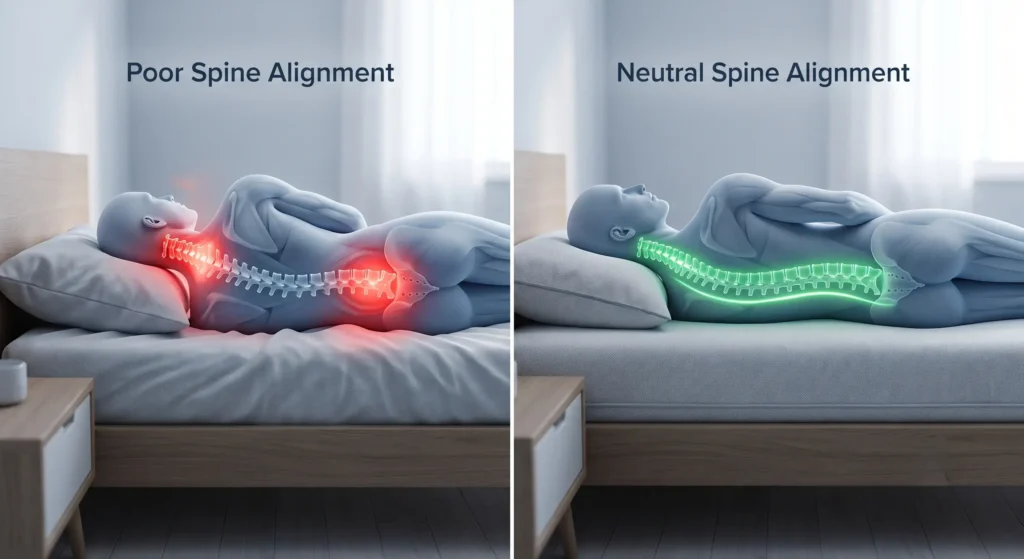
Table of Contents
This guide breaks down the best sleeping position for neck and shoulder pain, the smartest pillow placement for spine alignment, and what the actual research says about pillow height, contact pressure, and muscle activity during sleep — not just the recycled “sleep on your back” advice you’ve read a dozen times already.
Why Your Sleeping Posture Is Doing More Damage Than You Think
During the day, your nervous system is constantly making tiny corrections to your posture. You shift your weight, roll your shoulders back, adjust your neck when it starts to ache. At night, that feedback loop goes quiet. Whatever position you land in is the position your spine holds for hours, often without a single correction, while your muscles are at their most relaxed and least able to compensate for bad alignment.
That matters because sleep isn’t a passive shutdown — it’s an active repair window. During deep sleep, the body slows the heart rate and blood pressure, releases hormones that drive tissue growth, repairs blood vessels, and ramps up white blood cell production. If your spine spends that window twisted, compressed, or hyperextended, you’re asking your body to do repair work while simultaneously creating new damage. That’s the vicious cycle familiar to anyone with chronic back or neck pain: you need quality sleep to heal, but the pain itself prevents the deep, restorative sleep that healing requires.
Cervical spine researchers describe this in more clinical terms — endogenous stability from your vertebrae and ligaments, and exogenous stability from your muscles, working together to hold the neck’s natural curve. When that balance is disrupted night after night by a poorly positioned head or neck, the result is the kind of chronic irritation that shows up as numbness, stiffness, headaches, or dizziness during the day.
➟ Stop Waking Up Exhausted: 7 Proven Ways to Increase Deep Sleep and REM Sleep Naturally
The Best Sleeping Position for Neck and Shoulder Pain
If you’re dealing with both neck and shoulder discomfort at once, back sleeping is generally the strongest starting point, and here’s why it edges out the alternatives.
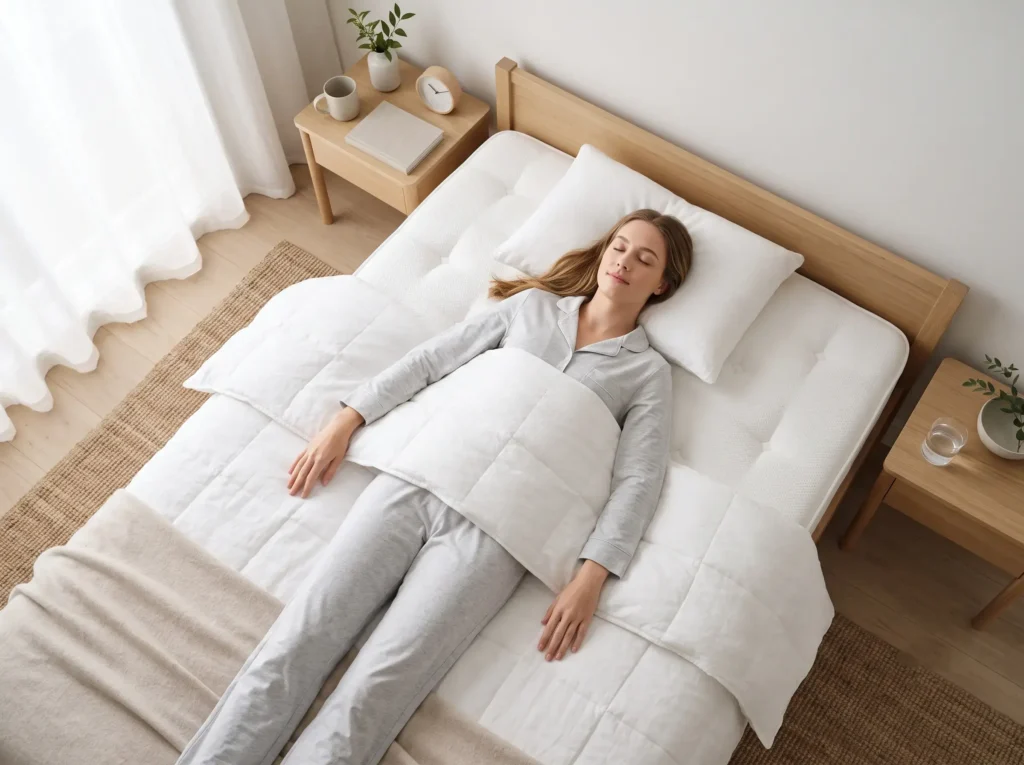
Lying on your back distributes your body weight evenly across the widest possible surface area, which means no single point — not your shoulder, not your hip, not the side of your skull — is bearing a disproportionate load for eight hours straight. It also reduces overactivity in the muscles surrounding your neck, since your head isn’t fighting gravity or a pillow to stay in one rotated position.
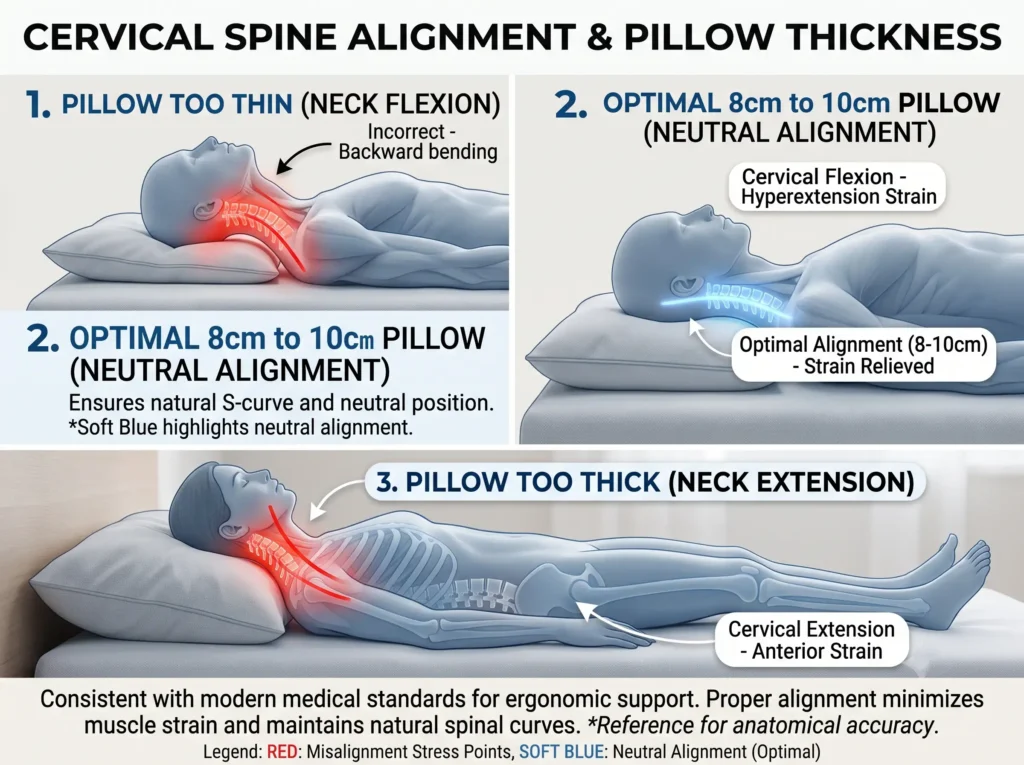
To get this right, the pillow has to do very specific work: it needs to fill the gap behind your neck without lifting your head so high that your chin tucks toward your chest, and without leaving it so low that your neck hyperextends backward. Your shoulders should rest flat on the mattress itself, not perched up on the pillow. If you find yourself stacking pillows to feel “supported,” that’s usually a sign the base pillow is the wrong height, not that you need more height.
For shoulder pain specifically — rotator cuff irritation, tendonitis, or general achiness — back sleeping with your arms resting comfortably at your sides keeps pressure off the joint entirely. If lying flat isn’t comfortable, the next best option is sleeping on the side opposite your sore shoulder, hugging a pillow to keep the affected shoulder rolled slightly forward.
This takes direct compression off the irritated tissue and allows normal blood flow through the joint, which matters more than people realize — sustained compression on an already inflamed shoulder overnight is a common reason morning stiffness feels worse than it did the night before.
If you’re a committed side sleeper and switching to your back isn’t realistic, side sleeping can still work for neck pain as long as the pillow is genuinely supportive — tall enough that your neck stays level with your spine rather than dipping toward the mattress.
How to Sleep With Forward Head Posture
Forward head posture — the slight forward jut of the chin that comes from hours hunched over a laptop or phone — doesn’t disappear just because you’ve laid down. If your daytime posture already pulls your head forward of your shoulders, a pillow that’s too thick will lock that same forward-head position in place all night, adding hours of sustained strain on top of what your neck already deals with during waking hours.
The fix starts with a lower-loft pillow when sleeping on your back — one that supports the natural curve of your neck without pushing your chin toward your chest. Some people with pronounced forward head posture find a small additional roll (a rolled hand towel or a thin cervical support) placed specifically under the neck, rather than the head, helps counteract the forward pull by gently encouraging the neck to sit back into its natural curve. It’s a small adjustment, but for people whose forward head posture is a daytime, desk-driven problem, undoing part of that pattern at night is one of the few interventions that works passively, without requiring any conscious effort.
Sleeping Position for Lower Back Pain Relief
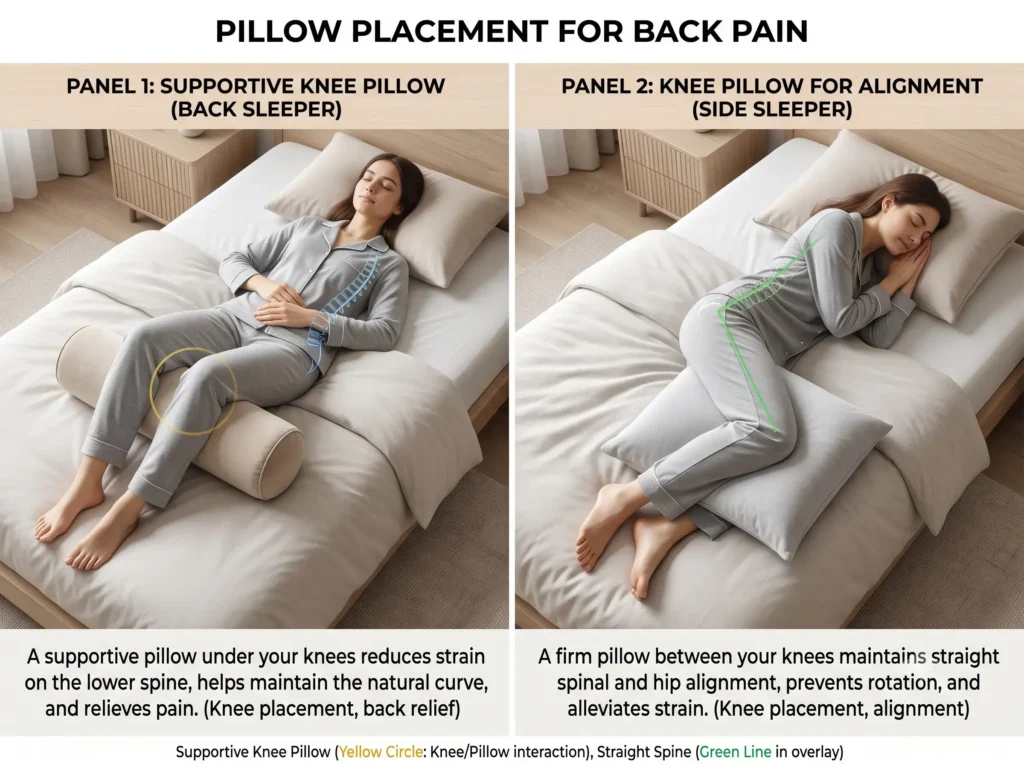
For lower back pain, the clearest research consensus points to sleeping on your back with a pillow under your knees. This keeps the pelvis in a neutral position and takes tension off the lower back muscles, which is why it shows up repeatedly across musculoskeletal research as the most favorable position for an aching back — a systematic review published in Musculoskeletal Care in 2025 specifically identified back sleeping with knee support as promoting proper spinal alignment and reducing low back pain.
If you’re a side sleeper, the equivalent move is a pillow between your knees. This keeps your hips, pelvis, and spine stacked in alignment rather than letting the top leg pull your lower spine into rotation — a subtle twist that, repeated every night for years, is a surprisingly common contributor to one-sided lower back tightness.
Stomach sleeping is where lower back pain tends to get worse, not better, because it forces the lumbar spine into extension and strains the surrounding muscles and joints. That said — and this is worth being honest about — plenty of people sleep on their stomach anyway, for reasons that have nothing to do with what’s “correct.” More on that below.
Sleeping Positions to Avoid for Spine Health
Not every position is created equal, and some deserve a clear warning label:
- Stomach sleeping with the head fully turned to one side twists the cervical spine into a rotation it never sits in during waking hours, straining the neck and putting pressure on nerves running through it.
- Back sleeping with an overly high or firm pillow hyperflexes the neck forward for hours, which research has directly linked to increased strain across the C2-7 vertebrae.
- Side sleeping without a knee pillow lets the top leg drop forward, rotating the pelvis and lower spine out of alignment.
- The “starfish” or fully sprawled position on your back, with limbs extended in every direction, tends to pull the shoulders and hips out of symmetrical alignment and can increase muscle activity rather than reduce it.
None of these positions are moral failures — they’re just patterns worth being aware of, especially if you’re already dealing with pain that isn’t improving.
Pillow Placement for Spine Alignment
Pillow placement is arguably more important than pillow brand, and it changes based on position:
Pillow under knees for back sleepers. This single adjustment reduces the load on the lumbar spine by taking up the natural gap that forms between your lower back and the mattress, letting your pelvis rest in a neutral tilt rather than one that’s subtly arched.
Pillow between knees for side sleepers. This keeps your top hip from rotating forward and dragging your spine out of its straight line from shoulder to hip. A pillow with some loft and a bit of firmness works better here than a soft, collapsing one, since it needs to actually hold the gap open rather than flatten under the weight of your leg.
Pillow under the hips for stomach sleepers. If stomach sleeping is non-negotiable for you, a thin pillow under the hips and lower stomach helps level out the exaggerated arch that stomach sleeping otherwise forces into the lower back.
A pillow that fills the gap, not one that closes it entirely. The general principle across every position is the same: your ears, shoulders, and hips should form as straight a line as possible, parallel to the mattress. Wherever a gap naturally opens up between your body and the bed — behind the neck, under the waist, between the knees — that’s where a pillow belongs.
Best Pillow Height for Neck Alignment: What the Research Actually Shows
This is the part most sleep-advice articles skip entirely, mostly because the honest answer is more complicated than “get an 4-inch pillow.”
A comprehensive review of pillow-height studies spanning the last two decades found that researchers have tested everything from radiographic spine measurements to pressure-sensor mats to electromyographic (EMG) muscle activity, trying to pin down one universal “correct” height. The findings are genuinely useful, even without a single magic number:
- One study using X-ray imaging found that as pillow height increased from flat to 20 cm, the angle of the neck and upper spine progressively changed — too high pushed the cervical spine into forward flexion, while too low let it drift backward — and identified roughly 10 cm as a reasonable middle ground for maintaining the neck’s natural curve while lying on the back.
- A separate study measuring pressure across the head and neck at four different pillow heights found that raising pillow height significantly increased both average and peak pressure in the cranial and cervical regions — meaning taller isn’t automatically better, since excess pressure can affect circulation and comfort even while technically “supporting” the neck.
- A third study focused specifically on EMG activity in the neck and upper back found that a pillow height around 10 cm produced the lowest muscle activity and highest comfort ratings, while both a much shorter (5 cm) and a taller (14 cm) pillow increased muscle strain.
- Other research measuring comfort in a group of women in their fifties found 7 cm to be the most comfortable height for back sleeping specifically — a reminder that age, body size, and individual anatomy shift the ideal range.
The honest takeaway, straight from that body of research: there’s no single pillow height that works for everyone, because body dimensions, sleep position, and even age change what “neutral” looks like for your particular neck. What does hold up consistently is the direction of the effect — pillows that are too tall push the neck into flexion and increase pressure and muscle activity, and pillows that are too flat let it drift into extension. The right height sits somewhere in the middle, and for most adults sleeping on their back, that tends to land in the 7–10 cm range, with side sleepers generally needing a noticeably taller pillow to bridge the wider gap between the ear and the mattress.
Cervical Pillow vs. Normal Pillow for Posture
A standard pillow is built for comfort first — soft, compressible, and shaped the same from edge to edge. A cervical pillow is built around a specific job: holding the neck’s natural curve without collapsing under the weight of the head.
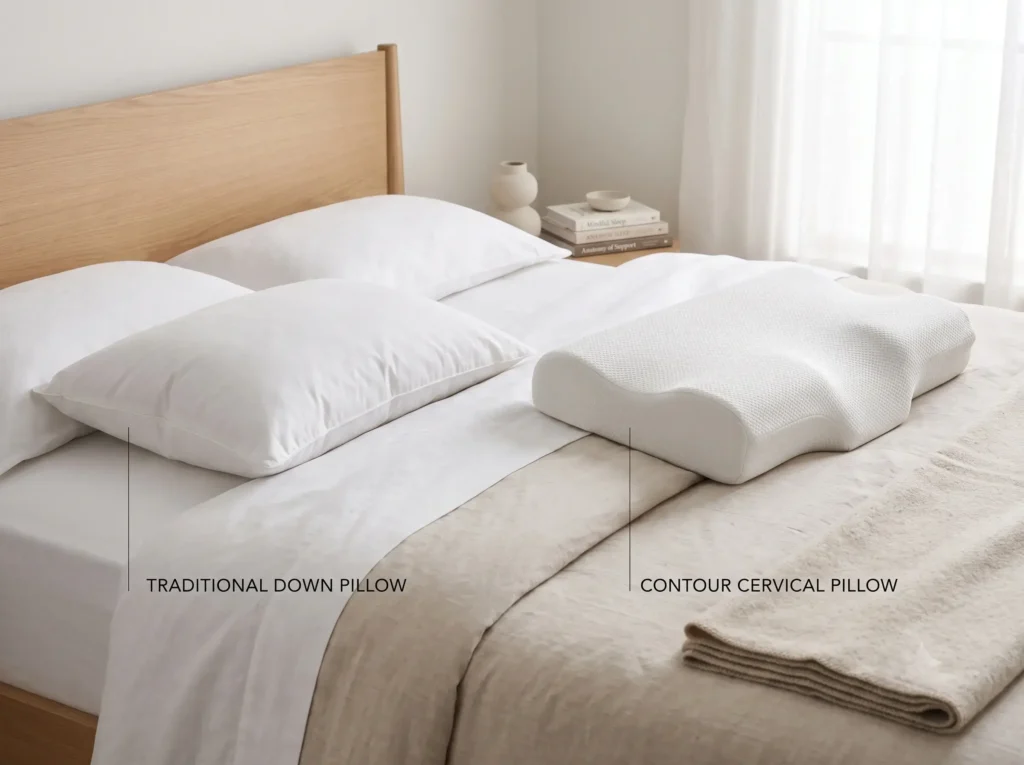
The difference shows up in the contouring. A cervical pillow typically has a raised ridge or wave-shaped support that sits directly under the neck, with a slight depression where the back of the head rests — so the head is cradled in the center while the neck gets extra lift. A flat, uncontoured pillow, by contrast, tends to support the head and neck at the same height, which sounds fine in theory but leaves the neck without the extra support it actually needs to stay in its natural forward curve.
That said, cervical pillows aren’t automatically superior for everyone. Research comparing anthropometric measurements — neck length, neck width, body mass index — against pillow height preference has found no strong, consistent correlation, meaning body dimensions alone don’t reliably predict which pillow shape a given person will find most comfortable or most effective. In practice, this means the “best” pillow is the one that keeps your specific neck in a neutral line when you check it in the mirror or take a phone photo of your side profile at night — not necessarily the one with the most orthopedic marketing on the box.
For side sleepers dealing with persistent stiffness, a firmer, higher-loft pillow (cervical or otherwise) that doesn’t compress flat under the weight of the head tends to outperform a soft, sinking one, simply because it holds the necessary height throughout the night instead of flattening by 2 a.m.
When “Correct” Posture Isn’t What Actually Gets You to Sleep
Here’s where most sleep-posture guides oversell the idea that there’s one right answer for everyone, and it’s worth pushing back on that a little.
I heard from someone — we’ll call him Jason — who put it plainly: he can technically fall asleep on his back, but it takes real effort and comes with a nagging sense of vertigo. Side sleeping doesn’t cause pain, but it takes him longer to drift off. Stomach sleeping, on the other hand, is the position that actually works — he described it as feeling less exposed, curled in rather than laid open to the world. He’s not fully flat on his stomach either; he tends to bend one leg up toward the knee on the same side as his head, which tilts his torso maybe five to eight degrees off the mattress and reduces how far he actually has to rotate his neck compared to lying dead flat. His own assessment was refreshingly clear-eyed: it’s not the “best” position by the textbook, but after ten minutes of tossing on his back, he’s asleep within twenty seconds on his stomach — and he’d rather not torture himself chasing an ideal that isn’t working for his body.
That’s a genuinely useful data point, not a contradiction of everything above. The research on stomach sleeping and cervical rotation is clear about the mechanical downside — sustained neck rotation for hours does add strain. But sleep itself is not optional, and a “correct” position that keeps someone awake and anxious for twenty extra minutes a night, every night, has its own cost. The practical middle ground researchers and clinicians tend to land on is harm reduction: if stomach sleeping is what actually gets you to sleep, small adjustments — an ultra-thin pillow or no pillow at all, a slight hip tilt like the one Jason described, or a thin pillow under the pelvis to reduce lower back arching — meaningfully soften the mechanical downsides without asking someone to fight their own nervous system every night.
The same principle Jason raised about chiropractic care applies almost word for word to sleep posture advice: be skeptical of anyone selling an absolute. A reasonable chiropractor, in his description, doesn’t manufacture fear around normal findings, doesn’t push treatment plans stretching for months without reassessment, and doesn’t treat areas that aren’t actually causing symptoms. Outsized claims — miracle cures, warnings about vague “toxins,” guarantees that don’t hold up to scrutiny — are a signal to look elsewhere. Sleep posture deserves the same evidence-based skepticism. The research points toward general directions that hold up across studies — back sleeping tends to be gentler on the spine than stomach sleeping, moderate pillow heights beat extremes, knee and between-knee pillows measurably reduce strain — but none of it is an absolute rule that overrides what actually lets a specific person sleep.
Making the Switch Without Making It Worse
If you’re moving away from a habitual position toward something more spine-friendly, expect an adjustment period. Sleep researchers who’ve studied position changes note that people naturally shift position roughly two dozen times a night, often reverting to old habits mid-sleep even when they consciously start in a better position. One small study following older adults with back pain found that people who successfully modified their sleep position saw noticeable pain relief within about four weeks — a timeline worth knowing going in, so you don’t give up after three uncomfortable nights.
A few practical notes for the transition:
- Change one variable at a time — pillow height, then pillow placement, then position — rather than overhauling everything on the same night.
- Use extra pillows liberally during the adjustment period to prop your body into the new position; you can taper off as it becomes more natural.
- Expect to wake up back in your old position sometimes. That’s normal, not a sign the new position “doesn’t work.”
- If pain persists or worsens over several weeks despite consistent changes to your sleep setup, that’s a signal worth bringing to a physical therapist or chiropractor rather than continuing to troubleshoot pillows on your own.
The Bottom Line
There’s no single sleeping position that’s mechanically perfect for every spine, but there is a clear, research-backed hierarchy: back sleeping with a pillow under the knees generally protects the lower back best; side sleeping with a pillow between the knees keeps the hips and spine aligned; and stomach sleeping, while the least favorable for the neck and lower back, isn’t an unforgivable habit if a few adjustments — hip tilt, minimal pillow, hip support — soften its impact.
Pillow height matters more than most people think, and the sweet spot generally sits in a moderate range rather than either extreme, though your ideal number depends on your body and your position. What matters most is paying attention to the actual signal your body gives you — morning stiffness, tingling, a neck that won’t turn — and treating that as useful information rather than something to sleep through. If a few weeks of consistent changes don’t move the needle, that’s the point to get a professional assessment rather than keep guessing.
This article is for informational and educational purposes only and is not a substitute for professional medical advice, diagnosis, or treatment. Always consult your doctor or a qualified health provider before starting any new diet, exercise, or wellness routine.
Frequently Asked Questions (FAQs) :
Q1 . What is the healthiest sleeping position for your spine?
Back sleeping with a pillow under the knees is generally the best sleeping position for spine alignment, since it distributes body weight evenly and keeps the pelvis in a neutral tilt. If side sleeping is your default, adding a pillow between the knees keeps the hips, pelvis, and spine stacked correctly. Stomach sleeping ranks lowest for spinal health but isn’t unmanageable with the right adjustments.
Q2 . Why does my back hurt after sleeping on my side?
Side sleeping without a pillow between the knees lets your top leg drop forward, rotating the pelvis and pulling the lower spine out of alignment. Repeated night after night, this subtle twist is a common contributor to one-sided lower back tightness. A firm pillow held between the knees keeps the hips level and prevents this rotation.
Q3 . Can bad sleeping posture cause neck pain?
Yes — a poorly positioned head or neck disrupts the balance between your vertebrae, ligaments, and muscles that normally hold the neck’s natural curve. Over time, this shows up as stiffness, numbness, headaches, or dizziness during the day. Positions like stomach sleeping with the head turned fully to one side, or back sleeping with too-high a pillow, are the biggest culprits.
Q4 . How to train yourself to sleep on your back?
Make the switch gradually — change one variable at a time, such as pillow height first, then placement, rather than overhauling everything in one night. Use extra pillows liberally at first to prop your body into the new position, and expect to wake up back in your old habit occasionally, since that’s normal during the adjustment period. Give it time: one study found people who stuck with a modified sleep position saw noticeable pain relief within about four weeks.

Nova
Health & Neuroscience Writer
Nova simplifies complex sleep architecture, circadian biology, and hormonal mechanics into actionable daily guides.
More in Sleep Science

8 Powerful Ways to Increase REM Sleep (Stop Waking Up Tired)
Sleeping 8 hours but still exhausted? Discover 8 science-backed ways to increase…
Stop Waking Up Exhausted: 7 Proven Ways to Increase Deep Sleep and REM Sleep Naturally
Sleeping 8 hours but still waking up tired? Discover science-backed habits, foods,…

5 Shocking Mouth Taping for Sleep Mistakes That Can Ruin Your Health
Discover the real benefits, hidden risks, and safety steps of mouth taping…

5 Hidden Tricks: How to Fall Asleep Fast Military Method Really Works!
It's 1 a.m. You have to be up in five hours. Your…

Why You Wake Up at 3AM After Drinking: 3 Shocking Reasons (And the Fix)
Wondering why you wake up at 3am after drinking? Discover the science…

5 Proven Tips for the Best Sleep Schedule for Night Shift Workers
Stop staring at the ceiling! Discover 5 vital strategies to build the…

5 Shocking Secrets to Reset Circadian Rhythm Naturally (No All-Nighters)
Struggling with late bedtimes? Learn 5 proven steps to reset circadian rhythm…

Constantly Wake Up at 3 AM to Pee? Here Are 3 Fixes That Actually Work
Stop the frustrating cycle of wake up at 3 AM to pee.…