
Dr. Amelia
Sleep Specialist & Medical Reviewer • 12+ Years Exp in Behavioral Sleep Medicine
You slept eight hours. You still feel like you got hit by a truck.
That gap between time in bed and feeling rested comes down to one thing: sleep architecture. Specifically, whether you’re getting enough deep sleep and REM sleep, the two stages that actually repair your body and sharpen your mind. Most people chasing better rest are optimizing the wrong number. They’re counting hours instead of counting quality.
This guide breaks down exactly how to increase deep sleep and REM sleep naturally, without prescription sleep aids, using strategies backed by sleep science rather than wellness trends.
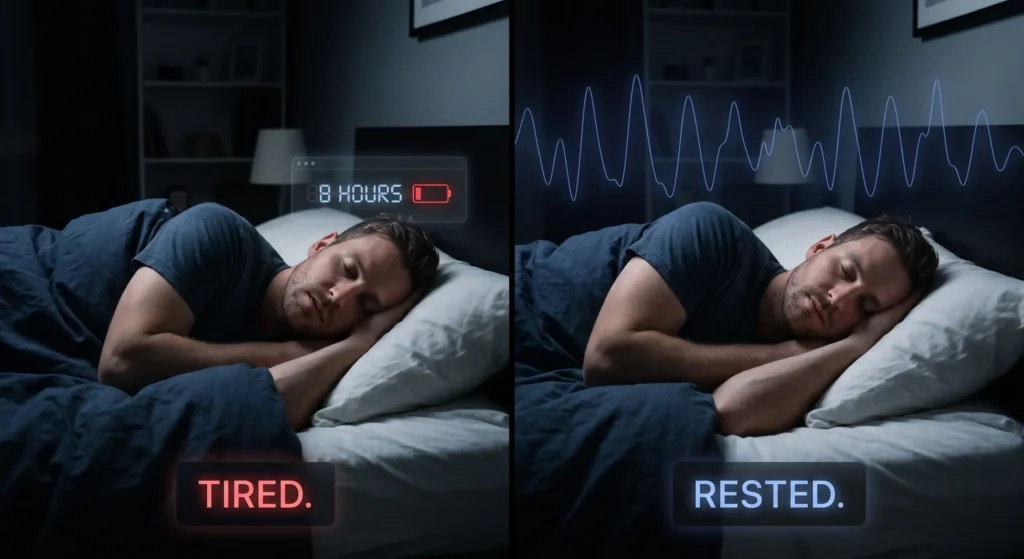
Table of Contents
Why Deep Sleep and REM Sleep Aren’t the Same Thing
Every night, your brain cycles through four to six sleep cycles, each lasting roughly 90 minutes. Inside each cycle are distinct stages, and they don’t do the same job.
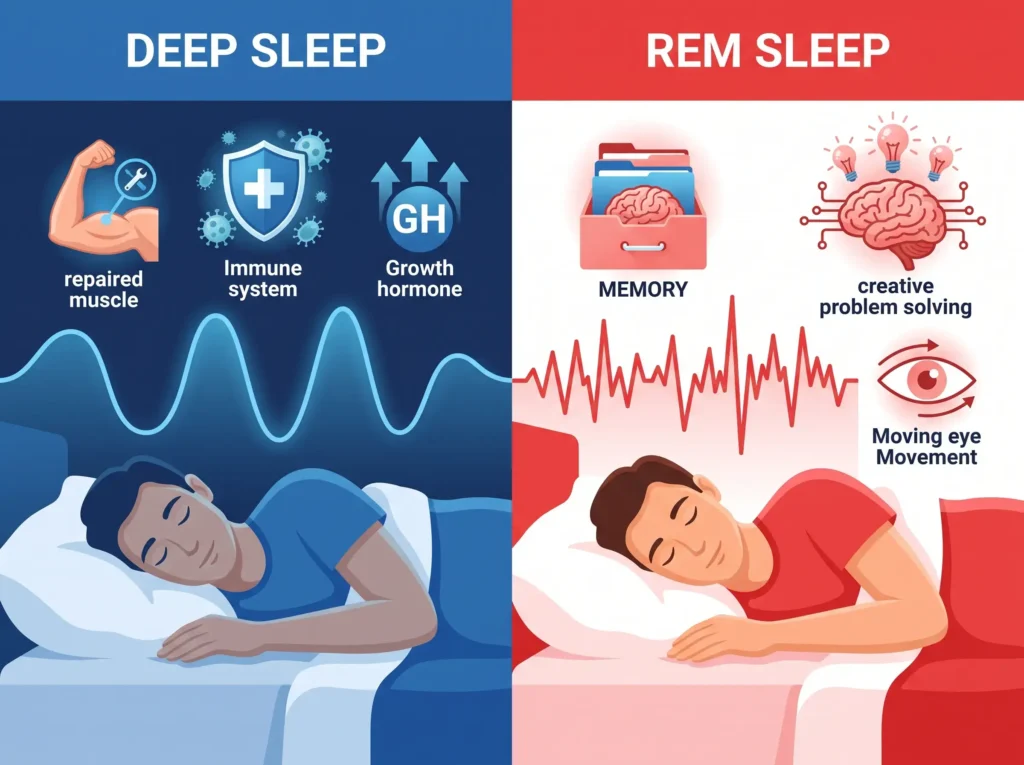
Deep sleep (also called slow-wave sleep) dominates the first half of the night. Your brain waves slow to a deliberate delta rhythm. Your body temperature drops. Growth hormone releases. Tissue repairs. This is where physical recovery happens — muscle repair, immune reinforcement, and glucose regulation all lean heavily on this stage.
REM sleep takes over more in the second half of the night, with each REM window stretching longer as morning approaches. Your eyes dart beneath closed lids. Your breathing turns irregular. Your brain, paradoxically, becomes almost as active as when you’re awake. This is where memory consolidation, emotional processing, and creative problem-solving happen.
Skimp on sleep by cutting it short at either end, and you shortchange one stage disproportionately. Go to bed late and wake up early? You’re stealing from REM. Fall asleep late and get interrupted early in the night? Deep sleep takes the hit.
Total sleep time matters less than what your brain does during that time. Deep sleep repairs your body. REM sleep processes your emotions and memories. You need both, and most modern habits quietly sabotage them.
Why This Actually Matters for Your Health
Poor sleep quality isn’t just a next-day inconvenience. Research has linked insufficient sleep to measurable declines in cognitive function, mood regulation, cardiovascular health, and immune response, along with higher risk of obesity and type 2 diabetes.
Deep sleep specifically supports:
- Physical recovery and muscle repair
- Metabolic and blood sugar regulation
- Immune system function
REM sleep specifically supports:
- Memory consolidation and learning
- Emotional regulation
- Creative and abstract thinking
Neither stage substitutes for the other. A person who sleeps nine hours but barely dips into deep sleep will still wake up groggy. A person who gets plenty of deep sleep but skips REM will feel physically fine but mentally foggy and emotionally flat.
Natural Ways to Increase Slow-Wave Sleep
If your goal is more restorative sleep at night, deep sleep is where to start. Here’s what actually moves the needle, based on current research.
1. Time Your Workouts Correctly
Physical activity is one of the most consistently supported natural ways to increase slow-wave sleep. Regular aerobic exercise increases the proportion of deep sleep you get, likely by raising the body’s need for physical recovery.
Timing matters more than most people realize. Exercise raises core body temperature and releases endorphins that keep you alert. Do it too close to bedtime, and you delay sleep onset instead of improving it. As a general rule, finish workouts at least four to six hours before you plan to sleep.
2. Cool Your Bedroom Down
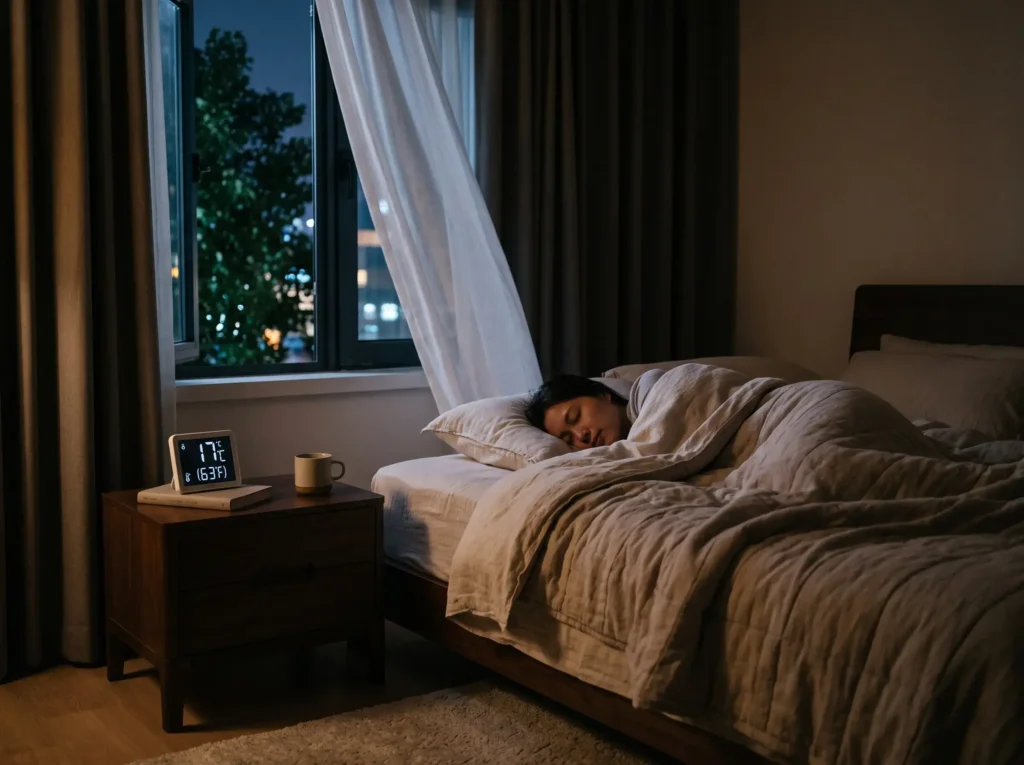
Room temperature affects deep and REM sleep more directly than most people account for. Your body needs to drop its internal temperature by roughly 1–2°F to initiate and sustain deep sleep. A hot bedroom fights that process.
Guidance from the NHS on sleep and tiredness points to a cool, quiet, and dark room as one of the foundational conditions for consistent, high-quality sleep. Most sleep researchers put the ideal range between 60–67°F (16–19°C), though personal tolerance varies.
3. Build a Genuine Wind-Down Routine
Cortisol and adrenaline don’t switch off the moment your head hits the pillow. If your nervous system is still in “alert” mode, your brain will struggle to drop into slow-wave sleep even if you technically fall asleep on time.
A real wind-down routine — not just turning off the lights — signals to your body that the day is over. This is less about any single trick and more about repetition. The same sequence, night after night, becomes a cue your nervous system learns to trust.

One example that illustrates this well: Jenni, who restructured her entire evening around protecting deep sleep, describes her routine like this — exercise wraps up at least six hours before bed, and she stops eating four hours out. An hour before sleep, she runs through the same sequence every night: brushing her teeth, washing her face, stretching, then either meditating or reading. Her lighting shifts too — a dim red light strip replaces overhead lighting, her phone goes into red-shift mode and gets dimmed, and every other screen goes off. By the time she’s actually in bed, the room is cooled down, blacked out, and she’s propped up with extra pillows to get properly comfortable. It’s not a dramatic overhaul. It’s a sequence she repeats without having to think about it, which is exactly why it works.
That’s the pattern worth copying: consistency over intensity.
4. Fiber-Forward Eating
Diet influences sleep architecture more than most people expect. Diets higher in fiber — vegetables, whole grains, legumes — have been associated with more time spent in slow-wave sleep, likely tied to more stable overnight blood sugar levels. Refined carbohydrates and sugar spikes do the opposite, fragmenting sleep and pulling you out of deep stages.
5. Rule Out Sleep Apnea
If you’re doing everything right and still waking up exhausted, it’s worth ruling out an underlying disorder. Sleep apnea repeatedly interrupts deep sleep as the body struggles to breathe, often without the person fully waking up or remembering it. Loud snoring, gasping, or a partner reporting pauses in your breathing are signals worth raising with a doctor.
How to Naturally Trigger REM Sleep
REM sleep behaves differently than deep sleep — it responds more to stress levels, sleep timing, and substances than to temperature or exercise. Here’s how to naturally trigger REM sleep and protect it once it starts.
1. Protect the Second Half of the Night
Because REM periods lengthen as the night goes on, cutting your sleep short at the back end — an early alarm, a late bedtime — disproportionately robs you of REM. If you consistently wake up before your body is ready, you’re very likely under-getting this stage regardless of total hours logged.
2. Manage Stress Before Bed, Not Just Sleep Habits
REM sleep is exceptionally sensitive to a stressed, hyperaroused nervous system. When cortisol stays elevated into the evening, REM gets suppressed even if you technically fall asleep. Breathing exercises, guided meditation, or simply journaling out the day’s mental clutter can lower that arousal enough to let REM proceed normally.
3. Be Careful With Alcohol
Alcohol is one of the most underestimated REM disruptors. It might help you fall asleep faster, but it suppresses REM sleep in the first half of the night and can trigger REM rebound with vivid, fragmented dreaming later — which usually means waking up more, not less. If you’re serious about optimizing REM, this is often the single highest-leverage habit to change.
4. Watch Medication and Substance Timing
Certain medications, along with caffeine taken later in the day, can suppress REM sleep for hours after consumption. According to research reviewed and indexed on PubMed, late-day caffeine intake measurably reduces total sleep time and sleep efficiency, with downstream effects on both REM and deep sleep proportions. If you’re a regular afternoon-coffee drinker and struggling with sleep quality, this is worth testing first.

Natural Supplements to Increase REM Sleep
Supplements aren’t a substitute for the fundamentals above, but a few have reasonable evidence behind them when combined with good sleep hygiene.
| Supplement | Primary Effect | What to Know |
|---|---|---|
| Melatonin | Shortens time to fall asleep | Effects on REM specifically are modest; timing (1–2 hours before bed) matters more than dose |
| Magnesium | Supports nervous system relaxation | May help with sleep onset and reducing nighttime waking |
| Glycine | Linked to improved sleep quality in some studies | Often taken in small doses before bed |
| L-theanine | Reduces pre-sleep anxiety | Non-sedating; works by lowering arousal rather than inducing sleep directly |
Melatonin is not classified as a drug by the FDA, which means dosage and purity can vary meaningfully between manufacturers. If you choose to use it, stick with one trusted brand and start at the lowest effective dose. Always check with a healthcare provider before starting any supplement, particularly if you’re on other medications or managing an existing health condition.
Foods That Increase Deep and REM Sleep
What you eat during the day quietly shapes what happens to your brain at night. A few categories worth prioritizing:
- Tryptophan-rich foods — turkey, eggs, dairy, and nuts support serotonin and melatonin production
- Magnesium-rich foods — leafy greens, almonds, and bananas support nervous system relaxation
- Complex carbohydrates — oats and whole grains support tryptophan uptake into the brain
- Tart cherries — one of the few natural food sources containing measurable melatonin
On the flip side, heavy, fatty, or spicy meals close to bedtime force your digestive system to work overtime, which fragments both deep and REM stages. Finishing your last real meal three to four hours before bed gives your body room to actually rest instead of digest.
Best Evening Routine for Deep Sleep: A Sample Framework
Pulling the science together, here’s what a research-aligned evening might look like:
- 4–6 hours before bed: Finish any intense exercise
- 3–4 hours before bed: Eat your last full meal
- 2 hours before bed: Cut caffeine entirely (if you haven’t already earlier in the day)
- 1 hour before bed: Begin a fixed wind-down sequence — dim lighting, screens off or shifted to red light, hygiene routine, then a calming activity like reading or meditation
- 30 minutes before bed: Lower the room temperature, close blackout curtains, get physically comfortable
- In bed: No screens, dark room, consistent sleep and wake time — even on weekends
The specifics can flex to fit your life. The structure shouldn’t.
Deep Sleep vs. Light Sleep Tracker Score: What the Numbers Actually Mean
If you’re using a wearable, you’ve probably seen a breakdown of deep sleep, light sleep, and REM as percentages. For context, deep sleep typically makes up roughly 13–23% of total sleep in healthy adults, while REM sits around 20–25%. Light sleep fills most of the remainder.
A few things worth knowing before you obsess over the exact numbers:
- Consumer trackers estimate, they don’t measure directly. Unlike a clinical polysomnography study, wrist- or ring-based trackers infer sleep stage from movement and heart rate variability, not brain waves. Treat the numbers as directional trends, not lab-grade data.
- Night-to-night variation is normal. A single low deep-sleep night usually reflects one bad day — poor timing of a meal, a stressful evening, alcohol — not a chronic problem.
- Trends over weeks matter more than any single reading. If your deep sleep percentage is consistently trending downward over two or three weeks, that’s a more meaningful signal than one off night.
How to Optimize REM Sleep for Memory
If your primary goal is cognitive — studying, learning a new skill, creative work — REM sleep is your priority stage, since this is where the brain consolidates new information into long-term memory.
A few specific levers for memory-focused sleep optimization:
- Sleep on it, literally. Studying or practicing a skill in the hours before bed, then getting a full, uninterrupted night, measurably improves next-day recall compared to studying and staying up.
- Protect your full sleep window. Since REM concentrates in the later cycles, cutting sleep short by even 90 minutes can disproportionately cut memory-consolidation time.
- Avoid alcohol on nights before high-stakes recall. Given how directly alcohol suppresses REM, an exam or presentation the next day is exactly the wrong time for a nightcap.
When to See a Doctor
Most sleep-quality issues respond well to the natural strategies above. But persistent problems sometimes point to something that needs medical attention rather than a better bedtime routine. Consider talking to a healthcare provider if you experience:
- Loud snoring, gasping, or breathing pauses during sleep
- Chronic insomnia lasting more than a few weeks despite consistent sleep hygiene
- Excessive daytime sleepiness despite adequate time in bed
- Restless legs or involuntary movements that disrupt sleep
The NIH’s National Institute of Neurological Disorders and Stroke maintains detailed resources on diagnosable sleep disorders, and a sleep specialist can run studies that consumer trackers simply can’t replicate.
The Bottom Line
Getting more deep sleep and REM sleep naturally isn’t about a single supplement or hack. It’s the compounding effect of consistent timing, a cooled and dark bedroom, a genuine wind-down routine, and paying attention to what you eat and drink in the hours before bed.
Start with one or two changes — maybe shifting your last meal earlier, or building a real wind-down sequence like Jenni’s — rather than overhauling everything overnight. Sleep architecture responds to consistency, not intensity. Give any single change two to three weeks before judging whether it’s working, and track trends rather than single nights.
The goal was never just more hours of sleep. It’s giving your brain and body the specific stages they need to actually repair, remember, and reset.
This article is for informational and educational purposes only and is not a substitute for professional medical advice, diagnosis, or treatment. Always consult your doctor or a qualified health provider before starting any new diet, exercise, or wellness routine.
Frequently Asked Questions (FAQs):
Q1. How much deep and REM sleep do adults need?
Deep sleep typically makes up roughly 13–23% of total sleep in healthy adults, while REM sleep sits around 20–25%. Consumer sleep trackers estimate these percentages from movement and heart rate rather than measuring brain waves directly, so treat the numbers as directional trends. Consistently low readings over several weeks — not one off night — is what actually signals a problem worth fixing.
Q2. Why am I not getting enough REM sleep?
REM sleep is highly sensitive to stress, alcohol, late-day caffeine, and cutting sleep short at the back end of the night, since REM periods lengthen closer to morning. An early alarm or late bedtime disproportionately steals from this stage, and an elevated cortisol level in the evening can suppress it even if you fall asleep on time. Alcohol is one of the most underestimated disruptors — it can trigger REM rebound with fragmented, restless sleep later in the night.
Q3. How do I fix a low deep sleep score?
Start with the fundamentals that naturally trigger slow-wave sleep: finish exercise 4–6 hours before bed, cool your bedroom to 60–67°F, and build a consistent one-hour wind-down routine with dimmed lighting. Since trackers only estimate deep sleep, focus on the weekly trend rather than a single low night, and rule out sleep apnea with a doctor if fatigue persists despite good sleep hygiene.
Q4. What vitamin helps REM sleep?
Vitamin B6 is the vitamin most directly linked to REM sleep, supporting the production of serotonin and melatonin and showing an association with improved dream recall in clinical research indexed on PubMed. This isn’t covered in depth in the natural-supplements section above, which focuses on melatonin, magnesium, glycine, and L-theanine — so treat B6 as an additional option and check with a healthcare provider before adding any new supplement.
Q5. What causes poor deep sleep?
Poor deep sleep is usually caused by exercising too close to bedtime, a bedroom that’s too warm, an inconsistent wind-down routine, and a diet heavy in refined carbohydrates instead of fiber. Undiagnosed sleep apnea is another common culprit, repeatedly pulling the body out of slow-wave sleep as it struggles to breathe, often without the person waking up or remembering it.

Nova
Health & Neuroscience Writer
Nova simplifies complex sleep architecture, circadian biology, and hormonal mechanics into actionable daily guides.
More in Sleep Science

8 Powerful Ways to Increase REM Sleep (Stop Waking Up Tired)
Sleeping 8 hours but still exhausted? Discover 8 science-backed ways to increase…
How to Fix Sleeping Posture: 4 Proven Ways to Stop Morning Neck Pain
Learn how to fix sleeping posture with 4 research-backed rules. Discover the…

5 Shocking Mouth Taping for Sleep Mistakes That Can Ruin Your Health
Discover the real benefits, hidden risks, and safety steps of mouth taping…

5 Hidden Tricks: How to Fall Asleep Fast Military Method Really Works!
It's 1 a.m. You have to be up in five hours. Your…

Why You Wake Up at 3AM After Drinking: 3 Shocking Reasons (And the Fix)
Wondering why you wake up at 3am after drinking? Discover the science…

5 Proven Tips for the Best Sleep Schedule for Night Shift Workers
Stop staring at the ceiling! Discover 5 vital strategies to build the…

5 Shocking Secrets to Reset Circadian Rhythm Naturally (No All-Nighters)
Struggling with late bedtimes? Learn 5 proven steps to reset circadian rhythm…

Constantly Wake Up at 3 AM to Pee? Here Are 3 Fixes That Actually Work
Stop the frustrating cycle of wake up at 3 AM to pee.…