

Dr. Wilder
Neuroscientist & Clinical Consultant • 15+ Years Exp in Cognitive Health
If you live with fibromyalgia, you already know the frustrating part isn’t just the pain. It’s the unpredictability. One day your body cooperates. The next, a shower feels like a marathon. Somewhere along the way, many people with fibromyalgia start bracing for the next flare before it even arrives — and that bracing, it turns out, may be feeding the very pain it’s trying to protect against.
This is where somatic tracking for fibromyalgia enters the conversation. It’s not a stretch, a supplement, or a device. It’s a brain-based skill that teaches your nervous system to stop treating ordinary sensations like emergencies. For a condition rooted in how the brain and spinal cord process signals, that distinction matters enormously.

Table of Contents
What Somatic Tracking Actually Is
Somatic tracking is a mindfulness-rooted technique built around three moves: noticing a sensation without judgment, reminding your nervous system that the sensation isn’t dangerous, and holding that observation with a light, curious attitude instead of dread. It’s the centerpiece skill inside Pain Reprocessing Therapy (PRT), developed largely through the clinical work of therapist Alan Gordon.
Here’s the distinction that trips people up. Ordinary mindfulness asks you to simply observe and accept. Somatic tracking goes a step further — it actively feeds your brain a specific message: this is uncomfortable, not harmful. That second layer is what separates passive observation from active retraining.
For fibromyalgia specifically, this matters because the condition is widely understood as a disorder of central sensitization — the nervous system amplifying signals that wouldn’t normally register as painful at all. A light touch, mild pressure, even temperature shifts can get processed as threat. Somatic tracking targets that amplification directly, rather than chasing the sensation itself.
Fibromyalgia pain is real, but a significant portion of it is generated by an oversensitive alarm system in the brain — not ongoing tissue damage. Somatic tracking works directly on that alarm system.
Neuroplastic Pain and the Fibromyalgia Connection
To understand why this technique applies to fibromyalgia, it helps to understand neuroplastic pain fibromyalgia research, which describes pain generated primarily by the brain’s threat-detection circuitry rather than by damaged tissue. Unlike a broken bone or a torn ligament, fibromyalgia pain rarely shows up on imaging or bloodwork. That absence of a clear structural cause isn’t a mystery to dismiss — it’s a clinical clue pointing toward the nervous system itself.
Pain neuroscience treats the brain as a prediction engine, constantly forecasting danger based on past experience, mood, and context. In chronic pain conditions, that forecasting gets stuck in an overprotective loop. The brain predicts danger, amplifies the signal into pain, and the resulting fear makes the next prediction louder still. Fibromyalgia patients often describe this exact spiral: pain triggers fear of movement, fear of movement triggers guarding and inactivity, and inactivity often deepens the sensitivity over time.
Somatic tracking interrupts that loop at the fear stage. Instead of avoiding or fighting the sensation, you turn calm attention toward it while simultaneously telling your nervous system it’s safe. Over repeated practice, the brain updates its prediction. This is genuinely what researchers call the TMS fibromyalgia connection — TMS here referring to Tension Myositis Syndrome, an older term Dr. John Sarno used for pain generated by the mind’s attempt to distract from or suppress difficult emotion, a concept that predates but overlaps meaningfully with today’s neuroplastic pain framework.
What the Research Actually Shows
A 2022 randomized trial published in JAMA Psychiatry found that a majority of chronic back pain patients became pain-free or nearly pain-free after just four weeks of Pain Reprocessing Therapy centered on somatic tracking, with a five-year follow-up confirming the results held. That trial focused on back pain, not fibromyalgia specifically, and it’s worth being upfront about that — the evidence base for fibromyalgia is still catching up to what’s been shown for other chronic pain conditions.
But the underlying mechanism fibromyalgia research points toward the same direction. A supplementary analysis of baseline data from the Fibromyalgia Activity Study with TENS, involving 191 women with fibromyalgia, found that half the sample reported moderate to severe anxiety, depression, or both. Pain catastrophizing, fear of movement, and pain severity were all significantly associated with both anxiety and depression — while fatigue and sleep disturbance tracked more specifically with depression. That pattern matters here because pain catastrophizing and fear of movement are precisely the mechanisms somatic tracking is designed to interrupt. When distress and fear amplify pain perception, a technique built to defuse fear has a plausible route to genuine symptom relief, even without a fibromyalgia-specific trial to point to yet.
For general background on fibromyalgia diagnosis, symptom management, and current treatment guidance, the NHS overview of fibromyalgia is a solid, medically vetted starting point, and the National Institute of Neurological Disorders and Stroke at NIH maintains current research summaries on chronic pain and central sensitization mechanisms.
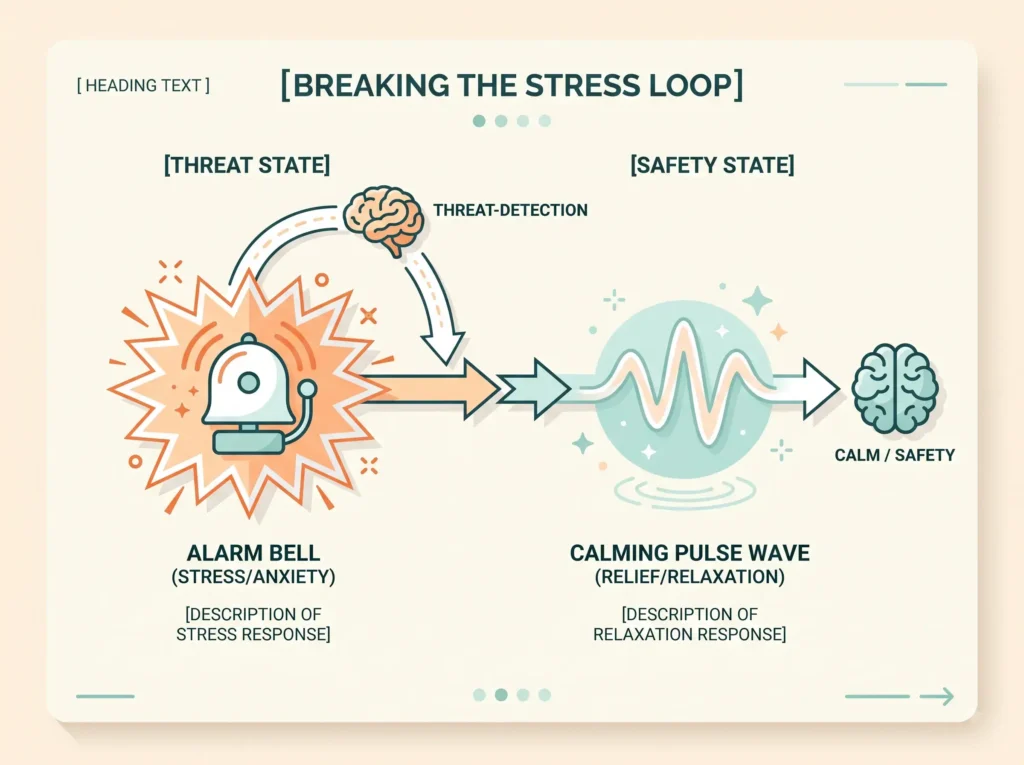
Calming Central Sensitization: Why the Brain Is the Entry Point
Central sensitization is the technical term for what fibromyalgia patients experience daily: a nervous system turned up too loud. Sound, light, touch, temperature, even emotional stress can all get processed with the volume dial stuck on high. Traditional pain treatment — medication, injections, physical therapy — targets the body. Calming central sensitization fibromyalgia protocols increasingly recognize that the dial itself lives in the brain and spinal cord, which is exactly the terrain somatic tracking operates in.
This doesn’t mean physical treatment is irrelevant. Movement, sleep hygiene, and medical management still matter enormously for fibromyalgia. But somatic tracking adds a layer those approaches don’t touch directly: retraining the brain’s threat interpretation, sensation by sensation, in real time.
How to Do Somatic Tracking During a Fibro Flare
This is often the exact moment people want to know about — not the calm Tuesday afternoon, but the 2 a.m. flare when everything aches and panic starts creeping in. Here’s a version of the practice built for that scenario.
Step 1: Check the intensity first. If your pain is sitting above roughly a 5 out of 10, this is not the moment to track it directly. Reach for comfort instead — warmth, a weighted blanket, slow breathing, gentle distraction. Somatic tracking works best on manageable pain; attempting it during a severe flare can accidentally teach your brain that observation makes things worse.
Step 2: Find one specific sensation. Fibromyalgia pain is often diffuse, which can feel overwhelming to track all at once. Narrow your focus to one area — your left shoulder, the base of your neck, wherever feels most present. Describe it in plain terms: throbbing, tight, buzzing, hot.
Step 3: Offer a safety message rooted in evidence. This step works best when it’s specific, not generic. If your bloodwork and imaging have come back clear, or your rheumatologist has confirmed there’s no active tissue damage, use that. Something like: “My labs are normal. This is my nervous system being overprotective, not my body being harmed.”
Step 4: Add lightness, not effort. Watch the sensation the way you’d watch clouds shift shape — with mild curiosity, not intensity. If it moves, changes, or fades even slightly, that variability is itself useful information: fixed tissue damage doesn’t behave that way.
Step 5: Widen out and release. After a few minutes, bring your attention to your whole body, including the parts that feel fine. Take a breath. End the session there, regardless of whether the sensation changed.
Two to three minutes, several times a day, tends to outperform one long session. Waiting rooms, commercial breaks, and the minutes before sleep are realistic slots to practice.
Somatic Exercises for Fibromyalgia Flare Ups: Where Movement Fits In
Somatic tracking is attention-based and requires no movement at all, but it pairs naturally with somatic exercises for fibromyalgia flare ups — gentle, body-awareness movement practices designed to release stored tension rather than build strength or endurance. Slow shoulder rolls, diaphragmatic breathing paired with subtle stretching, or short body-scan walks can complement tracking sessions on days when total stillness feels harder to access. Neither replaces the other; they operate on the same underlying premise that the nervous system responds to signals of safety, whether those signals come through attention or through movement.
Pain Reprocessing Therapy for Fibromyalgia: The Bigger Framework
Somatic tracking rarely stands alone in clinical settings. It’s typically one skill inside pain reprocessing therapy for fibromyalgia, a broader approach that also includes:
- Identifying and reframing the “story” a patient has built around their pain
- Building an evidence list of moments pain behaved inconsistently with structural damage
- Processing emotional material the nervous system may be suppressing through physical symptoms
- Gradual, fear-informed exposure to movements or activities that had been avoided
This last piece connects directly to something many fibromyalgia patients discover the hard way: emotional avoidance and physical guarding often travel together. Which brings up an experience worth sitting with honestly, rather than glossing over.
A Real Account Worth Reading Carefully
Roxan, who has lived with chronic fatigue syndrome for 25 years, started somatic work six months ago and describes herself as roughly 75% improved. Her account includes something clinicians in this space discuss often but rarely say plainly to patients: symptoms sometimes intensify before they ease. Her interpretation is that a flare during somatic work can signal that a stored pattern has been touched but not yet fully processed, and that consistency — showing up daily, even when it’s difficult — is what eventually allows a fuller release.
This is worth including not as a promise, but as an honest data point. Roxan describes the work as genuinely hard, done nearly every day, with results that built gradually rather than overnight. That combination — real effort, real time, partial and ongoing improvement — is a far more representative picture of somatic work than dramatic before-and-after claims tend to suggest. It’s also a useful caution: if symptoms spike during practice, that isn’t automatically a sign to quit, but it also isn’t something to push through recklessly without support. Working alongside a trained PRT therapist, especially when trauma may be involved, matters here.
What Somatic Tracking Cannot Do
Honesty about limits is part of what separates a credible resource from a sales pitch.
Somatic tracking does not address active infection, autoimmune flares requiring medical management, structural injury, or new and unexplained symptoms. Fibromyalgia itself should be diagnosed and monitored by a physician, and any new pain, fever, unexplained weight loss, or neurological symptom needs medical evaluation before being approached as neuroplastic. Somatic tracking is a tool for pain that has already been medically assessed and doesn’t have an ongoing structural driver — not a replacement for that assessment.
It also isn’t a fast fix. Roxan’s six months of near-daily practice for measurable but partial improvement reflects the realistic pace for most people, not the four-week trial results sometimes cited from back pain research.

Building a Sustainable Practice
A few patterns tend to separate people who stick with somatic tracking long enough to see change from those who abandon it early:
- Short sessions beat marathon ones. Two to three minutes, repeated often, teaches the nervous system more effectively than one long, effortful sitting.
- Tone matters more than words. A calm, matter-of-fact internal voice reassures the brain more than an enthusiastic pep talk.
- Evidence-based safety messages work better than generic ones. Grounding your safety statement in an actual clean scan, a doctor’s reassurance, or a documented pattern of inconsistent pain gives your brain something concrete to believe.
- Drop the outcome goal. Practicing specifically to make pain disappear sends a subtle message that pain is still an emergency. Curiosity without an agenda tends to work better than forced relief-seeking.
- Track flares differently than baseline days. The flare-specific steps outlined above exist because tracking high-intensity pain the same way you’d track mild discomfort can backfire.
Where This Fits Alongside Medical Care
None of this replaces the medical side of fibromyalgia management — appropriate diagnosis, monitoring for related conditions, and treatment of co-occurring anxiety or depression, which research shows affects roughly half of fibromyalgia patients to a significant degree. Somatic tracking works best as an addition to that care, not a substitute for it. If depression or anxiety are part of your picture, addressing them directly — through therapy, medical support, or both — often makes somatic work more accessible rather than less necessary.
For readers wanting to explore the clinical research base further, the PubMed database maintained by NIH’s National Library of Medicine indexes peer-reviewed studies on Pain Reprocessing Therapy and central sensitization for those who want to read primary sources rather than summaries.
The Bottom Line
Somatic tracking for fibromyalgia offers something most fibromyalgia treatments don’t: a direct way to work with the nervous system’s threat interpretation rather than only managing symptoms after they appear. It won’t erase every sensation, and it isn’t a substitute for medical evaluation or ongoing care. But for a condition where fear, guarding, and an oversensitive alarm system feed the pain cycle, teaching the brain a new, calmer response is a genuinely different angle — one grounded in both emerging clinical trial data and years of patient-reported experience like Roxan’s. Consistency, patience, and honest expectations are what make it work, not intensity or speed.
This article is for informational and educational purposes only and is not a substitute for professional medical advice, diagnosis, or treatment. Always consult your doctor or a qualified health provider before starting any new diet, exercise, or wellness routine.
Frequently Asked Questions (FAQs) :
Q1. Can somatic therapy help with fibromyalgia?
Yes — somatic tracking for fibromyalgia works by targeting central sensitization, the nervous system’s tendency to amplify ordinary sensations into pain. Since pain catastrophizing and fear of movement are strongly linked to both anxiety and depression in fibromyalgia patients, a technique built to reduce fear has a plausible path to real relief. It isn’t a replacement for medical care, but it adds a brain-based layer that traditional treatment doesn’t address directly.
Q2. Can stress trigger fibromyalgia?
Yes — stress is one of the most commonly reported triggers for both the onset of fibromyalgia and individual flare-ups. Emotional or physical stress activates the same nervous system pathways involved in central sensitization, which is exactly why calming central sensitization in fibromyalgia through techniques like somatic tracking can help break the stress-pain cycle. Practices like how to do somatic tracking during a fibro flare are specifically designed to interrupt this stress response in the moment.
Q3. What is the best pain relief for fibromyalgia?
There’s no single best treatment — current clinical guidance favors a combination approach, with exercise, psychological therapies (including pain reprocessing therapy for fibromyalgia), and select medications like duloxetine or pregabalin used together rather than any one fix alone. Non-drug approaches such as somatic tracking and somatic exercises for fibromyalgia flare ups are increasingly recommended alongside medical treatment, not instead of it. The right combination depends on individual symptoms and should be built with a doctor.
Q4. What types of exercise should people with fibromyalgia avoid?
High-impact and high-intensity activities — running, jumping, heavy weightlifting, and HIIT-style workouts — tend to strain the body and can trigger flares. Gentle, low-impact options like walking, swimming, tai chi, and light resistance work are generally better tolerated, and pairing these with somatic exercises for fibromyalgia flare ups can support movement without overloading a sensitized nervous system.
Q5. What vitamin deficiencies are linked to fibromyalgia?
Low vitamin D levels are the most consistently studied deficiency associated with fibromyalgia, with research linking it to greater pain sensitivity and symptom severity, though it’s unclear whether low vitamin D causes fibromyalgia or results from it. Magnesium and vitamin B12 deficiencies have also been studied in connection with fibromyalgia symptoms like stiffness and fatigue. Any suspected deficiency should be confirmed through bloodwork rather than assumed or self-treated.

Remi
Mental Health & Psychology Writer
Remi focuses on stress physiology, nervous system regulation, cognitive resilience, and mindfulness.
More in Mind & Nervous

7 Proven Polyvagal Exercises for Nervous System Regulation: End Chronic Panic & Feel Safe
Logic can't talk your body down from panic. Master 7 polyvagal exercises…

7 Secrets of Breathing Exercise for Vagus Nerve Stimulation to Stop Anxiety Fast
Struggling with stress? Discover 5 science-backed breathing exercise for vagus nerve stimulation…

1 Proven Way to Heal Chronic Pain: Somatic Tracking Alan Gordon Guide
Learn somatic tracking Alan Gordon techniques to retrain your brain's alarm system…

12 Powerful Somatic Exercises for Stress to Reset Your Nervous System
Feeling overwhelmed or physically tense? Discover 12 simple somatic exercises for stress…

7 Powerful Polyvagal Exercises to Heal Your Dysregulated Nervous System
Stuck in anxiety or shutdown? Learn how 7 powerful polyvagal exercises help…
7 Proven Ways How to Activate the Vagus Nerve for Rapid Stress Relief
Discover how to activate the vagus nerve naturally with science-backed habits. Improve…

Infrared Sauna vs Traditional Sauna: Don’t Waste 1 Minute on the Wrong Choice
Discover Infrared Sauna vs Traditional Sauna for muscle recovery and longevity. Compare…

8 Powerful Ways to Increase REM Sleep (Stop Waking Up Tired)
Sleeping 8 hours but still exhausted? Discover 8 science-backed ways to increase…