

Dr. Amelia
Sleep Specialist & Medical Reviewer • 12+ Years Exp in Behavioral Sleep Medicine
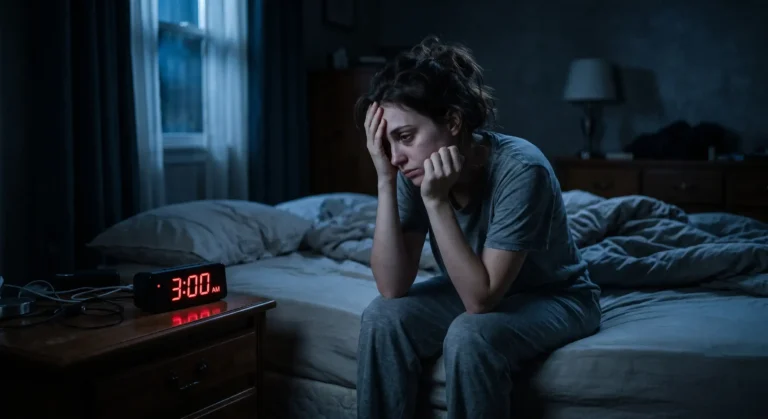
It’s 1 a.m. You have to be up in five hours. Your brain has picked this exact moment to replay a conversation from 2019.
If that sounds familiar, you’ve probably already searched how to fall asleep fast military method at least once during a bad night. It’s the internet’s favorite sleep hack for a reason — a technique built for fighter pilots who needed to sleep on command, in a chair, mid-mission, with adrenaline still running hot. Whether it can do the same for you, lying in a dark, quiet bedroom with nothing chasing you but your own thoughts, is a fair question. It’s also more complicated than the viral videos let on.
Here’s the real breakdown: what the method actually is, what it can and can’t do, and what to try if it doesn’t work for you on night one.

Table of Contents
How to Fall Asleep Fast Military Method: What It Actually Is
The military sleep method is a two-minute relaxation sequence that combines deep breathing, progressive muscle relaxation, and visualization into one routine. It comes from Lloyd Bud Winter’s 1981 book Relax and Win: Championship Performance, where he describes a technique developed for the U.S. Navy Pre-Flight School to help pilots fall asleep despite stress, noise, and sleep deprivation.
The claim that made it go viral: after six weeks of practice, 96% of pilots could reportedly fall asleep within two minutes — sitting upright, with recorded gunfire playing, after drinking coffee.
That statistic gets repeated everywhere. What gets left out is that it comes from a decades-old training anecdote, not a peer-reviewed trial. No controlled study has tested the military method as a standalone protocol. What has been studied, extensively, are the individual pieces it’s built from — and that’s where the science actually holds up.
The Military Method, Step by Step
Lie down, get comfortable, and work through the sequence in order. Don’t rush it.
- Relax your face. Close your eyes. Breathe slowly and deeply. Soften your forehead, then your eyebrows, cheeks, jaw, and tongue. Let your eyes go still.
- Drop your shoulders and arms. Release your neck and traps. Let your shoulders sink. Move down one arm at a time — bicep, forearm, hand, fingers — then repeat on the other side.
- Exhale and relax your chest. With your upper body already loose, this step should come easily. Let your breathing settle into a slow rhythm.
- Relax your legs. Start with one thigh, then calf, ankle, and foot. Repeat on the other leg. Imagine your whole body sinking into the mattress.
- Clear your mind for 10 seconds. Picture something calm and specific — a canoe drifting on still water, a hammock swaying in a quiet room. If your thoughts wander, gently pull them back to the image.
- If visualization doesn’t work, say “don’t think” on repeat for 10 seconds. It sounds strange, but it gives your brain something neutral to chew on instead of your to-do list.
➟ Why You Wake Up at 3AM After Drinking: 3 Shocking Reasons (And the Fix)
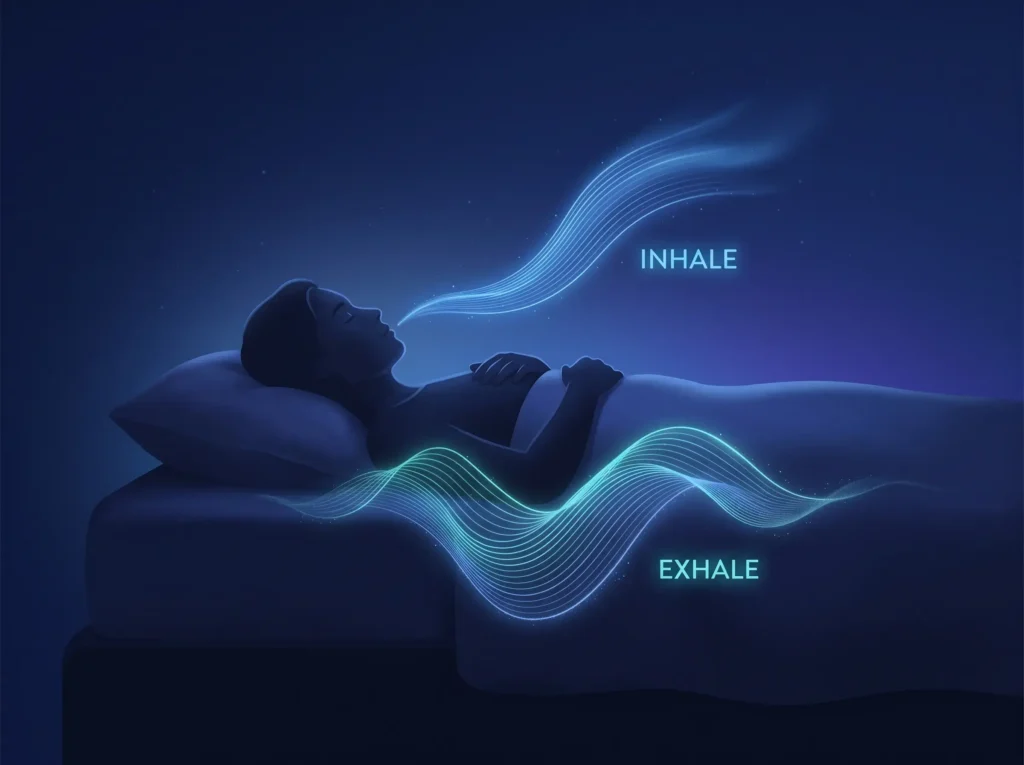
Do Navy SEALs Really Use This?
This is where the popular version of the story gets shaky. The technique is tied to Navy pilots, not SEALs, and even that origin is difficult to verify independently — Winter’s book is the primary source, and no military training documentation has been made public to confirm it. Treat the SEAL and elite-operator framing as internet folklore layered onto a real, older technique, not a verified fact.
Does the Military Sleep Method Actually Work?
Here’s the honest answer: the components are legitimate, the two-minute promise is the marketing.
- Deep breathing slows your heart rate and shifts your body out of fight-or-flight mode and into the parasympathetic “rest and digest” state. A 2021 diaphragmatic breathing study on PubMed found this kind of slow breathing training measurably improved sleep quality in a group of frontline hospital staff under heavy stress.
- Progressive muscle relaxation — tensing then releasing muscle groups, or simply releasing them as the military method does — has repeatedly been shown to reduce insomnia symptoms, including in a controlled trial published on PubMed Central that tracked sleep quality before and after a course of PMR sessions.
- Visualization gives your brain a low-stimulation focal point, which crowds out the racing, anxious thoughts that usually keep people awake.
The military method isn't a magic trick. It's three well-established relaxation techniques packaged into one routine — and like any of them, it works better with repetition than with desperation.
What the two-minute claim ignores is your sleep drive and circadian rhythm — the two biological forces that actually determine whether you’re ready to sleep, regardless of how relaxed your jaw is. A perfectly relaxed body that isn’t sleepy yet still won’t fall asleep on command. That’s not a failure of the technique; it’s basic sleep physiology.
Real Talk: What This Technique Actually Feels Like
Mike, who’s spent months practicing the method, put it plainly: it’s essentially a stripped-down version of yoga nidra — a progressive body scan paired with deep breathing that guides you toward deep sleep. He was clear that it isn’t the instant fix people expect from the viral videos. It’s a skill you build over time, and what you’re really training isn’t “falling asleep fast” — it’s learning to manage your own nervous system on demand.
That framing matches the six-week practice period baked into the original pilot training. Nobody in that program fell asleep in two minutes on day one either.
Other Fast Sleep Techniques Worth Trying
If the military method isn’t clicking yet, or you want backup options, these are the next best evidence-backed approaches.
The 4-7-8 Breathing Technique
Developed by Dr. Andrew Weil and based on pranayama breathing, this is one of the most searched how to fall asleep fast breathing techniques:
- Rest your tongue against the roof of your mouth, just behind your front teeth.
- Exhale completely through your mouth with a whoosh sound.
- Inhale quietly through your nose for 4 seconds.
- Hold your breath for 7 seconds.
- Exhale fully through your mouth for 8 seconds.
- Repeat for four full cycles.
The extended exhale is doing most of the work here — it activates the vagus nerve and slows your heart rate faster than breathing alone.

Progressive Muscle Relaxation (PMR), Full Version
Unlike the military method’s “just release” approach, classic PMR has you actively tense each muscle group for 5 seconds before releasing it:
- Raise your eyebrows, hold, release.
- Squint your eyes shut, hold, release.
- Clench your jaw, hold, release.
- Work down through shoulders, arms, chest, legs, and feet.
The contrast between tension and release makes the “relaxed” state more noticeable, which some people find easier to lock onto than passive relaxation alone.
Visualization and Cognitive Refocusing
If picturing a beach or a meadow feels too vague to hold your attention, try a more absorbing mental task instead — planning a fictional road trip, redesigning a room in your head, or inventing alternate lyrics to a song. The goal is a mental activity that’s engaging enough to crowd out anxious thoughts but boring enough not to spike your adrenaline.
Acupressure for Faster Sleep
If breathing and visualization aren’t cutting it, a few pressure points are worth trying alongside them. A systematic review and meta-analysis on PubMed found acupressure had a measurable positive effect on sleep quality across multiple trials, though researchers note the evidence base is still limited and shouldn’t replace other treatment when insomnia is persistent.
Spirit Gate (on the wrist crease, pinky side): Apply gentle circular pressure for 2–3 minutes on each wrist.
Inner Frontier Gate (three finger-widths down from the wrist crease, palm up): Press steadily between the two central tendons for a minute or two.
Wind Pool (base of the skull, where your neck meets your head): Interlock your fingers behind your head and press your thumbs into this point with firm, circular pressure while breathing deeply.
None of these are a replacement for the breathing and relaxation work above — think of them as a low-effort add-on, not a standalone fix.
Spirit Gate (on the wrist crease, pinky side): Apply gentle circular pressure for 2–3 minutes on each wrist.
Inner Frontier Gate (three finger-widths down from the wrist crease, palm up): Press steadily between the two central tendons for a minute or two.
Wind Pool (base of the skull, where your neck meets your head): Interlock your fingers behind your head and press your thumbs into this point with firm, circular pressure while breathing deeply.
None of these are a replacement for the breathing and relaxation work above — think of them as a low-effort add-on, not a standalone fix.
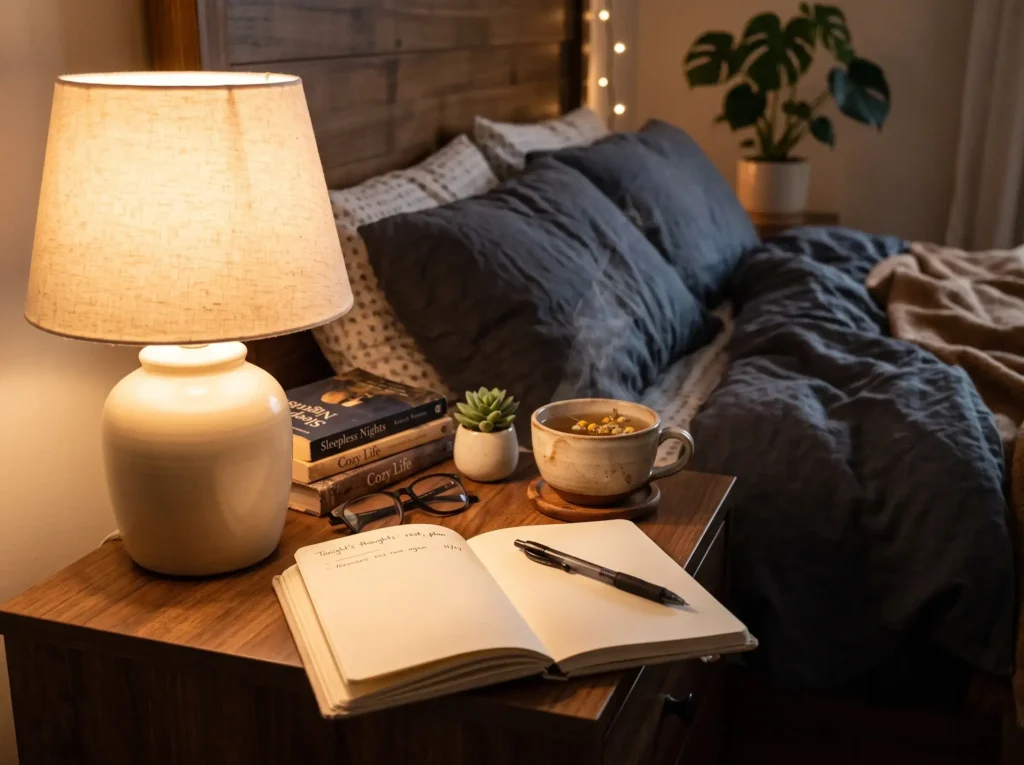
How to Stop Overthinking and Sleep
Racing thoughts are the single biggest reason relaxation techniques fail on their own. A few ways to address the thinking, not just the breathing:
Try a Bedtime Journaling Exercise
Keep a notebook by your bed and spend five minutes writing before you turn off the light. This works because it “offloads” your brain’s need to keep rehearsing tomorrow’s tasks so it doesn’t lose track of them.
- Write your to-do list for tomorrow, with specifics. Vague entries don’t help much — instead of “clean the house,” write “spend 15 minutes vacuuming the living room and wiping down the kitchen counters.” The more detailed the list, the less your brain has to keep replaying it.
- If you finish early, look further ahead. Jot down what needs doing later in the week — “pay the electric bill by Thursday” or “book the dentist appointment before Friday.”
- Separate your worries from your tasks. If something is bothering you that isn’t a task, write it down too, then add a short note: “I’ll deal with this tomorrow when I’m more alert.” That’s often enough to give your brain permission to let it go for the night.
Try Paradoxical Intention
Instead of forcing sleep, deliberately try to stay awake with your eyes closed, without actively resisting it. A 2021 systematic review and meta-analysis on PubMed found this approach produced meaningful improvements in insomnia symptoms, largely by reducing the performance anxiety that builds up around “trying” to fall asleep. Removing the pressure to perform often lets sleep arrive on its own.
Get Up If You’re Still Awake After 20 Minutes
Lying in bed, frustrated, trains your brain to associate the bed with wakefulness. Move to a dim room, do something quiet, and go back once you’re actually drowsy.
How to Fall Asleep Fast When You’re Not Tired
Sometimes the problem isn’t tension — it’s timing. If you’re not sleepy yet, no breathing pattern will override your circadian clock. In that case:
- Delay your bedtime by 30–60 minutes and see if sleep comes faster once your body is genuinely ready.
- Dim the lights an hour before bed to support natural melatonin release.
- Skip the “trying” altogether — go do something calm and boring elsewhere until you feel that heavy, eyes-drooping kind of tired, then head back to bed.
How to Fall Asleep Fast in 10 Minutes: The Sleep Hygiene Basics
Relaxation techniques work best on top of a foundation that isn’t fighting against you:
| Factor | What Helps |
|---|---|
| Room temperature | Around 60–68°F (cooler tends to support deeper sleep) |
| Light exposure | Dark room, dim screens 1 hour before bed |
| Caffeine | Cut off at least 8 hours before bedtime |
| Consistency | Same sleep and wake time daily, even on weekends |
| Naps | Keep under 20 minutes, and avoid late-afternoon naps |
None of these guarantee sleep in 10 minutes, but stacked together, they remove most of the common blockers — which is often enough to get most people close to it.
How to Fall Asleep Fast Naturally Without Medicine
If you’re specifically trying to avoid melatonin or sleep aids, combine two or three non-drug techniques rather than relying on one:
- Breathing + visualization for the nervous system and the mind.
- Consistent sleep-wake times to anchor your circadian rhythm.
- A wind-down routine — same order of actions each night (dim lights, brush teeth, read a few pages) — so your brain starts recognizing the pattern as a cue for sleep.
For guidance on when a sleep issue moves beyond home remedies, NHS guidance on insomnia outlines the point at which it’s worth speaking to a doctor, especially if poor sleep is persistent or paired with loud snoring or gasping, which can signal sleep apnea rather than simple restlessness.
Common Mistakes That Sabotage the Method
- Expecting it to work on night one. The original pilot data reflects six weeks of daily practice, not one lucky attempt.
- Skipping steps to rush through it. The sequence works because it’s sequential — jumping straight to visualization skips the physical relaxation that makes the mental part possible.
- Staying tense without realizing it. Clenched jaws and curled toes are easy to miss. Do an actual body check as you go.
- Turning it into a performance. Watching the clock and stressing about hitting two minutes creates exactly the kind of alert, anxious state the technique is trying to undo.

The Bottom Line
The military sleep method isn’t a hack — it’s a legitimate relaxation practice wearing a two-minute headline. The breathing, the muscle release, and the visualization are all grounded in real physiology, and given consistent practice, most people do get faster and better at falling asleep using it. What it won’t do is override a body that isn’t ready for sleep yet, or replace the basics of good sleep hygiene.
If you’re trying how to fall asleep fast military method style tonight, go in with realistic expectations: it’s less a switch you flip and more a skill you build — one slow breath, one relaxed muscle, at a time.
This article is for informational and educational purposes only and is not a substitute for professional medical advice, diagnosis, or treatment. Always consult your doctor or a qualified health provider before starting any new diet, exercise, or wellness routine.
Frequently Asked Questions (FAQs) :
Q1. How do the military fall asleep quickly?
The military method works by moving through a fixed sequence: relaxing your face muscles first, then your shoulders and arms, your chest, and finally your legs, before clearing your mind for 10 seconds using a calming image or repeating “don’t think.” This step-by-step release lowers your body’s alertness before you ever try to fall asleep, which is what makes the military method different from just lying there hoping to drift off.
Q2. How to sleep fast in 5 minutes trick?
One effective trick from the article is bedtime journaling — spending five minutes writing down tomorrow’s to-do list with specific details (not vague ones), which “offloads” your brain’s need to keep replaying tasks overnight. Pairing this with the 4-7-8 breathing technique, which only takes a few minutes to run through four cycles, gives your mind and body a fast one-two combination for falling asleep.
Q3. How can I get 100% sleep?
No single trick guarantees sleep — the article is clear that even stacking multiple techniques together only removes the common blockers, it doesn’t promise instant results. The closest to a complete approach is combining breathing and visualization for your nervous system with consistent sleep-wake times and a repeatable wind-down routine, so your body and brain are both working with you instead of against you.
Q4. What will help me sleep immediately?
Deep breathing is the fastest lever you have — slow, deliberate breathing shifts your body out of fight-or-flight and into “rest and digest” mode almost immediately, which is why it opens every version of the military method. If you need more support right away, follow it with progressive muscle relaxation (tensing and releasing each muscle group) and a calming visualization to quiet racing thoughts.

Nova
Health & Neuroscience Writer
Nova simplifies complex sleep architecture, circadian biology, and hormonal mechanics into actionable daily guides.
More in Sleep Science

8 Powerful Ways to Increase REM Sleep (Stop Waking Up Tired)
Sleeping 8 hours but still exhausted? Discover 8 science-backed ways to increase…
How to Fix Sleeping Posture: 4 Proven Ways to Stop Morning Neck Pain
Learn how to fix sleeping posture with 4 research-backed rules. Discover the…
Stop Waking Up Exhausted: 7 Proven Ways to Increase Deep Sleep and REM Sleep Naturally
Sleeping 8 hours but still waking up tired? Discover science-backed habits, foods,…

5 Shocking Mouth Taping for Sleep Mistakes That Can Ruin Your Health
Discover the real benefits, hidden risks, and safety steps of mouth taping…

Why You Wake Up at 3AM After Drinking: 3 Shocking Reasons (And the Fix)
Wondering why you wake up at 3am after drinking? Discover the science…

5 Proven Tips for the Best Sleep Schedule for Night Shift Workers
Stop staring at the ceiling! Discover 5 vital strategies to build the…

5 Shocking Secrets to Reset Circadian Rhythm Naturally (No All-Nighters)
Struggling with late bedtimes? Learn 5 proven steps to reset circadian rhythm…
Constantly Wake Up at 3 AM to Pee? Here Are 3 Fixes That Actually Work
Stop the frustrating cycle of wake up at 3 AM to pee.…