

Dr. Wilder
Neuroscientist & Clinical Consultant • 15+ Years Exp in Cognitive Health
Your shoulders are up by your ears. Your jaw is tight. You’ve had a good cry, a good workout, even a good night’s sleep — and somehow the tension is still sitting in your chest. That’s not in your head. It’s in your body, and it’s exactly where somatic exercises for stress come in.
Somatic exercises are slow, body-based movements that help you notice and release tension your nervous system is holding onto, often without your permission. Unlike a hard workout, which can actually spike stress hormones when your body is already depleted, somatic work is designed to calm your system down, not push it further. Below is a practical, evidence-informed guide to what somatic exercises are, why they work, and twelve you can start using today.
Table of Contents
What Are Somatic Exercises for Stress?
Somatic exercises are gentle, awareness-based movements that use breath, slow motion, and stillness to help you reconnect with physical sensation. The word “somatic” simply means “of the body” — and that’s the whole point. Instead of training for performance, you’re training for perception: noticing how your body holds, moves, and releases tension.
Traditional therapy tends to work top-down, starting with thoughts and working toward feelings. Somatic work flips that. It’s bottom-up: you start with sensation — a clenched fist, a shallow breath, a locked jaw — and let the nervous system settle from there. That distinction matters, because talk-based approaches don’t always reach stress that’s stored physically rather than cognitively.
Somatic exercises aren't a replacement for strength training or cardio. They're a separate tool for a separate job — regulating your nervous system rather than building fitness.
How Chronic Stress Gets Stuck in the Body
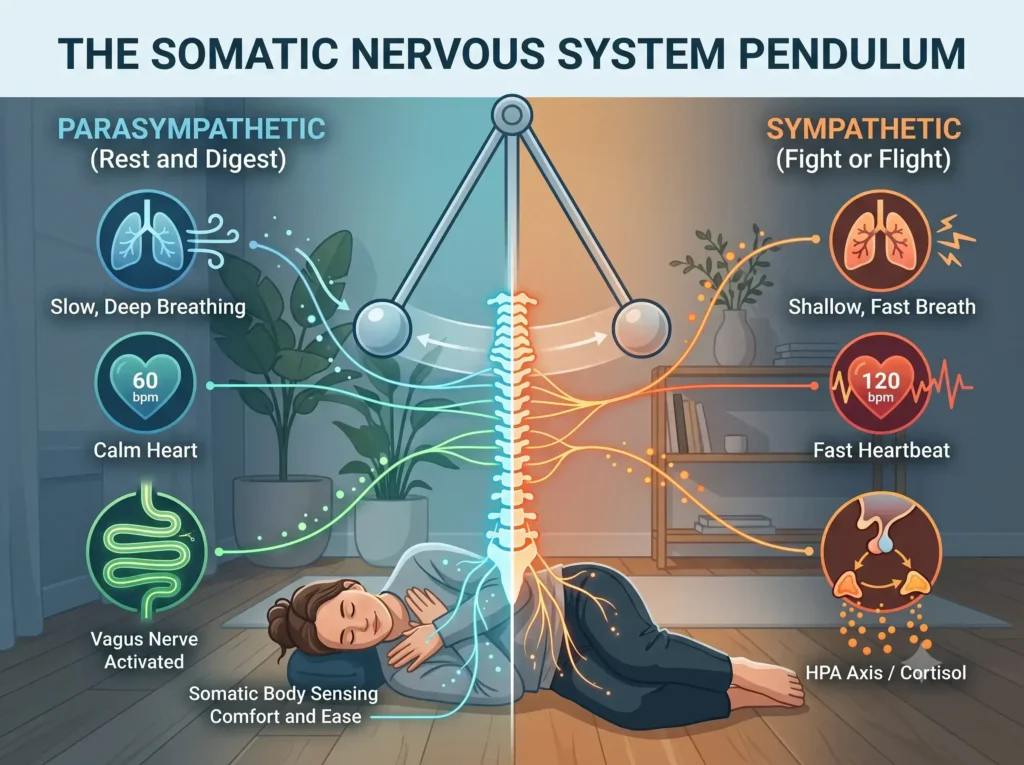
Stress isn’t just a feeling; it’s a physiological event. When your brain perceives a threat, it activates the hypothalamic-pituitary-adrenal (HPA) axis, which releases cortisol and prepares your muscles to fight, flee, or freeze. That response is useful for a few minutes. It’s a problem when it doesn’t switch off.
According to the National Institute of Mental Health, stress that lingers without resolution can begin to interfere with sleep and disrupt the immune, digestive, cardiovascular, and reproductive systems. Researchers studying the brain’s stress circuitry have also mapped how structures like the amygdala and prefrontal cortex regulate this cortisol response, and how that regulation can be trained through consistent, targeted practice — not just left to chance (PubMed).
Here’s how that unresolved stress tends to show up physically:
| Stress Response | Common Physical Signal |
|---|---|
| Anxiety | Tight chest, racing heartbeat |
| Dissociation | Numbness, “zoning out” |
| Anger | Clenched jaw, tight fists |
| Grief or overwhelm | Slumped posture, heaviness, fatigue |
| Chronic hypervigilance | Shallow breathing, tense shoulders |
Somatic movement doesn’t argue with these patterns intellectually. It interrupts them physically, which is often faster.
The Science Behind Somatic Nervous System Regulation Exercises
The Vagus Nerve and the Parasympathetic Reset
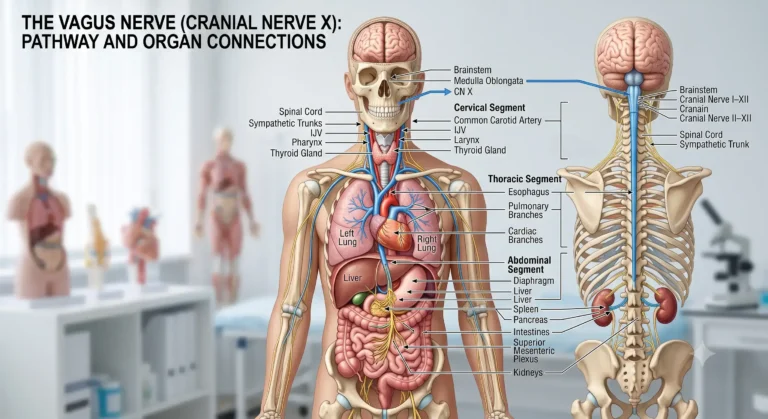
Your autonomic nervous system runs on two main settings: sympathetic (fight-or-flight) and parasympathetic (rest-and-digest). The vagus nerve is the main communication line for the parasympathetic side, and slow, controlled practices — deep breathing, humming, gentle movement — are thought to encourage it toward a calmer state. A controlled crossover study on non-invasive nerve stimulation found measurable reductions in physiological stress markers during targeted stimulation, supporting the general idea that the vagus nerve is a meaningful lever for stress management (NCBI).
It’s worth being honest here: not every popular “vagus nerve hack” circulating online has strong clinical backing, and the mechanisms are still being studied. What’s better supported is the broader principle — slow, intentional movement paired with breath reliably shifts your body out of a defensive state, even if the exact vagal pathway isn’t fully mapped for every technique.
Somatic Movement for Trauma
Somatic movement for trauma works from a similar premise: the body keeps a physical record of overwhelming experiences, and that record doesn’t always resolve through conversation alone. A randomized trial on cognitive-behavioral stress management found that structured, repeated practice produced measurable, lasting reductions in cortisol reactivity to acute stress — reinforcing that the nervous system can be retrained, but it takes consistency, not a single session (PubMed).
➟ 7 Proven Ways How to Activate the Vagus Nerve for Rapid Stress Relief
This is where proactive nervous system care tends to separate people who cope from people who feel genuinely steadier. Jenna, who lives with CPTSD and now works in trauma support herself, describes it this way: she built her education around the condition and restructured her lifestyle so that nervous system hygiene became a non-negotiable daily habit — not something she reaches for only in a crisis. Her routine layers polyvagal-informed yoga, vagus nerve activation practices, brief cold exposure to the face, meditation, and somatic therapy. The logic behind it is straightforward: when you practice regulation proactively, you’re building a nervous system with more capacity to absorb the next stressor, rather than one that’s already running on empty when it hits.
That’s an important reframe. Somatic work isn’t only damage control after a bad day. Practiced consistently, it functions more like resilience training — lowering your baseline stress load, sometimes called allostatic load, so your system has room to respond rather than react.
12 Somatic Exercises to Regulate Your Nervous System
You don’t need a mat, equipment, or a studio. Most of these take under five minutes. Move slowly — small and slow is the whole method, not a warm-up for something bigger.
1. Grounding Through the Feet
Stand barefoot, feet hip-width apart. Slowly shift your weight side to side, noticing the texture beneath you and the points of contact through your feet. Do this for 30–60 seconds whenever you feel scattered or disconnected.
2. Diaphragmatic Breathing
Lie down or sit with one hand on your belly, one on your chest. Inhale through the nose for a count of 4, letting the belly rise. Exhale for a count of 6. Repeat for 6–10 breaths. The longer exhale is doing most of the work here — it’s the signal that tells your body it’s safe to downshift.
3. Body Scanning
Close your eyes and slowly move your attention from your scalp down to your feet, pausing at each area to notice temperature, tightness, or ease without trying to change anything. A full scan takes 5–10 minutes; a micro version (head, chest, belly, feet) takes under two.
4. Progressive Muscle Relaxation
Starting at your feet and working upward, gently tense each muscle group for 4–6 seconds, then release and rest for 8–12 seconds before moving to the next. This builds a felt sense of the difference between gripping and letting go.
5. Shoulder Release
Inhale and shrug your shoulders toward your ears. Hold for 2–3 seconds. Exhale and let them drop heavy. Repeat 6–10 times, then add a few slow shoulder rolls to loosen the shoulder blades.
6. Spinal Roll-Down
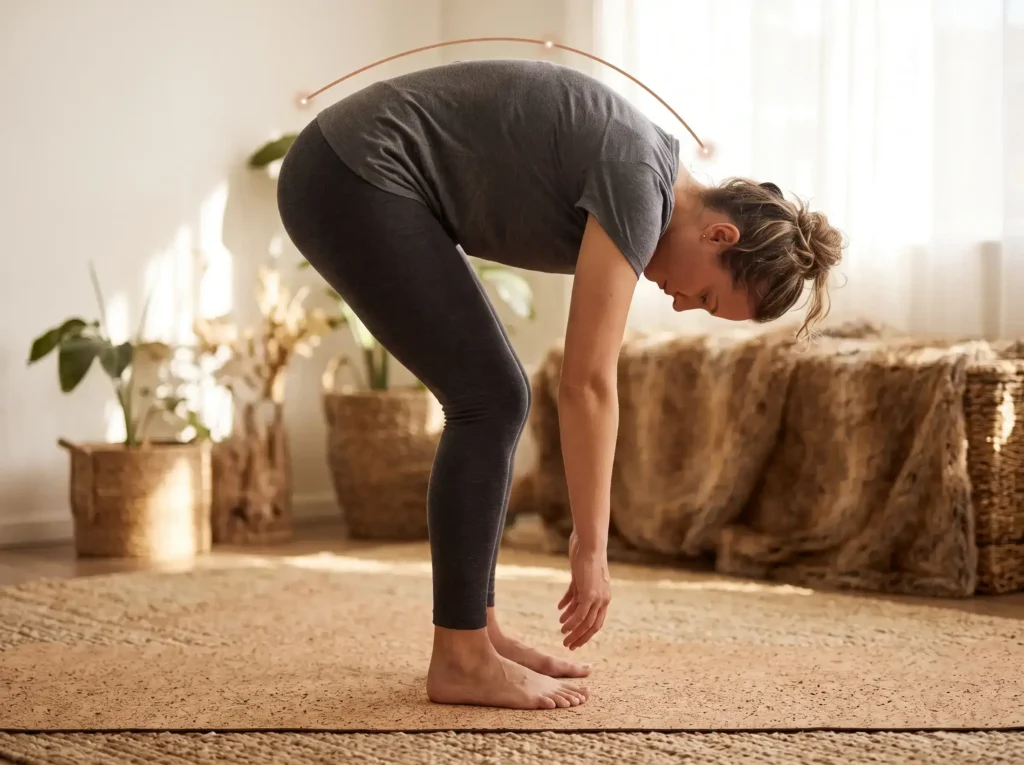
Standing with soft knees, hinge forward from the hips and let your spine round down vertebra by vertebra, head and arms hanging heavy. Pause at the bottom, breathe, then stack back up slowly through the pelvis, ribs, and neck.
7. Pandiculation (Stretch and Release)
Lengthen your body like a big yawn-stretch, gently tensing the target muscles for 2–3 seconds, then let go completely on a long exhale. This is the same reflex your body performs involuntarily when you wake up.
8. Somatic Shaking Exercise
Standing or seated, shake out your arms, hands, legs, and shoulders for 20–30 seconds, letting the movement be loose and a little chaotic rather than controlled. Many mammals discharge stress this way naturally; a somatic shaking exercise borrows the same instinct to release excess activation stuck in the muscles.
9. Hand-to-Heart (Butterfly Hug)
Cross your arms over your chest and rest your hands on opposite shoulders, or simply place one hand on your heart. Breathe slowly for a minute, optionally alternating gentle taps on each shoulder. This combines touch with breath to cue safety quickly.
10. Orienting
Slowly turn your head left and right, letting your eyes land wherever feels calming in the room. This simple check-in reminds your nervous system that your environment is safe right now, which is often enough to interrupt a spiral.
11. Somatic Walking
Slow your normal walking pace by about 20%. Notice the heel-to-toe roll of each step, the natural swing of your arms, and any subtle rotation through your hips. A few minutes turns an ordinary walk into a regulation practice.
12. Humming or Toning
Hum a low, steady note for 30–60 seconds, feeling the vibration in your throat and chest. The gentle vibration is thought to offer mild sensory stimulation along vagal pathways in the neck, and it doubles as a built-in exhale-lengthening exercise.

Building Somatic Practice Into a Routine
Consistency outperforms intensity here. A single session can help in the moment; a daily habit is what actually changes your baseline. A few starting points:
- Micro-reset (1–3 minutes): One or two exercises at your desk or in the car.
- Short session (5–10 minutes): A small combination — shoulder release, breathing, and a body scan — morning or evening.
- Full practice (10–20 minutes): Rest-day recovery or a wind-down routine, layering three or four exercises together.
Jenna’s approach reflects the full-practice end of that spectrum: a daily stack rather than an occasional add-on, which is part of why she frames it as nervous system hygiene rather than a stress-relief trick. The comparison she uses is simple — a nervous system that’s been proactively regulated has more room to absorb the next hit of stress instead of tipping straight into overwhelm.
A Few Honest Caveats
➟ 7 Powerful Polyvagal Exercises to Heal Your Dysregulated Nervous System
Somatic exercises are generally low-risk for most people, but a few things are worth flagging plainly:
- Cold exposure isn’t for everyone. Face-icing or cold water can be a strong vagal cue for some people, but it can also feel overstimulating, and anyone with a cardiovascular condition should check with a doctor first.
- Trauma processing can bring things up. Somatic movement for trauma can surface intense sensations or emotions. That’s not a failure of the exercise — it’s often a sign to slow down and, ideally, work alongside a trained somatic or trauma therapist rather than solo.
- It’s a complement, not a cure. Chronic stress has been linked to worsened symptoms in conditions such as fibromyalgia and some autoimmune conditions, but somatic practice is supportive self-care, not a diagnosis or treatment plan. If you have an existing health condition or persistent pain, loop in your physician.
The Bottom Line
You don’t need a harder workout to feel less stressed — sometimes you need the opposite. Somatic exercises for stress work because they meet the nervous system where it actually lives: in sensation, not just in thought. Start small, pick two or three exercises from this list, and give them a few weeks before judging the results. The goal was never to perform them perfectly. It’s to notice, a little more each day, when your body is holding on — and to give it permission to let go.
This article is for informational and educational purposes only and is not a substitute for professional medical advice, diagnosis, or treatment. Always consult your doctor or a qualified health provider before starting any new diet, exercise, or wellness routine.
Frequently Asked Questions (FAQs) :
Q1. Do somatic exercises work for stress?
Yes — somatic exercises for stress work by interrupting tension patterns physically rather than just talking through them, which often resolves stress faster than cognitive approaches alone. Research cited in the guide shows structured, repeated practice produces measurable, lasting reductions in cortisol reactivity to stress. The key is consistency: a single session helps in the moment, but a daily habit is what actually shifts your baseline.
Q2. What exercises reduce stress?
Effective options include diaphragmatic breathing, body scanning, progressive muscle relaxation, grounding through the feet, and a somatic shaking exercise to discharge built-up tension from the muscles. Shoulder release, spinal roll-downs, and humming (vagal toning) also help by cueing the parasympathetic nervous system to switch on. All are simple nervous system regulation exercises that need no equipment and take under five minutes.
Q3. How to control somatic anxiety?
Physical anxiety symptoms — a tight chest, racing heart, or clenched jaw — respond best to slow, sensation-based practices rather than thinking your way out of them. Diaphragmatic breathing with a longer exhale, orienting (slowly turning your head and letting your eyes settle), and grounding through the feet are quick ways to regulate the nervous system in the moment. These act as a fast somatic nervous system reset when anxiety spikes.
Q4. What is somatic stress?
Somatic stress is stress that shows up as a physical event in the body, not just a mental one — triggered when the HPA axis releases cortisol and prepares your muscles to fight, flee, or freeze. When that response doesn’t switch off, it settles into the body as a tight chest, clenched fists, shallow breathing, or slumped posture. Somatic exercises for stress target this physical layer directly instead of only addressing the thoughts behind it.
Q5. Can anxiety be somatic?
Yes — anxiety is often experienced physically before it’s recognized mentally, showing up as a racing heartbeat, tight chest, or hypervigilant, shallow breathing. Because this response is bottom-up rather than purely cognitive, exercises to regulate the nervous system — like breathing, grounding, and gentle movement — can calm it more directly than thought alone. This is also why somatic movement for trauma is often used alongside talk therapy, since trauma-related anxiety tends to live in the body as much as the mind.

Remi
Mental Health & Psychology Writer
Remi focuses on stress physiology, nervous system regulation, cognitive resilience, and mindfulness.
More in Mind & Nervous
7 Proven Polyvagal Exercises for Nervous System Regulation: End Chronic Panic & Feel Safe
Logic can't talk your body down from panic. Master 7 polyvagal exercises…
Stop the Pain: 5 Proven Somatic Tracking for Fibromyalgia Steps
Break the chronic flare-up cycle. Learn how Somatic Tracking for Fibromyalgia calms…

7 Secrets of Breathing Exercise for Vagus Nerve Stimulation to Stop Anxiety Fast
Struggling with stress? Discover 5 science-backed breathing exercise for vagus nerve stimulation…
1 Proven Way to Heal Chronic Pain: Somatic Tracking Alan Gordon Guide
Learn somatic tracking Alan Gordon techniques to retrain your brain's alarm system…

7 Powerful Polyvagal Exercises to Heal Your Dysregulated Nervous System
Stuck in anxiety or shutdown? Learn how 7 powerful polyvagal exercises help…
7 Proven Ways How to Activate the Vagus Nerve for Rapid Stress Relief
Discover how to activate the vagus nerve naturally with science-backed habits. Improve…

Infrared Sauna vs Traditional Sauna: Don’t Waste 1 Minute on the Wrong Choice
Discover Infrared Sauna vs Traditional Sauna for muscle recovery and longevity. Compare…

8 Powerful Ways to Increase REM Sleep (Stop Waking Up Tired)
Sleeping 8 hours but still exhausted? Discover 8 science-backed ways to increase…