

Dr. Wilder
Neuroscientist & Clinical Consultant • 15+ Years Exp in Cognitive Health
If your body reacts to ordinary moments like they’re emergencies, you’re not broken. You’re dysregulated — and that’s a nervous system problem, not a character flaw. Polyvagal exercises are the practical toolkit that grew out of Dr. Stephen Porges’ polyvagal theory, built around one simple premise: your body can learn its way back to safety, even after years of not feeling safe at all.
This guide walks through the science, the exercises themselves, and what real recovery from chronic dysregulation actually looks like — including one woman’s account of using this framework to climb out of a genuinely brutal situation.

Table of Contents
What Polyvagal Theory Actually Says About Your Nervous System
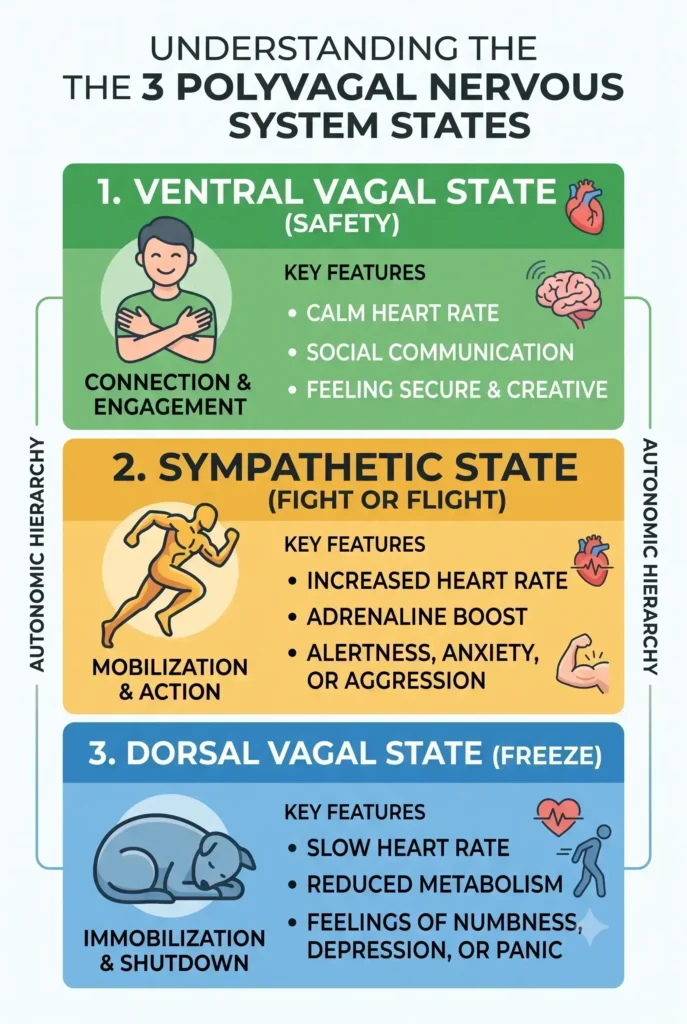
Porges’ framework, developed at Indiana University, reframed how clinicians think about trauma, anxiety, and chronic stress. Instead of treating the autonomic nervous system as a simple on/off switch between “calm” and “stressed,” polyvagal theory maps three distinct states, each with its own physiology and its own job to do.
The Three Autonomic States
Ventral vagal state (safety and connection). Steady heart rate. Easy breathing. The ability to think clearly and actually connect with another person. This is rest-and-digest mode, and it’s the state most polyvagal work is trying to restore access to.
Sympathetic state (fight or flight). Heart rate climbs. Adrenaline floods in. Your body gets ready to act. Useful when you’re actually in danger. Exhausting when it fires constantly over nothing.
Dorsal vagal state (shutdown). Numbness. Disconnection. A sense of being far away from your own body. This is the freeze response, and it shows up when fight or flight isn’t a workable option.
None of these states are the enemy — they’re all protective in the right context. What clinicians describe as autonomic flexibility is really the goal: the nervous system’s ability to move through fight, flight, or freeze as needed, and then actually find its way home to ventral vagal safety afterward. For people carrying trauma, that return trip is often the hardest part, because the system has learned, understandably, to get stuck.
Polyvagal exercises don't eliminate stress responses. They build flexibility — the ability to move between nervous system states and return to baseline instead of getting stuck.
Breathing-Based Polyvagal Exercises for Anxiety
Breath sits in an unusual spot — it happens on its own, but you can also take the wheel. That’s what makes breathwork such a direct entry point into shifting your autonomic state, and why it shows up first in nearly every polyvagal protocol out there.
It won’t work the same way for everyone, though. Some people find that focusing on their breath makes anxiety worse, not better. If that’s you, skip ahead to the grounding or movement sections — there’s no rule that says breathwork has to be your entry point.
Extended exhale breathing leans on a simple fact: the exhale is tied to parasympathetic activation, the inhale to sympathetic activation. Lengthen the exhale relative to the inhale, and the whole system tends to follow. Try inhaling for a count of four and exhaling for six to eight, adjusting the counts until it feels workable rather than forced. If counting itself starts to feel stressful, just drop it and breathe naturally — the goal here is ease, not a perfect score.
The physiological sigh is something your body already knows how to do — it’s the pattern that shows up spontaneously after a good cry, or right before you drift off to sleep. Neuroscience research on this exact pattern has drawn attention to how quickly it can shift state: take a deep inhale through the nose, then a second, shorter sip of air at the top to fully expand the lungs, followed by a long, slow exhale through the mouth. One to three rounds is usually enough.
Resonance breathing, sometimes called coherent breathing, means slowing down to around five or six breaths a minute. That pace is linked to improved heart rate variability (HRV) — a measurable marker of autonomic flexibility that’s been studied fairly extensively, including in clinical literature indexed on NIH. Inhale for a count of five or six, exhale for the same count, and hold that rhythm for five to ten minutes. It can feel unfamiliar at first. Give it a few sessions before deciding whether it’s for you.
Vagal Toning Exercises: The Stephen Porges Vagus Nerve Exercises
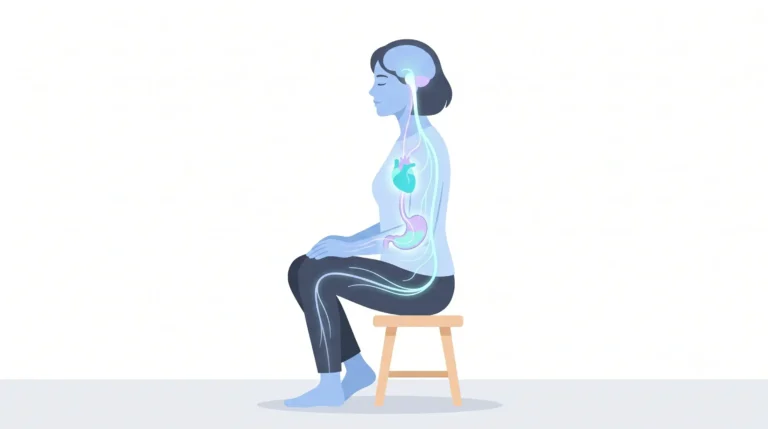
The vagus nerve runs from your brainstem through your throat, heart, lungs, and gut, which means several points along that path double as access points for influencing vagal tone directly.
Humming and vocal toning work because the vagus nerve innervates the muscles of the larynx and pharynx — so a sustained hum, a chanted “om,” or even just a long, low vowel sound creates real vibration along that pathway. Take a breath in, hum steadily on the way out, and notice where you feel it in your throat and chest. Some people find this deeply soothing. Others feel self-conscious doing it, especially the first few times — that’s a completely normal response, not a sign you’re doing it wrong.
Cold water application taps into something called the dive reflex — brief cold exposure to the face, particularly around the forehead, eyes, and cheeks, can trigger a parasympathetic response that slows the heart down. A cold, damp cloth pressed to the face for thirty seconds works just as well as a splash of water. One caution worth taking seriously: if you have any cardiovascular condition, this isn’t a practice to try without checking in first. The NHS advises speaking with a healthcare provider before starting cold-exposure or intensive breathwork practices if heart health is a concern.
Gargling is the least glamorous option on this list, and also one of the simplest. Vigorous gargling for thirty seconds to a minute engages the same throat muscles the vagus nerve supplies. Do it once or twice a day. It’ll feel a little silly at first. That’s fine.
How to Stimulate the Dorsal Vagus Nerve Safely
Here’s something most polyvagal content skips over entirely: everything above assumes you’re trying to calm an overactive system — bring a racing sympathetic response down. But if you’re in dorsal vagal shutdown instead — numb, foggy, disconnected from your own body — calming techniques can actually make things worse. What you need isn’t relaxation. It’s gentle, gradual re-activation back toward ventral vagal safety, without overshooting into sympathetic overwhelm.
A few things tend to help specifically with shutdown:
- Orienting slowly — looking around a room, naming what you see, letting your eyes land on something that feels pleasant
- Small, low-stakes movement — wiggling fingers and toes, a gentle stretch, standing up slowly rather than all at once
- Sensory input from the outside in — touching different textures, noticing temperature, engaging smell and taste
- Sound and voice — humming, speaking out loud, narrating what you’re doing as you do it
If you experience dissociation, body-focused practices can sometimes deepen the disconnection rather than ease it. Starting with externally-focused exercises — the orienting and sensory ones above — tends to be a gentler entry point.
➟ 7 Proven Ways How to Activate the Vagus Nerve for Rapid Stress Relief
Grounding and Orienting Techniques
Grounding works by pointing attention outward, toward the present environment, instead of inward toward internal sensations that might feel like too much right now.
The 5-4-3-2-1 technique is the most widely used version: name five things you can see, four you can hear, three you can physically feel, two you can smell, and one you can taste. It’s fine to shorten it — two or three senses instead of five is still a complete exercise, not a failed one.
Slow orienting asks for something a little different: let your gaze soften and widen, then turn your head slowly, taking in colors, shapes, and textures at a pace that’s noticeably slower than however you’d normally move. Silently naming what you see — “lamp,” “window,” “plant” — helps anchor the exercise without turning it into a performance.
Movement-Based Polyvagal Therapy Exercises
Movement earns its place here because the sympathetic state prepares your body for physical action. When that action never gets to finish — because running or fighting away from a threat wasn’t actually an option — completing it later, on your own terms, can help the nervous system discharge and settle.
Gentle shaking is exactly what it sounds like: stand with your knees slightly bent, and let a small bounce or shake move through your body, starting at the hands and spreading outward through the arms, shoulders, and beyond. One to five minutes is plenty. Some people notice an emotional release during or right after — that’s a known response, not something to be alarmed by, though having support nearby the first few times you try it is a reasonable precaution.

Pushing and pressing — palms flat against a wall or a table, pressing in with your arms and core for a few seconds before releasing — engages the same muscles used in a fight response. It can genuinely take the edge off feeling anxious, irritable, or stuck in place.
Slow, mindful walking sounds almost too simple to matter, but deliberately dropping your pace, with attention on each foot lifting and placing, shifts some people out of sympathetic activation more effectively than sitting still ever could.
Social Engagement and Co-Regulation Exercises
Porges calls this the “social engagement system” — the muscles of the face, middle ear, and voice, all wired directly into the ventral vagal pathway. These exercises work through connection, not solitary effort.
Facial relaxation is often the quiet first step: softening the jaw, easing the tension around your eyes, letting the forehead go. Voice modulation — deliberately speaking in a warmer, slower, more melodic tone, even just to yourself — taps the same pathway. And co-regulation, simply being near someone whose presence feels calming, works by essentially borrowing their regulated state without needing to talk about anything at all.
For people with relational trauma, this one can feel complicated rather than soothing, at least at first. That’s not a sign it’s failing — it’s a normal part of relearning that closeness can be safe.
Real Healing: A Client’s Journey Through Somatic Trauma Release
Regina Raff, who has used polyvagal work as part of her own recovery, describes hitting her thirties still trapped in an abusive living situation, in a city she found chaotic and dysregulating on top of everything else. A decade of accumulating health issues had left her body breaking down under sustained stress, and the toll it took on her executive functioning made it even harder to find a way out. Severe dissociation and a persistent sense of disembodiment made the whole picture heavier still.
A year of focused nervous system regulation changed the trajectory. Her body stopped deteriorating and started actively healing. The trauma she’d been carrying began surfacing somatically — first as a kind of chronic physical armoring that intensified before eventually giving way to what she describes as an organic, ongoing release process, one that’s continued for years because so much of her trauma had been stored in the body rather than the mind.
Regina traces the intensity of that somatic storage back to childhood — she describes being a highly sensitive kid, deeply embodied, emotionally intense, with a strong sense of self that stayed aware something was wrong even before she had the words for it. She dates her disconnection from her body and sense of self to age thirteen, and says that’s exactly why polyvagal theory mattered so much: without a framework for understanding nervous system states, she wouldn’t have had a way back into a body she’d left behind years earlier.
What her account lands on is worth sitting with — that mind and body were never really separate to begin with. Trauma is what creates the felt sense of a split. Integration, in her experience, isn’t a metaphor. It means coming back into full-bodied awareness, physically as much as psychologically. It hasn’t been fast. But by her account, it’s been the throughline of everything else that’s healed since.

Building a Personal Regulation Toolkit
Nervous system work is stubbornly individual. What calms one person’s system can activate another’s entirely — the NIH has documented substantial variability in stress-response patterns between individuals, which is a large part of why no single protocol works for everyone.
A few honest questions worth tracking as you experiment:
- Which practices actually help when you’re activated — anxious, wired, irritable?
- Which help when you’re shut down — numb, foggy, low on energy?
- What works in the moment, versus what supports regulation over weeks and months?
- Are there exercises that feel flat or uncomfortable, and might just need dropping?
Keep loose notes if that helps. Patterns tend to show up only with repetition, not on the first or second try.
This article is for informational and educational purposes only and is not a substitute for professional medical advice, diagnosis, or treatment. Always consult your doctor or a qualified health provider before starting any new diet, exercise, or wellness routine.
When to Seek Professional Support
Self-guided polyvagal exercises are a real starting point — but they’re not a replacement for a trauma-informed therapist, especially if you’re carrying a significant trauma history, managing a diagnosed condition, or have a cardiovascular concern that makes cold exposure or intense breathwork genuinely risky. Modalities that explicitly build on polyvagal principles include Somatic Experiencing, Sensorimotor Psychotherapy, and polyvagal-informed EMDR.
A trained therapist can pace this work appropriately, help you stay within your window of tolerance, and support you through the parts of the process — like the years-long somatic release Regina describes — that aren’t easily navigated alone.
Polyvagal exercises were never going to switch your stress response off for good, and that was never really the point. What they offer is a way to teach a nervous system that’s been stuck in protection mode how to find its way back to safety again — one breath, one hum, one slow walk at a time.
This article is for general information and isn’t a substitute for individualized medical or mental health care. If you have a trauma history, a cardiovascular condition, or are currently in crisis, please reach out to a qualified professional before starting a new regulation practice.
Frequently Asked Questions ( FAQs) :
Q1. How to activate the vagus nerve naturally?
You can activate the vagus nerve naturally through breathing-based polyvagal exercises like extended exhale breathing, the physiological sigh, and resonance breathing. Vocal toning practices such as humming, along with cold water application to the face and gargling, directly stimulate the vagal pathway through the throat and larynx. Movement-based methods — gentle shaking, pushing/pressing, and slow walking — round out a natural, at-home vagal nerve exercises toolkit.
Q2. What are polyvagal exercises?
Polyvagal exercises are practices built on Stephen Porges’ vagus nerve exercises and polyvagal theory exercises, designed to help your nervous system move between fight-or-flight, shutdown, and safety more easily. Rather than eliminating stress responses altogether, they build autonomic flexibility — the ability to return to a regulated ventral vagal state after activation. This makes them a core tool in polyvagal exercises for anxiety and broader polyvagal therapy exercises.
Q3. How to repair vagus nerve damage?
The article focuses on supporting and toning the vagus nerve, not repairing physical nerve damage — these are different goals. Its polyvagal nerve exercises (breathing, humming, cold exposure, movement) are aimed at improving vagal tone and heart rate variability, not treating an injured nerve. If actual nerve damage is suspected, the article’s guidance points toward working with a trauma-informed professional rather than self-directed exercises alone.
Q4. How to massage the vagus nerve in the neck?
The article doesn’t describe a dedicated neck massage technique, but it does cover gargling and humming as ways to engage the vagus nerve where it passes through the throat, since the nerve directly innervates the muscles of the larynx and pharynx. Vigorous gargling for 30 seconds to a minute, once or twice daily, is the closest at-home equivalent to targeted vagal stimulation in this area.
Q5. What are the symptoms of a tight vagus nerve?
The article doesn’t use the term “tight vagus nerve,” but it outlines the two states this usually points to: dorsal vagal shutdown (numbness, disconnection, low energy, feeling far from your own body) and an overactive sympathetic state (racing heart, anxiety, feeling wired). Both reflect a nervous system stuck away from the calm, connected ventral vagal state that polyvagal exercises aim to restore.

Remi
Mental Health & Psychology Writer
Remi focuses on stress physiology, nervous system regulation, cognitive resilience, and mindfulness.
More in Mind & Nervous
7 Proven Polyvagal Exercises for Nervous System Regulation: End Chronic Panic & Feel Safe
Logic can't talk your body down from panic. Master 7 polyvagal exercises…

Stop the Pain: 5 Proven Somatic Tracking for Fibromyalgia Steps
Break the chronic flare-up cycle. Learn how Somatic Tracking for Fibromyalgia calms…

7 Secrets of Breathing Exercise for Vagus Nerve Stimulation to Stop Anxiety Fast
Struggling with stress? Discover 5 science-backed breathing exercise for vagus nerve stimulation…

1 Proven Way to Heal Chronic Pain: Somatic Tracking Alan Gordon Guide
Learn somatic tracking Alan Gordon techniques to retrain your brain's alarm system…
12 Powerful Somatic Exercises for Stress to Reset Your Nervous System
Feeling overwhelmed or physically tense? Discover 12 simple somatic exercises for stress…

7 Proven Ways How to Activate the Vagus Nerve for Rapid Stress Relief
Discover how to activate the vagus nerve naturally with science-backed habits. Improve…

Infrared Sauna vs Traditional Sauna: Don’t Waste 1 Minute on the Wrong Choice
Discover Infrared Sauna vs Traditional Sauna for muscle recovery and longevity. Compare…

8 Powerful Ways to Increase REM Sleep (Stop Waking Up Tired)
Sleeping 8 hours but still exhausted? Discover 8 science-backed ways to increase…
3 Responses