

Dr. Wilder
Neuroscientist & Clinical Consultant • 15+ Years Exp in Cognitive Health
If you’ve spent any time googling why your body feels stuck in overdrive, you’ve probably landed on the same answer: learn how to activate the vagus nerve. It shows up in wellness videos, therapy sessions, and biohacking forums alike, usually promising instant calm. The science is real, but it’s more specific than a single breathing trick — it’s about a nerve pathway you can train, not a switch you flip once and forget.
This guide breaks down what the vagus nerve does, what actually stimulates it, and where the line sits between “helpful daily habit” and “medical treatment that requires a doctor.”
The information provided in this article is for educational and informational purposes only and is not intended as medical advice, diagnosis, or treatment. Always seek the advice of your physician or a qualified healthcare provider with any questions you may have regarding a medical condition or before attempting any vagal stimulation techniques.
Table of Contents
What the Vagus Nerve Actually Does
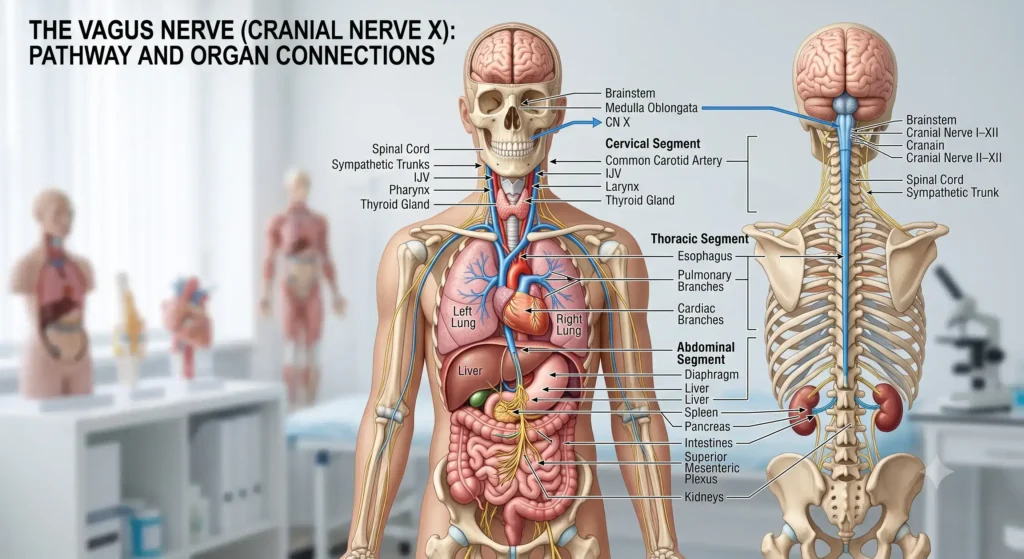
The vagus nerve — cranial nerve X — is the longest cranial nerve in the body, running from your brainstem down through your neck, chest, and abdomen. About 80% of its fibers are afferent, meaning they carry information from your organs up to your brain, not the other way around. That single fact explains a lot: your gut, heart, and lungs are constantly reporting back to your brain through this pathway, shaping mood, digestion, and stress response far more than most people realize.
It’s the main highway of your parasympathetic nervous system — the “rest and digest” counterpart to the fight-or-flight sympathetic system. When vagal signaling is strong, your heart rate settles, digestion runs smoothly, and inflammation stays in check through what researchers call the cholinergic anti-inflammatory pathway.
A well-functioning vagus nerve isn't just about feeling relaxed. It's tied to heart rate regulation, immune balance, and even how quickly you recover from stress.
Signs Your Vagal Tone Might Be Low
Vagal tone isn’t something you can see in a mirror, but your body tends to signal it anyway, if you know what to look for. Digestion is often the first clue — swinging between sluggish and reactive, bloating for no clear reason, or a stomach that overreacts to stress in ways it probably shouldn’t. A resting heart rate that stays elevated even when you’re just sitting around is another one worth noticing. So is that thing where you can’t seem to downshift after something stressful happens — you’re still keyed up hours later, long after the actual event has passed, and honestly you’re not sure why. Shallow, chest-dominant breathing as your day-to-day default (instead of the occasional exception) fits the pattern too, and so does bouncing back slowly from minor illness or inflammation, since vagal signaling plays a direct role in dialing that response down.
None of this is diagnostic on its own — these things overlap with a dozen other conditions, so don’t jump to conclusions. But together, they’re a reasonable cue to start paying attention to vagal-supportive habits. And if they’re persistent or severe, that’s a stronger cue to loop in a doctor rather than just riding it out.
How to Activate the Vagus Nerve Naturally
Most people don’t need a device to nudge vagal activity — they need consistent, low-effort inputs. Here’s what has real support behind it.
Slow, Extended-Exhale Breathing
Breathing is the fastest lever you have. When your exhale is longer than your inhale, you’re mechanically slowing your heart rate through the vagus nerve. A 2019 sleep study found that 30 days of nightly slow-paced breathing measurably increased overnight cardiac vagal activity compared to a control group using social media before bed.
Try this: inhale for 4 counts through your nose, exhale for 6-8 counts through your mouth. Five minutes is enough to notice a shift.
Cold Exposure
A brief cold-water splash to the face or a cool shower rinse triggers the mammalian dive reflex, which slows the heart via vagal pathways. Start with 15-30 seconds — you don’t need an ice bath to get the effect.
Humming, Gargling, and Singing
The vagus nerve innervates your vocal cords and the muscles at the back of your throat. Humming, gargling water, or singing loudly creates vibration that mechanically stimulates the nerve along its cervical path. It’s one of the simplest vagal tone exercises because it requires nothing but two minutes and a closed door.
Movement and Aerobic Exercise
Regular endurance activity — walking, cycling, swimming — is associated with better resting vagal tone over weeks and months, not because any single workout “activates” the nerve, but because consistent aerobic conditioning shifts your baseline autonomic balance toward parasympathetic dominance.
How to Calm the Vagus Nerve During a Stress Spike
Sometimes the goal isn’t a long-term training effect — it’s just getting through the next ten minutes. When you’re mid-stress-response, a few things work faster than any slow habit-building routine. The physiological sigh is probably the quickest: two short inhales through the nose, one long exhale through the mouth, repeated three to five times. Cold water on the wrists or face does something similar and doesn’t need privacy, which helps if you’re at your desk and can’t exactly lie down.

Pressing a hand firmly against your chest or stomach while breathing slowly gives your nervous system something to anchor to — sounds almost too basic, but it works. And if none of that’s doing much, just step outside. Even a couple minutes of daylight and open space can interrupt a spiral that indoor pacing never quite fixes.
None of this addresses what’s actually driving the stress in the first place, to be fair. It buys you regulation, not resolution.
Vagal Tone Exercises Worth Trying
Two names come up constantly in this space: somatic educator Sukie Baxter, whose work focuses on nervous system regulation through posture and breath awareness, and physiotherapist Stanley Rosenberg, whose polyvagal-informed “basic exercise” is one of the more widely taught self-help techniques.
Stanley Rosenberg’s Basic Exercise, in short:
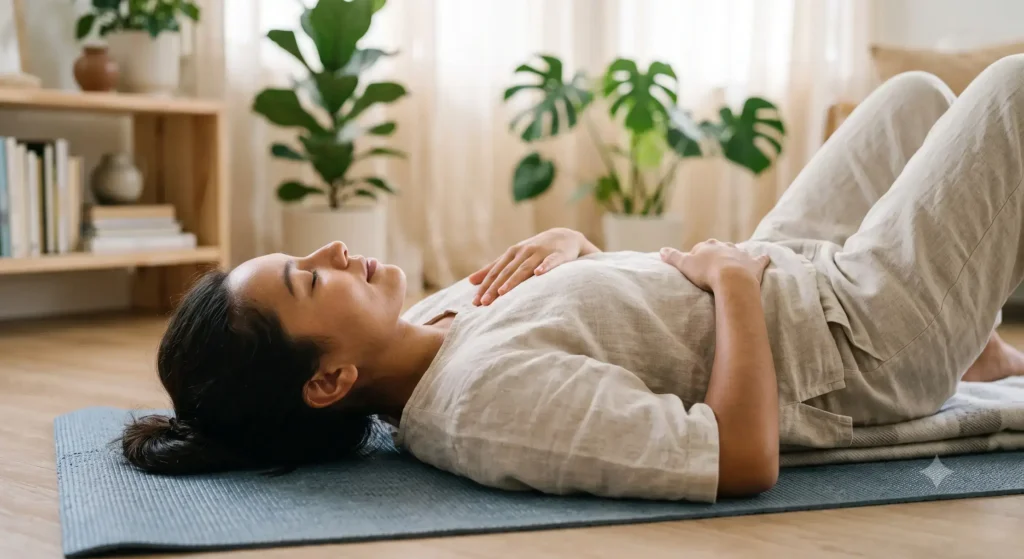
- Lie on your back, hands interlaced behind your head, elbows resting on the floor or bed.
- Without moving your head, shift only your eyes to look right. Hold until you feel a spontaneous swallow, sigh, or yawn — often 30-60 seconds.
- Return your eyes to center, then repeat looking left.
The premise is that this eye movement gently engages neck muscles connected to vagal pathways, cueing the nervous system toward safety. It’s not a clinically validated protocol in the way implanted stimulation is, but it’s low-risk and widely reported as calming by people who practice it regularly.

Vagus Nerve Self-Massage: A Simple At-Home Technique
Vagus nerve self-massage targets the areas where the nerve runs close to the skin — the neck and the outer ear.
- Neck: Using light pressure, glide your fingers down the side of your neck from just below the ear to the collarbone, alternating sides.
- Ear (auricular branch): Gently massage the cymba conchae — the small hollow just above the ear canal opening — in slow circles. This spot is supplied almost exclusively by the vagus nerve’s auricular branch, which is the same target used by non-invasive transcutaneous stimulation devices.
Keep pressure gentle. Deep or painful massage can trigger a stress response rather than a calming one.
➟ 7 Powerful Polyvagal Exercises to Heal Your Dysregulated Nervous System
How to Improve Vagal Tone Over Time
Single sessions help in the moment, but vagal tone — your baseline capacity to shift into parasympathetic mode — builds through repetition, not a one-off effort. Consistency beats intensity here, pretty much every time: five minutes of breathwork daily will outdo one long hour crammed in once a week. Sleep regularity matters more than people expect too, since irregular sleep and vagal function are closely linked, and poor sleep tends to blunt heart rate variability, which is the usual proxy researchers use for vagal activity. Then there’s social connection, which sounds like it belongs in a different category entirely but doesn’t — co-regulation, that feeling of being safe around another person, is itself a vagal input, not just some emotional nicety tacked on at the end.
These vagus nerve healing exercises won’t cure a diagnosed condition, and it’s worth being upfront about that. Think of them as a maintenance layer instead — closer to how stretching supports joint health without fixing a torn ligament.
When Stress Becomes Chronic: One Person’s Experience
Sometimes the connection between stress and physical symptoms isn’t obvious until you’ve lived it. Nayra, who dealt with a persistent, burning pain between her belly button and pelvis, spent a long stretch of time unable to get doctors to take the pattern seriously:
“For a long time, I struggled to make doctors understand my pain — a severe, burning sensation below my stomach, between my belly button and pelvis, that felt like a hot blade scratching internally. After multiple unsuccessful treatments that only made things worse, I began noticing a pattern: severe stress and oversleeping were major triggers for these flare-ups.”
The turning point wasn’t the vagus nerve directly — it was addressing sleep and cortisol regulation, both of which are closely tied to vagal signaling:
“The real turning point came when I was prescribed medication to improve my sleep and regulate cortisol levels — a hormone directly connected to the vagus nerve. While it didn’t cure the pain entirely, it significantly reduced the intensity and kept it from spiraling out of control.”
Her experience reflects a pattern researchers are still mapping: cortisol, sleep, and vagal activity influence each other in a loop. Disrupt one — through poor sleep, unmanaged stress, or both — and the others tend to follow. It’s a reminder that vagal health isn’t isolated from the rest of the body’s stress-response system; it’s woven into it.
Medical Vagus Nerve Stimulation vs. At-Home Techniques
It’s worth being clear about where breathing exercises and neck massage end and medical treatment begins. Implanted vagus nerve stimulation (VNS) is a surgically placed device, FDA-approved for drug-resistant epilepsy and treatment-resistant depression, and also used in stroke rehabilitation. It delivers programmed electrical pulses directly to the left vagus nerve and requires ongoing management by a neurologist or psychiatrist.

Non-invasive transcutaneous devices, which stimulate the ear’s vagal branch externally, are approved in some regions for migraine and cluster headache. Research into these devices for other conditions — including inflammatory bowel disease and rheumatoid arthritis — is still in early clinical stages.
None of the at-home methods in this article replicate that level of stimulation or its clinical effects. They’re supportive habits, not treatment for epilepsy, clinical depression, or chronic pain conditions.
How to Stimulate Your Parasympathetic Nervous System Safely
A few boundaries worth keeping in mind before you get started. None of these techniques replace medical care — if you’re dealing with fainting spells, unexplained heart rate changes, chronic pain, or diagnosed depression or epilepsy, that’s a doctor’s conversation, not a breathing exercise’s job. Keep massage near the neck light, too; deep tissue or painful pressure there can activate a stress response instead of calming one, which sort of defeats the whole point. Cold exposure isn’t for everyone either — if you have any cardiac history, check with a doctor first rather than jumping straight into a cold shower. And go easy on your expectations generally. Results build gradually, over weeks of consistent practice, not in one dramatic session that fixes everything.
The Bottom Line
Learning how to activate the vagus nerve isn’t about chasing one perfect technique — it’s about stacking small, repeatable inputs: slower exhales, gentler mornings, consistent sleep, occasional cold water, and a little humming when no one’s listening. None of it replaces medical treatment when something more serious is going on, but for everyday stress regulation, these habits are some of the most evidence-backed tools available, and they cost nothing but a few minutes a day.
Frequently Asked Questions ( FAQs)
Q1. How do you manually stimulate the vagus nerve?
You can manually stimulate the vagus nerve through slow, extended-exhale breathing, cold water exposure, or humming, gargling, and singing — all of which mechanically engage the nerve along its path through the throat and neck. Self-massage along the neck or outer ear, and eye-movement exercises like Stanley Rosenberg’s Basic Exercise, are two other low-effort ways to activate it. These count among the most accessible vagal tone exercises, since none require a device or prescription.
Q2. What are the symptoms of a weak vagus nerve?
Low vagal tone often shows up as digestion that swings between sluggish and reactive, a resting heart rate that stays elevated even at rest, or difficulty downshifting after stress — feeling keyed up long after the stressful moment has passed. Shallow, chest-dominant breathing as a daily default and slow recovery from minor illness or inflammation are also common signs. None of these are diagnostic on their own, but together they’re a cue to focus on how to strengthen your vagus nerve, and a stronger cue to see a doctor if they’re persistent.
Q3. What does it feel like when your vagus nerve is stimulated?
Techniques like breathing, humming, or cold water typically produce a noticeable shift within minutes — a slower heart rate and looser shoulders are the most common cues. Exercises like the Basic Exercise often trigger a spontaneous swallow, sigh, or yawn, which signals the nervous system settling into a calmer state. Building baseline vagal tone through consistent practice, though, takes weeks rather than a single session.
Q4. Where is the pressure point for the vagus nerve?
The clearest access point is the cymba conchae — the small hollow just above the ear canal opening — which is supplied almost exclusively by the vagus nerve’s auricular branch and is the same spot used by non-invasive transcutaneous stimulation devices. The side of the neck, where the nerve runs close to the skin’s surface, is the other main access point for manual stimulation.
Q5. Where can I massage my vagus nerve?
For a vagus nerve self-massage, use light pressure to glide your fingers down the side of your neck, from just below the ear to the collarbone, alternating sides. You can also gently massage the cymba conchae on the outer ear in slow circles. Keep the pressure gentle in both spots — deep or painful massage can trigger a stress response instead of a calming one.

Remi
Mental Health & Psychology Writer
Remi focuses on stress physiology, nervous system regulation, cognitive resilience, and mindfulness.
More in Mind & Nervous
7 Proven Polyvagal Exercises for Nervous System Regulation: End Chronic Panic & Feel Safe
Logic can't talk your body down from panic. Master 7 polyvagal exercises…
Stop the Pain: 5 Proven Somatic Tracking for Fibromyalgia Steps
Break the chronic flare-up cycle. Learn how Somatic Tracking for Fibromyalgia calms…

7 Secrets of Breathing Exercise for Vagus Nerve Stimulation to Stop Anxiety Fast
Struggling with stress? Discover 5 science-backed breathing exercise for vagus nerve stimulation…
1 Proven Way to Heal Chronic Pain: Somatic Tracking Alan Gordon Guide
Learn somatic tracking Alan Gordon techniques to retrain your brain's alarm system…
12 Powerful Somatic Exercises for Stress to Reset Your Nervous System
Feeling overwhelmed or physically tense? Discover 12 simple somatic exercises for stress…

7 Powerful Polyvagal Exercises to Heal Your Dysregulated Nervous System
Stuck in anxiety or shutdown? Learn how 7 powerful polyvagal exercises help…
Infrared Sauna vs Traditional Sauna: Don’t Waste 1 Minute on the Wrong Choice
Discover Infrared Sauna vs Traditional Sauna for muscle recovery and longevity. Compare…

8 Powerful Ways to Increase REM Sleep (Stop Waking Up Tired)
Sleeping 8 hours but still exhausted? Discover 8 science-backed ways to increase…
2 Responses