

Dr. Amelia
Sleep Specialist & Medical Reviewer • 12+ Years Exp in Behavioral Sleep Medicine
Same script, different night. You find yourself asking, why do i wake up every night at 3 am? Eyes open, room silent, clock reading somewhere around 3:00 or 3:15. Nothing woke you — no noise, no bad dream, no alarm. And now you’re doing sleep math: if I’m back out in ten minutes, I still get five hours — while your brain, with perfect comic timing, drags up a conversation from three years ago that has absolutely no business being relevant right now.
You’re not imagining a pattern. Over a third of adults wake up at least three nights a week, and a striking number of them land in that same narrow 2 to 4 AM window. There’s a real physiological reason this specific hour keeps showing up, and once you see it, the whole thing stops feeling like a personal curse and starts looking like something you can actually work with.
Quick framing before we get into it: this is rarely a mystery illness. Most of the time it’s your sleep architecture, your hormones, or your bedroom doing something entirely predictable — and predictable things can be fixed.

Table of Contents
why do i wake up every night at 3 am
Sleep moves in roughly 90-minute cycles, and each one has a different personality. Early cycles lean heavily toward deep, slow-wave sleep — the kind you’re hard to pull out of. By the third or fourth cycle, though, which for a 10 or 11 PM bedtime lands right in that 2 to 4 AM stretch, you’re spending far more time in lighter REM sleep.
Light sleep doesn’t take much to disturb. A partner shifting position, a car outside, a stray thought — any of it can be enough. Two things stack against you the moment you’re pulled out of it:
- You’re already sitting closer to full wakefulness than you were three hours earlier
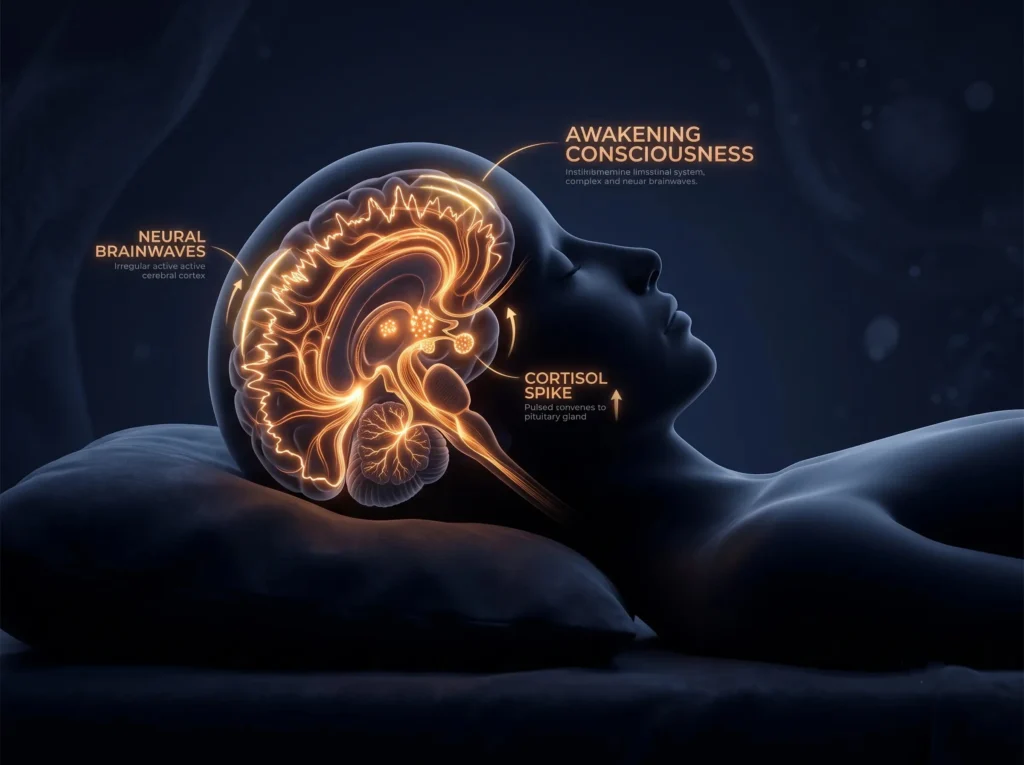
- Your cortisol has quietly started its climb, well ahead of any alarm
That second point does most of the heavy lifting here, so it’s worth slowing down on.
Reason #1: Cortisol Is Already Rising
Cortisol gets a bad reputation as “the stress hormone,” but it’s also your body’s built-in alarm clock. It begins climbing in the early morning hours specifically to prepare you for waking — researchers call this the cortisol awakening response. In the window right after natural waking, cortisol typically jumps by 50% or more, peaking somewhere between 30 and 60 minutes later. What’s notable is that this rise tracks your circadian rhythm rather than the act of waking itself, which is a large part of why it shows up around the same hour, night after night, no matter what technically disturbed you.
If your baseline stress is already running high — a demanding week, a health worry sitting in the back of your mind, ongoing anxiety — that natural cortisol uptick doesn’t stay gentle. It becomes the thing that yanks you fully awake instead of letting you drift through it.
A real example of this: one of my clients, Nicole, based in Australia, ran into this almost textbook version of the problem. She hadn’t run a formal cortisol panel, but she didn’t need one to know what was happening — high day-to-day stress combined with intense CrossFit-style training five to six days a week, the kind of training load that pushes cortisol hard. Her 3 AM wake-ups weren’t random; they were her body’s stress response colliding with an already-elevated hormonal baseline. While she worked on bringing her overall cortisol load down, she started taking magnesium glycinate before bed. Her description was simple: it worked like a wind-down ritual rather than a sedative, easing her into sleep within about half an hour and keeping her there through the night without next-day grogginess.
Worth being straight about this: magnesium glycinate isn’t a fix for elevated cortisol, and it won’t undo the effects of six hard training sessions a week on its own. It’s a supportive tool some people find useful while addressing the actual driver — training load, stress, or both. Anyone considering adding a supplement to their routine should run it by a doctor first, particularly if they’re on medication or managing another health condition.
What actually moves the needle here is lowering your daytime stress baseline so that morning cortisol rise has less room to overshoot. Earlier-in-the-day exercise, a genuine wind-down routine, ten minutes of journaling — small, boring, consistent habits outperform anything you do in the moment at 3 AM.
Reason #2: Blood Sugar Has Dropped
Dinner at 6, bed at 10 — by 3 AM you’re nine-plus hours into a fast, which is long enough for blood sugar to dip noticeably in some people. When your brain catches that dip, it releases stress hormones to push glucose back up. That hormonal nudge is often enough to wake you.
A small, protein-heavy snack in the 30 to 60 minutes before bed tends to help — a few almonds, a spoon of nut butter, plain Greek yogurt. Skip the sugary dessert right before sleep, too; it sets up a spike-and-crash cycle that works against you overnight.
Reason #3: A Mind That Won’t Switch Off
There’s no email to answer at 3 AM, no meeting to prep for — just you and whatever’s been sitting unresolved since morning. That silence is exactly what makes it prime territory for spiraling thoughts. People with anxiety, and those with naturally higher “sleep reactivity” — a genuine, studied tendency for stress to hit sleep harder than it hits other people — run into this constantly.
A few things that genuinely help, rather than just sound like they should:
- 4-7-8 breathing — inhale for 4, hold for 7, exhale slowly for 8, repeated three or four times
- A notepad on the nightstand. Writing the worry down, even in one line, quiets the mental effort of trying to “hold onto it” until morning
- If you’re still awake past 20 minutes, get up. Do something quiet and low-stimulation. Lying there fighting for sleep almost always backfires
Reason #4: The Bedroom Itself Is the Problem
This is the most overlooked category, mostly because people assume their bedroom is “fine” without ever actually testing that assumption.
| Disruption | Why it matters |
|---|---|
| Light | A streetlamp, a charger LED, hallway light — even dim sources can nudge you out of light sleep |
| Noise | Traffic, a snoring partner, a neighbor’s odd hours — your brain registers it even when you don’t fully wake |
| Temperature | A room that runs warm is one of the single most common, and most fixable, causes on this list |
| A full bladder | Its own category, covered next |
Blackout curtains or a sleep mask, a white noise machine or earplugs, a thermostat set a few degrees cooler at night, fluids cut off two to three hours before bed — none of this is glamorous, but it’s the highest-return fix available.
Reason #5: You’re Waking Up to Use the Bathroom
Waking specifically to pee at 3 AM is common enough to have its own clinical name — nocturia. Most of the time it’s simple: too much water, coffee, or alcohol too close to bedtime. Occasionally it points to something more — an overactive bladder, a bladder condition, or an underlying issue like diabetes. It’s also a frequent, temporary companion of pregnancy.
Less commonly, people wake needing to have a bowel movement rather than urinate — this can be tied to eating late, a sensitive gut, or conditions like IBS, and generally responds to the same evening-eating adjustments as blood-sugar-driven wake-ups.
If bathroom trips are paired with feeling unrefreshed, snoring, or gasping, don’t file it under “just fluids.” That combination can point toward interrupted breathing overnight, which leads into the next section.

Reason #6: Waking Up Sweating
A few things worth ruling out, roughly in order of likelihood:
- A room that runs warm or bedding that’s too heavy — by far the most common cause
- Alcohol, which interferes with the body’s overnight temperature regulation
- Hormonal shifts, including perimenopause and menopause, which frequently bring night sweats alongside broken sleep
- Certain medications, some of which list night sweats as a known side effect
If it’s happening most nights regardless of room temperature, that’s a pattern worth mentioning to a doctor rather than adjusting around indefinitely.
Reason #7: Alcohol From Earlier That Night
Alcohol plays a two-faced role. It can speed up falling asleep, but as your body metabolizes it over the following hours, it disrupts the second half of the night — which happens to be exactly where that 3 AM window sits. This is why people so often notice their wake-ups track precisely with the nights they had a drink or two, even when they felt completely fine going to bed.
Stopping alcohol at least four to six hours before bed, and simply tracking whether your wake-ups line up with drinking nights, tends to answer this one quickly.

Reason #8: An Underlying Sleep Disorder
When none of the above fully accounts for it — especially if it’s happening most nights for weeks on end — a sleep disorder becomes the more likely explanation than a habit. The usual suspects:
- Insomnia, specifically the sleep-maintenance type, where falling asleep isn’t the issue but staying asleep is
- Obstructive sleep apnea (OSA) — brief breathing pauses that wake you, sometimes without any obvious reason why
- Restless leg syndrome — an uncomfortable urge to move that intensifies at rest
- Circadian rhythm disorders — your internal clock and your actual schedule pulling in different directions
- Nightmare disorder — distressing dreams concentrated in the REM-heavy second half of the night
According to guidance from the NHS, insomnia is generally classed as short-term under three months, and long-term beyond that, and it’s typically approached first through changes to sleep habits before any other treatment enters the picture.
Reason #9: Sleep Simply Changes With Age
Sleep architecture genuinely shifts as you get older — less time in deep sleep, more time in the lighter stages that are easier to be pulled out of. Circadian rhythms tend to drift earlier too, which is a large part of why older adults report waking earlier, including inside that 2 to 4 AM window, far more often than they did in their twenties or thirties.
A Straightforward Way to Work Through This
Not sure which of the nine applies to you? This order tends to be the most efficient:
- Track a week. Wake time, alcohol, last meal timing, room temperature — write it down before you forget
- Fix the environment first. It’s the cheapest lever and usually the fastest to show results
- Adjust the evening routine. Cut caffeine after early afternoon, ease off alcohol, stop eating three hours before bed
- Handle racing thoughts before bed, not during it. A written worry list earlier in the evening beats trying to think your way out of one at 3 AM
- Give it two to three weeks before judging whether anything worked. Sleep habits are stubborn but they do respond to consistency
When It’s Time to See a Doctor
An occasional 3 AM wake-up is normal — genuinely nothing to lose sleep over. A doctor’s visit becomes the right move when you notice:
- Waking three or more nights a week for several weeks running, despite the changes above
- Daytime fallout — fatigue, poor concentration, irritability, or unplanned dozing off
- Gasping, choking, or chest pain on waking
- A partner reporting loud snoring
- Bathroom wake-ups paired with other symptoms of a bladder or metabolic issue
A doctor can help sort out whether stress, a medication side effect, or an underlying condition is actually driving things — that distinction matters more than guessing on your own for months. For general context, the CDC notes that adults generally need at least 7 hours of sleep a night for good health, and consistently falling short is worth addressing rather than quietly adapting to.
Where This Leaves You
Waking at 3 AM feels personal in the moment, like your body picked you out specifically. It hasn’t. It’s almost always one of a fairly short list — a cortisol rhythm doing exactly what it’s built to do, a dip in blood sugar, a mind that won’t sit still, a bedroom working against you, alcohol’s second-half effect, or occasionally something that needs a proper diagnosis rather than a habit change.
The fixes aren’t exciting. A cooler room. One less drink. A protein snack. A notepad within reach. Nicole’s version was magnesium glycinate alongside actually addressing her training-and-stress load — everyone’s combination looks a little different, but the underlying approach is the same: identify what’s actually driving it, then make the boring, consistent change rather than chasing a quick trick.
And on the nights it still happens anyway — try not to fight it. Stressing about being awake is usually what turns a five-minute interruption into a ninety-minute one. A few slow breaths, a reminder that this is common and temporary, and sleep tends to find its way back on its own.
Frequently Asked Questions (FAQs) :
Q1. What does it mean when you wake up at 3am every night?
Answer: It usually means your sleep cycle has shifted into lighter REM sleep for that stretch of the night, right as your cortisol naturally begins its morning climb. This combination — light sleep plus rising cortisol — makes you far easier to jolt wide awake at 3am than you were a few hours earlier. It's rarely a sign of a mystery illness; it's typically your sleep architecture and hormones doing something predictable.
Q2. How do I break the cycle of waking up at 3am?
Answer: Start by tracking a week of wake times alongside alcohol intake, last meal timing, and room temperature to spot your pattern. Fix the bedroom environment first (cooler room, blackout curtains, white noise), then adjust evening habits like cutting caffeine, easing off alcohol, and handling racing thoughts with a written worry list before bed rather than during it. Give any changes two to three weeks before judging results — sleep habits are stubborn but do respond to consistency.
Q3. What vitamin deficiency causes you to wake up at 3am?
Answer: The article doesn't identify a specific vitamin deficiency as a cause of 3am wake-ups — the reasons it covers are cortisol rhythm, dropped blood sugar, stress, bedroom environment, alcohol, nocturia (waking up at 3am to pee), and underlying sleep disorders. If you suspect a nutritional cause behind your sweating, waking 3-4 times a night, or overall sleep disruption, that's worth raising with a doctor rather than guessing.
Q4. What does waking up at 3am mean about the liver?
Answer: This isn't something the article addresses — it focuses on physiological explanations like the cortisol awakening response, blood sugar drops, sleep-cycle timing, and lifestyle factors like alcohol, rather than any connection to liver function. If liver health is a specific concern, that's a question for a doctor rather than something covered by general sleep-pattern causes.

Nova
Health & Neuroscience Writer
Nova simplifies complex sleep architecture, circadian biology, and hormonal mechanics into actionable daily guides.
More in Sleep Science

8 Powerful Ways to Increase REM Sleep (Stop Waking Up Tired)
Sleeping 8 hours but still exhausted? Discover 8 science-backed ways to increase…

How to Fix Sleeping Posture: 4 Proven Ways to Stop Morning Neck Pain
Learn how to fix sleeping posture with 4 research-backed rules. Discover the…
Stop Waking Up Exhausted: 7 Proven Ways to Increase Deep Sleep and REM Sleep Naturally
Sleeping 8 hours but still waking up tired? Discover science-backed habits, foods,…

5 Shocking Mouth Taping for Sleep Mistakes That Can Ruin Your Health
Discover the real benefits, hidden risks, and safety steps of mouth taping…

5 Hidden Tricks: How to Fall Asleep Fast Military Method Really Works!
It's 1 a.m. You have to be up in five hours. Your…

Why You Wake Up at 3AM After Drinking: 3 Shocking Reasons (And the Fix)
Wondering why you wake up at 3am after drinking? Discover the science…

5 Proven Tips for the Best Sleep Schedule for Night Shift Workers
Stop staring at the ceiling! Discover 5 vital strategies to build the…

5 Shocking Secrets to Reset Circadian Rhythm Naturally (No All-Nighters)
Struggling with late bedtimes? Learn 5 proven steps to reset circadian rhythm…
2 Responses