

Dr. Amelia
Sleep Specialist & Medical Reviewer • 12+ Years Exp in Behavioral Sleep Medicine
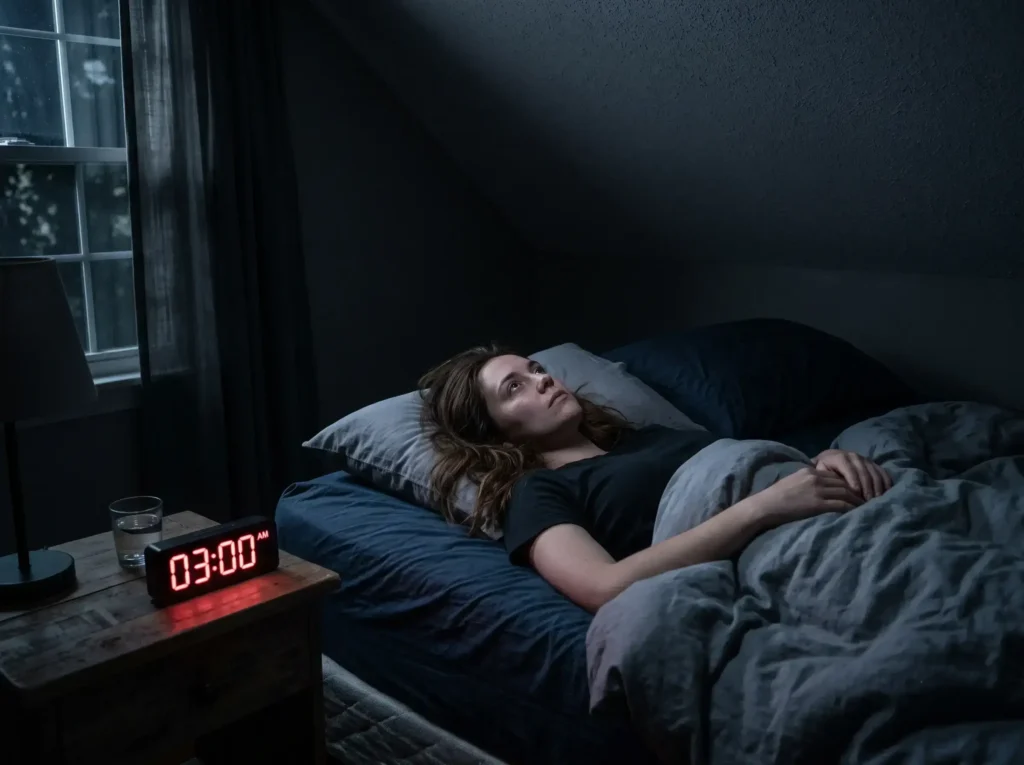
It’s 2 p.m., your eyes feel like they’ve been sandpapered, and somewhere in the back of your mind you already know how tonight’s going to go: you’ll be staring at the ceiling at 3 a.m., wide awake, wondering why the exhaustion vanished the second you actually wanted to sleep. If you just pulled an all-nighter — deadline, flight, newborn, or just one of those nights — figuring out how to fix sleep schedule after staying up all night isn’t bad luck. It’s biology doing exactly what it’s designed to do, just at the wrong time.
Here’s the part nobody tells you when you’re desperately Googling how to fix your sleep schedule after an all-nighter at 3 p.m.: your body isn’t broken. It’s confused. And confused systems respond to clear signals, not more caffeine or an early bedtime out of desperation.
Here’s the part nobody tells you when you’re desperately Googling how to fix your sleep schedule after an all-nighter at 3 p.m.: your body isn’t broken. It’s confused. And confused systems respond to clear signals, not more caffeine or an early bedtime out of desperation.

Table of Contents
The Two Clocks Running Your Sleep — And Why Both Just Got Scrambled
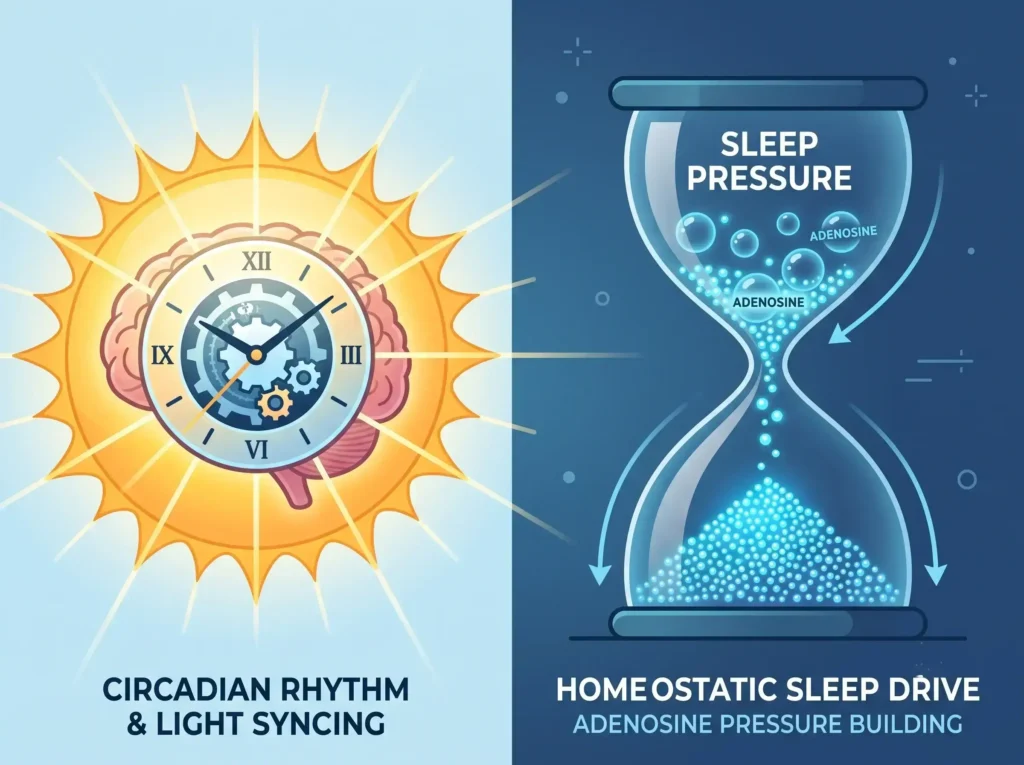
Sleep isn’t one system. It’s two, running in parallel, and an all-nighter throws both of them off simultaneously.
The first is your circadian rhythm — a roughly 24-hour internal clock managed by a cluster of brain cells called the suprachiasmatic nucleus (SCN). It runs almost entirely on light. Morning brightness hits your eyes, the SCN registers “daytime has started,” and it tells your pineal gland to hold off on melatonin — the hormone responsible for that heavy-eyed, ready-for-bed feeling. According to the National Institute of General Medical Sciences, this master clock also governs body temperature and hormone timing, and it’s notoriously easy to knock out of sync through jet lag, shift work, or late-night screen exposure.
The second system has nothing to do with light. It’s called sleep drive, or homeostatic pressure, and it’s chemical. A compound called adenosine builds up in your brain for every hour you’re awake, creating a literal physical pull toward unconsciousness. Sleep clears it out. That’s the entire mechanism behind why a long nap backfires — you’re draining the pressure you were supposed to cash in at bedtime.
Put an all-nighter through both filters and you get the mess most people experience: sky-high sleep pressure paired with a circadian clock that has no idea what time it thinks it is anymore. That combination is exactly what makes one rough night snowball into a week of feeling perpetually jet-lagged in your own house.
Getting Through the Day: What Actually Works Right Now
If you’re reading this mid-crash, here’s the sequence that gives you the best odds of sleeping normally tonight — not tomorrow, tonight.
Keep naps short and early, if you take one at all. Twenty to thirty minutes, before 3 p.m., alarm set. Longer than that and you risk dropping into deep sleep, waking up groggier than before (sleep inertia is real), and eating into the sleep pressure you’ll need later.
Get outside within an hour of waking up. This single habit does more heavy lifting than anything else on this list. Morning sunlight resets the SCN’s internal “day has started” signal, which anchors when melatonin will naturally kick in later that night.
Front-load your caffeine, then cut it off hard. Skipping coffee entirely just adds a withdrawal headache to an already rough day. Have your normal amount early, but stop 8 to 10 hours before your target bedtime — caffeine’s half-life is around 5 to 6 hours, so a 2 p.m. cup is still partly active at 2 a.m.
Stay physically busy rather than fighting drowsiness passively. One of my clients, Edwin, deals with this on a recurring cycle — roughly every three weeks his schedule slides back into a 5 a.m.-to-noon pattern and he has to reset it. His honest take: “It’s a pain when noon rolls around and you know you have to keep staying awake for another 8 hours.” His fix was staying occupied with physical tasks — yard work, fixing things around the house — anything that kept his hands and body moving instead of sitting still and fighting the urge to nap. It worked, in the sense that it got him through the day. What it didn’t do was stop him from relapsing back into the same off-kilter schedule within a few weeks.
Hold your normal bedtime — don’t collapse into bed at 8 p.m. Crashing dramatically early feels like the obvious move, but your circadian clock hasn’t caught up yet, and you’ll likely wake up at 2 or 3 a.m. fully alert. Stay within an hour of your usual bedtime, and spend the last half-hour before it winding down with dim lights and no screens.
Why Do I Wake Up 3 Hours After sleeping?
This question comes up constantly, and it’s rarely random.
Sleep moves in roughly 90-minute cycles through light sleep, deep sleep, and REM. The three-hour mark lands right at a natural cycle boundary — a point where brief awakenings are normal. Usually you drift back off without remembering it. After a disrupted schedule, though, your system is more reactive, and that boundary turns into an actual wake-up.
Alcohol is a frequent culprit too — it speeds up sleep onset, but as your body metabolizes it over the next few hours, it triggers a rebound in brain activity that often surfaces right around that three-hour window. A too-warm room, a full bladder, or a mind still wired from the sleep deprivation itself can all do the same thing.
If it’s a one-off after a bad night, give your schedule a few days to settle and it typically resolves on its own. If it’s happening most nights regardless of what you try, that’s a conversation for a healthcare provider rather than another round of self-troubleshooting — the NHS points out that persistent insomnia tends to improve once the underlying habits driving it are identified, which is a more durable fix than chasing symptoms night after night.
The Real Fix: A Multi-Day Reset, Not a One-Night Miracle
Here’s where Edwin’s story gets useful. After the “stay busy and push through” approach kept failing him long-term, he switched strategies: fixed wake-up time at 9:00 a.m., no exceptions, then gradually nudging that time earlier. That approach stuck. His own assessment: “I guess a 24-hour reset might be worth a shot, but try alternatives if it doesn’t work.” That’s a fair way to think about it — a single all-nighter reset can work for a genuinely isolated bad night, but a schedule that keeps sliding back needs a structural fix, not a one-time push.
Anchor a wake-up time first, everything else follows from it. Pick a time you can hit daily — weekends included — and don’t move it regardless of how the night went. This is the step that made the difference for Edwin, and it’s the step most people skip because it feels less dramatic than “just staying up 24 hours.”
Shift bedtime in small increments, not all at once. Fifteen to twenty minutes earlier every two to three days. Trying to force a three-hour jump overnight just leaves you lying in bed, awake, frustrated. A one-night disruption usually corrects within a few days this way; a schedule that’s drifted for weeks can take up to two.
Treat light exposure as your primary lever. Bright light immediately after waking, dim light starting an hour or two before bed, screens away or on night mode — the blue wavelength is particularly aggressive at suppressing melatonin production.
If you’re not asleep within 20 minutes of lying down, get up. Do something calm in dim light — a physical book, not a phone — until you actually feel drowsy, then try again. Lying there frustrated teaches your brain to associate the bed with wakefulness, which works directly against you.
What Quietly Sabotages the Reset
A few habits undo everything above, even when the rest of the plan is solid:
- Snoozing repeatedly. Ten-minute fragments of extra sleep don’t restore anything — they just compress your morning and leave you groggier.
- “Revenge” late nights on weekends. One night of sliding back into old hours can erase several days of progress.
- Heavy meals, alcohol, or nicotine near bedtime. All three interfere with either falling asleep or staying asleep.
- High-stakes conversations or decisions right before bed. Emotional and cognitive arousal doesn’t switch off on command.

When This Stops Being a DIY Problem
Most post-all-nighter disruption sorts itself out with consistency. See a doctor if:
- Sleep trouble persists most nights for a month or longer
- You wake up gasping, snore heavily, or a partner has noticed breathing pauses
- You feel an unusually strong urge to move your legs at night
- Daytime drowsiness starts affecting your safety — driving, operating equipment, that kind of thing
- Your natural sleep-wake timing stays many hours off from what your life requires, no matter how consistent you are
The CDC frames quality sleep as a function of both quantity and how restorative it actually is — persistent trouble with either is worth a real medical conversation, not another self-help article.
The Bottom Line
A blown night doesn’t have to become a blown month. Skip the marathon nap, get outside early, hold your normal bedtime instead of crashing at dusk, and anchor a wake-up time you’re willing to defend daily. Edwin’s experience is a useful reality check here: pushing through with busywork can get you through one rough patch, but it’s the fixed-and-gradual wake time strategy that actually breaks the cycle for good. Your body responds to repetition, not heroics — give it a boring, predictable week, and it’ll hand your schedule back.
Q1. What is the 3-3-3 rule for sleep?
Answer : The 3-3-3 rule is a grounding technique that calms a racing mind before bed by naming three things you can see, three things you can hear, and moving three parts of your body. It works by shifting your focus away from anxious thoughts and back to the present moment, which is often what’s actually keeping you up when you’re trying to fall asleep fast after a disrupted schedule. It’s a quick add-on to your wind-down routine, not a replacement for the core fix — consistent bedtime and light exposure.
Q2. How do you fall asleep after staying up all night?
Answer : Hold your normal bedtime instead of crashing early — going to bed dramatically sooner than usual means your circadian clock hasn’t caught up yet, and you’ll likely end up wide awake at 2 or 3 a.m. Spend the last 30 to 60 minutes before bed winding down with dim lights and no screens, and if you’re still not asleep 20 minutes in, get up and do something calm in low light until drowsiness actually kicks in.
Q3. How do you fix your sleep schedule after a night out?
Answer :Anchor a fixed wake-up time first, every day including weekends, since that single habit does more to fix a sleep schedule after an all-nighter than a one-off push ever will. From there, shift your bedtime 15 to 20 minutes earlier every two to three days, get bright light right after waking, and dim the lights an hour or two before bed to help you fall asleep fast and wake up refreshed instead of groggy.
Q4. Is 7pm to 4am enough sleep?
Answer : Yes — a 7 p.m. to 4 a.m. window gives you 9 hours, which sits within the healthy range for adults. That said, the article’s core point still applies: an unusually early bedtime like 7 p.m. only works if it lines up with a schedule you can hold consistently, since your circadian clock resets based on repetition, not a single early night.

Nova
Health & Neuroscience Writer
Nova simplifies complex sleep architecture, circadian biology, and hormonal mechanics into actionable daily guides.
More in Sleep Science

8 Powerful Ways to Increase REM Sleep (Stop Waking Up Tired)
Sleeping 8 hours but still exhausted? Discover 8 science-backed ways to increase…
How to Fix Sleeping Posture: 4 Proven Ways to Stop Morning Neck Pain
Learn how to fix sleeping posture with 4 research-backed rules. Discover the…
Stop Waking Up Exhausted: 7 Proven Ways to Increase Deep Sleep and REM Sleep Naturally
Sleeping 8 hours but still waking up tired? Discover science-backed habits, foods,…

5 Shocking Mouth Taping for Sleep Mistakes That Can Ruin Your Health
Discover the real benefits, hidden risks, and safety steps of mouth taping…

5 Hidden Tricks: How to Fall Asleep Fast Military Method Really Works!
It's 1 a.m. You have to be up in five hours. Your…

Why You Wake Up at 3AM After Drinking: 3 Shocking Reasons (And the Fix)
Wondering why you wake up at 3am after drinking? Discover the science…

5 Proven Tips for the Best Sleep Schedule for Night Shift Workers
Stop staring at the ceiling! Discover 5 vital strategies to build the…

5 Shocking Secrets to Reset Circadian Rhythm Naturally (No All-Nighters)
Struggling with late bedtimes? Learn 5 proven steps to reset circadian rhythm…
One Response