
Dr. Gianna
Longevity & Metabolic Health Expert • 10+ Years Exp in Integrative Physiology
Somewhere around week 28, a lot of women stop recognising their own feet. Rings stop fitting, and socks leave deep grooves in the skin by evening. When standard advice like “put your feet up” barely touches the swelling, many turn to lymphatic drainage pregnancy massage. The topic keeps coming up in conversation, usually passed along from one mum to another rather than from a textbook. So let’s actually get into it: what it is, whether it’s safe, and whether the hype holds up.
Quick answer: In a healthy, uncomplicated pregnancy, lymphatic drainage performed by a therapist trained in prenatal work is low-risk and, for many women, genuinely effective against swelling. It’s not universal, though — a handful of conditions rule it out entirely, and we’ll get to those.
This article is for informational and educational purposes only and is not a substitute for professional medical advice, diagnosis, or treatment. Always consult your doctor, OB-GYN, or midwife before starting any new wellness routine or if you have concerns about your pregnancy symptoms.
Table of Contents
What Lymphatic Drainage Actually Does
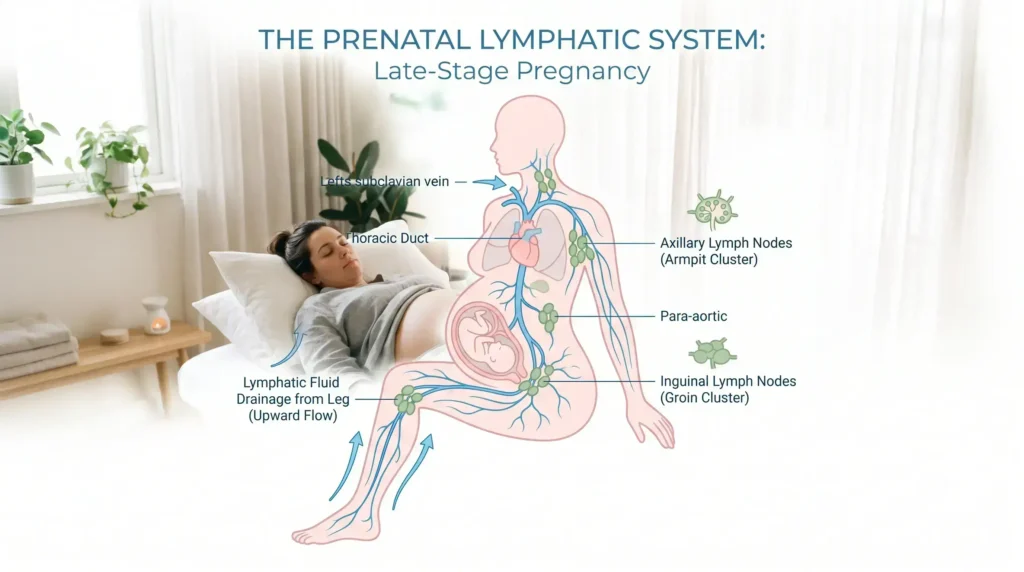
Your lymphatic system is the quiet plumbing running underneath your circulatory system — a network of vessels and nodes that clears excess fluid, cellular waste, and immune cells out of your tissue and routes it back into the bloodstream. During pregnancy, that plumbing gets overloaded. Blood volume climbs by nearly 50%, hormones relax vein walls, and the growing uterus presses on the pelvic veins that would normally help fluid flow back up from your legs. The result: puffiness that seems to arrive overnight.
Manual lymphatic drainage (MLD) is built to work with that system directly. A therapist uses slow, rhythmic, almost feather-light strokes — no kneading, no deep pressure — to nudge stagnant fluid toward the lymph nodes, where it gets filtered and reabsorbed. Emil and Estrid Vodder developed the technique in the 1930s, and it’s since become a standard clinical tool for lymphoedema and post-surgical swelling, long before it found its way into prenatal care.
Not the Same Thing as a Regular Prenatal Massage
People often assume “prenatal massage” and “lymphatic massage” are interchangeable. They’re not. A prenatal massage works on muscle — the tight shoulders, the aching lower back, the hip pain that comes from carrying weight differently. It uses moderate pressure. Lymphatic drainage pregnancy sessions do the opposite: barely any pressure at all, because the goal isn’t muscle release, it’s fluid movement. Push too hard and you can actually irritate the very vessels you’re trying to help.
Is Lymphatic Drainage Safe While Pregnant?
For most women, yes. The pressure is light enough that it sidesteps most of the caution that applies to firmer massage styles. But “generally safe” isn’t a blanket clearance — a few conditions take it off the table entirely:
- Pre-eclampsia or high blood pressure
- Deep vein thrombosis (DVT), or a history of blood clots
- Active infection or fever
- Heart or kidney conditions affecting fluid balance
- Placenta praevia or unexplained bleeding
None of those apply to you? Still worth a quick conversation with your midwife or GP first, particularly if anything else about your pregnancy is being monitored. The NHS recommends flagging any complementary therapy with your midwife or doctor so it fits into your wider care plan rather than sitting outside it.
Most therapists also hold off starting sessions until after week 12, especially for anyone with a history of miscarriage — less because of documented risk and more as a standard precaution while the pregnancy settles.
How Sessions Change by Trimester
A therapist who knows what they’re doing won’t treat week 10 the same as week 34:
- First trimester — no direct abdominal work, full stop.
- Second and third trimester — abdominal work, if done at all, is minimal and careful; positioning shifts to accommodate your bump.
- Past week 16 — lying flat on your back for any length of time is out, since the uterus can compress major blood vessels underneath it. Expect side-lying positions or a pregnancy bolster instead.
What a Session Actually Feels Like
Sessions typically run 45 to 60 minutes. Expect a short check-in first — a good therapist asks your exact week of pregnancy, not just a vague “yes, I’m pregnant,” plus any symptoms worth flagging.
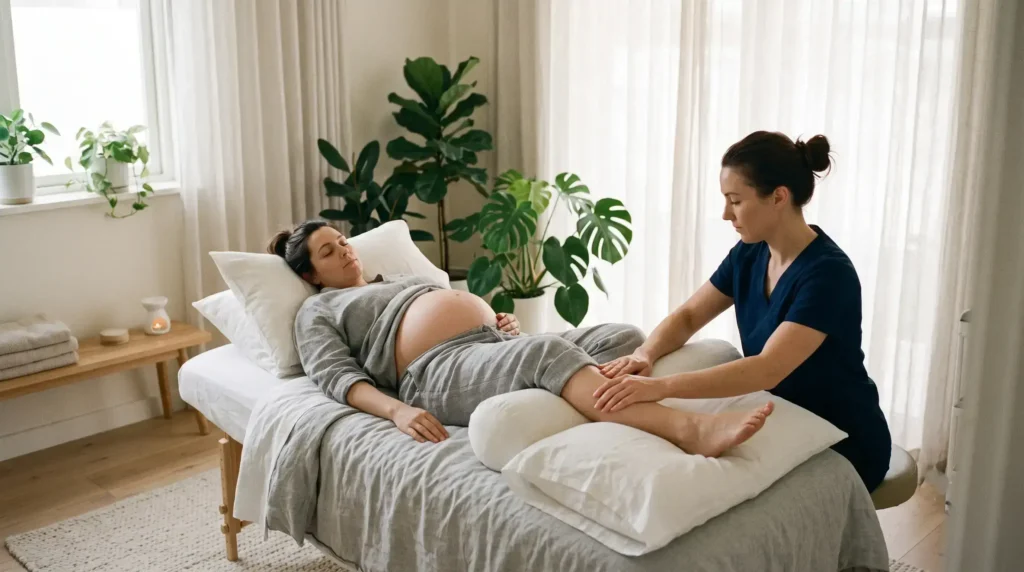
From there, you’re propped on your side, and the massage itself is close to nothing — light enough that plenty of women fall asleep partway through. Hydrating afterward matters more here than after a typical massage, since you’ve just set a lot of fluid in motion and your body needs support to actually process it.

One Client’s Experience: Sarah, 32 Weeks
Sarah, one of our clients, had done everything “right” throughout her pregnancy — she stayed active with daily walks, biking, stretching, foam rolling. Still, once she hit the third trimester, her feet, ankles, and calves swelled to the point of real discomfort, and none of her usual habits made a dent in it.
What finally helped was lymphatic massage. She specifically sought out a therapist trained in prenatal lymphatic work, and after a few sessions, the difference was noticeable enough that her therapist taught her a simplified self-massage routine to use between appointments — something she now credits with getting her through the rest of the third trimester. For women without easy access to a specialist nearby, guided tutorials exist online, though learning proper technique from a trained therapist first is what makes self-massage safe and worth doing.
Her other takeaway, worth repeating: if swelling shows up and you haven’t mentioned it to your OB or midwife yet, do that before anything else. It’s not a step to skip.
Leg Swelling Pregnancy Relief: What the Massage Targets
Oedema — the medical term for that swelling — hits the ankles, feet, and lower legs hardest, and it typically worsens through the third trimester as the uterus bears down harder on the pelvic veins. Lymphatic drainage works by moving that trapped fluid back into circulation, which is exactly why it’s become one of the more sought-after non-medical options for leg swelling pregnancy relief.
It’s not confined to the legs, either. Hands, fingers, and faces swell too, and gentle facial or hand drainage can bring the same kind of relief there.
Prenatal Lymphatic Massage Benefits Beyond Swelling
- Sleep quality improves almost as a side effect — swollen legs make it hard to get comfortable at night, so easing that discomfort tends to translate directly into better rest.
- The parasympathetic nervous system gets a nudge. Slow, repetitive touch shifts the body toward “rest and digest” mode, which a fair number of women find useful for the general anxiety that tags along with late pregnancy.
- Legs feel lighter, not just less swollen. That heavy, dragging sensation many women describe by evening tends to ease as lymph flow improves.
One caveat worth being blunt about: this massage manages symptoms, it doesn’t treat causes. Sudden or severe swelling — especially in the face or hands, or paired with headaches or vision changes — needs a call to your midwife immediately. That combination can signal pre-eclampsia, and no amount of massage addresses that.
➟ Waking Up in the Middle of the Night in Early Pregnancy: Why It Happens and What Actually Helps
How to Reduce Fluid Retention During Pregnancy Between Sessions
Massage works better as part of a system than as a standalone fix. A few habits worth building in:
- Elevate your legs above hip height whenever you’re resting — gravity does half the work lymphatic drainage does manually.
- Walk regularly. Calf muscles function as a pump for both blood and lymph; long stretches without movement work against you.
- Wear compression garments. Pregnancy-safe compression socks apply graduated pressure that supports venous return — ask your midwife which compression class suits you.
- Get into water. Swimming or water aerobics uses hydrostatic pressure as a natural, full-body compression effect.
- Go easy on sodium and electrolytes. Salt encourages your body to hold onto water, and if you’ve been supplementing electrolytes, it’s worth dialling that back rather than adding to the load.
- Ask your provider about creatine, if you’re taking it. Some women notice water retention eases after stopping or reducing creatine — this isn’t something to act on without discussing it with your OB first, since it’s anecdotal rather than established guidance, but it’s a reasonable question to raise.
- Try dry body brushing — light strokes toward the lymph nodes before showering can offer mild stimulation between professional sessions.
- Break up long sitting or standing stretches with a few minutes of movement every hour.
None of this requires special equipment. Combined, though, these habits tend to outperform any single one done in isolation.
How Often Should You Book Sessions?
There’s no fixed formula — it comes down to your symptoms and trimester:
- First trimester — most practitioners hold off, or proceed cautiously if you do start.
- Second trimester — monthly sessions are a solid baseline once your pregnancy is progressing normally.
- Third trimester — as retention peaks, fortnightly sessions tend to serve women better.
If swelling comes back within a day or two of a session, that’s your body telling you to come in more often. If relief holds for weeks, monthly is plenty. Plenty of women also continue sessions postpartum, when the body is still shedding fluid accumulated during pregnancy.
Choosing a Therapist Who Actually Knows What They’re Doing
This is where the real safety of the treatment lives — not in the technique, but in who’s applying it.
- Prenatal-specific training matters more than general massage credentials. You want someone trained in both MLD and pregnancy massage specifically.
- Check for professional registration — in the UK, look for CNHC or FHT membership, both of which require verified training and insurance.
- Give your exact week of pregnancy, not a vague “I’m pregnant,” and mention any complications even if they seem minor.
- Confirm positioning adjustments happen automatically past week 16 — you shouldn’t have to request it.
Areas a Trained Therapist Will Steer Clear Of
- Direct abdominal massage in the first trimester, and cautious handling even later on.
- Certain ankle and foot pressure points traditionally linked to uterine stimulation.
- Deep pressure anywhere on the legs, given the elevated clot risk during pregnancy.
If a therapist skips these questions or seems unfamiliar with pregnancy adaptations, that’s reason enough to look elsewhere.
The Bottom Line
Swelling isn’t something you’re required to just tolerate for nine months. Lymphatic drainage, done properly by someone trained in prenatal work and cleared by your midwife, offers real relief for a lot of women — Sarah’s experience is a fairly typical example of what changes when the right technique meets the right timing.
It won’t fix the underlying cause, and anything sudden or severe still belongs in a call to your midwife, not a massage table. But paired with movement, elevation, sensible salt intake, and compression where needed, it’s one of the more genuinely useful tools available for getting through the later months more comfortably.
If persistent swelling is wearing you down, raise it with your midwife or GP first — they can rule out anything more serious and confirm whether lymphatic drainage fits your specific pregnancy. For anyone who wants to look at the underlying research, manual lymphatic drainage techniques are well documented in the clinical literature available through PubMed, alongside general NHS guidance on managing swollen ankles, feet, and fingers during pregnancy.
Frequently Asked Questions (FAQs) :
Q1 . Can lymphatic drainage cause miscarriage?
No evidence supports that. The pressure involved is far too light to stimulate the uterus the way deeper massage styles might. Waiting until after 12 weeks remains a common precaution anyway, particularly for anyone with a prior pregnancy loss.
Q2. Is lymphatic drainage safe in the third trimester?
Yes, and it’s often when it’s most useful, given how much fluid retention intensifies at that stage. Sessions may need to increase in frequency as your bump grows.
Q3. How many sessions will I actually need?
Monthly from the second trimester covers general maintenance; more pronounced swelling, especially later on, usually calls for weekly or fortnightly visits.
Q3. Does it help with bloating too?
Partially. Digestive bloating and fluid retention aren’t the same mechanism, but lymphatic drainage still eases the puffiness and heaviness that tend to show up alongside it.
Q4. Does it help with bloating too?
No — prenatal massage targets sore muscles with moderate pressure; lymphatic massage is far lighter and focused entirely on fluid movement. Different goal, different technique, even though they get lumped together.

Lyra
Biohacking & Human Performance Writer
Lyra explores human optimization, cellular health, protocols, and data-backed performance habits.
More in Biohacking

Infrared Sauna vs Traditional Sauna: Don’t Waste 1 Minute on the Wrong Choice
Discover Infrared Sauna vs Traditional Sauna for muscle recovery and longevity. Compare…

72-Hour Extended Fasting Autophagy Protocol: Proven Cellular Reset
Learn the proven 72-hour extended fasting autophagy protocol. Discover exact hour-by-hour cellular…

Waking Up in the Middle of the Night in Early Pregnancy: Why It Happens and What Actually Helps
Discover how lymphatic drainage pregnancy techniques relieve first-trimester insomnia, reduce fluid buildup,…
7 Proven Polyvagal Exercises for Nervous System Regulation: End Chronic Panic & Feel Safe
Logic can't talk your body down from panic. Master 7 polyvagal exercises…

8 Powerful Ways to Increase REM Sleep (Stop Waking Up Tired)
Sleeping 8 hours but still exhausted? Discover 8 science-backed ways to increase…

How to Fix Sleeping Posture: 4 Proven Ways to Stop Morning Neck Pain
Learn how to fix sleeping posture with 4 research-backed rules. Discover the…
Stop Waking Up Exhausted: 7 Proven Ways to Increase Deep Sleep and REM Sleep Naturally
Sleeping 8 hours but still waking up tired? Discover science-backed habits, foods,…

Don’t Ignore These 9 Warning Early Perimenopause Symptoms in 30s
Struggling with irregular cycles or fatigue? Don't ignore these early perimenopause symptoms…
One Response